
The Spice Islands
In 1667, the Dutch traded Manhattan for a speck of volcanic rock in the Banda Sea. The island was called Run, barely two miles long, and the deal made perfect sense at the time. Nutmeg grew on Run. Nutmeg grew almost nowhere else. And nutmeg, ounce for ounce, was worth more than gold. This single transaction captures something essential about the Maluku Islands: for centuries, these 632 islands scattered across eastern Indonesia's volcanic arc were the center of the world economy, even if most of the world had no idea where they were.
The Fragrance That Launched Armadas
Cloves grew wild on just five islands in northern Maluku: Ternate, Tidore, Makian, Moti, and Bacan. Nutmeg and its lacy outer coating, mace, came exclusively from the tiny Banda archipelago in the south. For over a thousand years, Indonesian sailors carried these spices westward to Java and the Malay Peninsula, where Indian and Arab traders picked them up and moved them through the Red Sea to Alexandria or across the Persian Gulf to the Levant. By the time Venetian merchants brought them to European tables, the markup exceeded 1,000 percent. Nobody in Europe knew where the spices originated. They arrived wrapped in myth, said to grow in lands guarded by serpents, blown into rivers from the edges of paradise. The Portuguese were the first Europeans to find the source, arriving in Maluku in 1511 and building a fort on Ternate. Spain followed with Magellan's expedition of 1519, officially named the Armada de Molucca, because reaching these islands was the entire point of circumnavigating the globe.
Blood on the Nutmeg
The Dutch East India Company arrived in 1599 and set about eliminating all competition with methodical violence. On the Banda Islands, the Bandanese people had traded nutmeg freely for centuries, selling to whoever offered the best price. The VOC demanded exclusivity. When the Bandanese resisted, Governor-General Jan Pieterszoon Coen arrived in 1621 with fifteen ships and over 1,600 soldiers. What followed was genocide. Coen ordered the execution of forty-four orang kaya, the islands' leaders, and the remaining population was enslaved or deported to Batavia. Of an estimated 15,000 Bandanese, perhaps a thousand survived. Coen then established nutmeg plantations worked by enslaved laborers imported from across the archipelago. The English were expelled from Ambon in 1623 after ten English traders were tortured and executed on charges of conspiracy. The 'Amboyna massacre' became a rallying cry in England for decades, but it accomplished the VOC's goal: total monopoly over the world's most valuable spices.
Where Worlds Collide
The violence of the spice trade obscures a deeper story about the islands themselves. Maluku sits astride one of the planet's most volatile volcanic belts, where the Australian and Pacific plates grind against each other. The naturalist Alfred Russel Wallace spent years here in the 1850s and 1860s, and the archipelago helped him formulate his theory of natural selection independently of Darwin. Wallace noticed that the islands straddled a biological boundary, now called the Wallace Line, separating Asian and Australian fauna. Melanesian features are strongest in the Kei and Aru islands to the southeast, while Austronesian influences dominate the north. Over 130 languages were once spoken across the archipelago, a density of linguistic diversity that reflects millennia of isolation and contact in equal measure. Today, most islanders have shifted to Ambonese Malay in the south or Ternate Malay in the north, but the older languages survive in remote villages where the forest still crowds the shore.
Islands of Ironwood and Pearl
Cloves and nutmeg are still cultivated here, though they are no longer worth killing for. The modern economy has diversified in ways the VOC never imagined. The Aru Islands produce pearls from warm, shallow seas. Seram exports lobster and yields ironwood from forests that climb to the 3,027-meter summit of Mount Binaiya, the highest peak in Maluku. Buru produces teak and ebony. Fishing drives the economy around Halmahera and Bacan, where boats work some of the richest waters in the Coral Triangle. The islands remain off the beaten track for travelers, connected by ferries that can take eighteen hours between major ports and flights that hopscotch through Ambon and Ternate. But the combination of pristine reefs, tropical beaches, forest-coated volcanoes, and crumbling colonial forts rewards those willing to navigate the logistical challenges.
Ghosts and Resilience
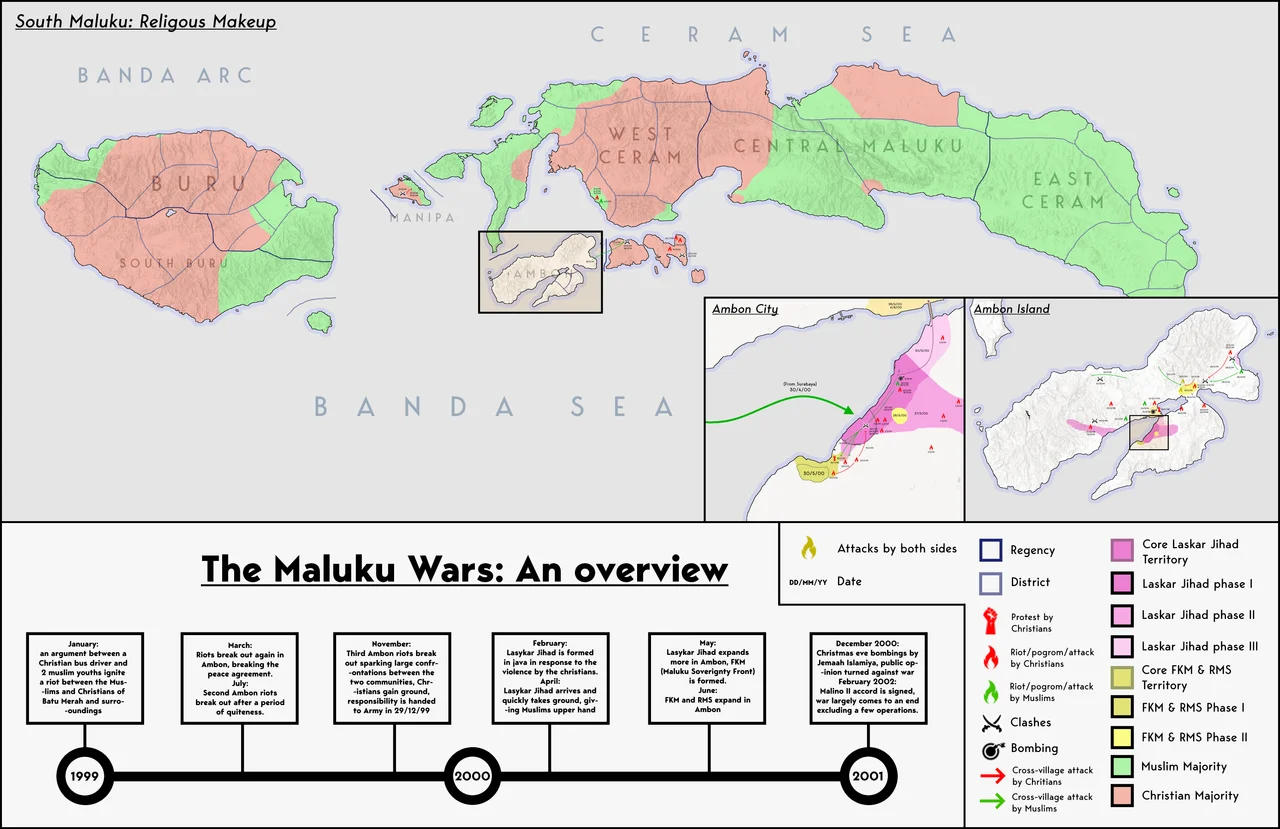
The Maluku Islands have endured more than most places. The spice wars. Japanese occupation during World War II. Sectarian violence between Christians and Muslims that erupted in 1999 and killed thousands before subsiding in the early 2000s. Yet the islands keep recovering. Ambon, the provincial capital, is a pluralistic city where Bugis, Balinese, Javanese, Chinese, and descendants of Portuguese and Dutch settlers live side by side. Many Moluccans still carry European surnames, a legacy of four centuries of colonial entanglement. Walk through Ambon's markets and the scent of cloves hangs in the humid air, the same fragrance that once drew armadas across uncharted oceans. The spices are still here. The empires they built are gone.
From the Air
The Maluku Islands (centered around 2.0S, 128.0E) stretch across a vast area of eastern Indonesia between Sulawesi and Papua. Pattimura Airport (WAPP) on Ambon Island is the main gateway to southern Maluku, while Sultan Babullah Airport (WAEE) on Ternate serves the north. From altitude, the volcanic cones of Ternate and Tidore are unmistakable landmarks rising from the Halmahera Sea. The Banda Islands lie further south, a tiny cluster visible as dark volcanic specks in the turquoise Banda Sea. Expect tropical weather year-round with visibility often excellent over the deep blue waters separating the islands.
Nearby Stories
- Where the Spice Routes Converged 29 km away
- The Amazon of the Seas 36 km away
- The Island Nobody Is From 48 km away
- The Witch That Walks Among the Living 114 km away
- Twenty-Five Thousand Islands Between Two Worlds 119 km away
- Seram's Last Wilderness 120 km away
- The Islands That Made Wallace Faint 128 km away
- The Nutmeg Wars of Banda Neira 148 km away