
The Amazon of the Seas
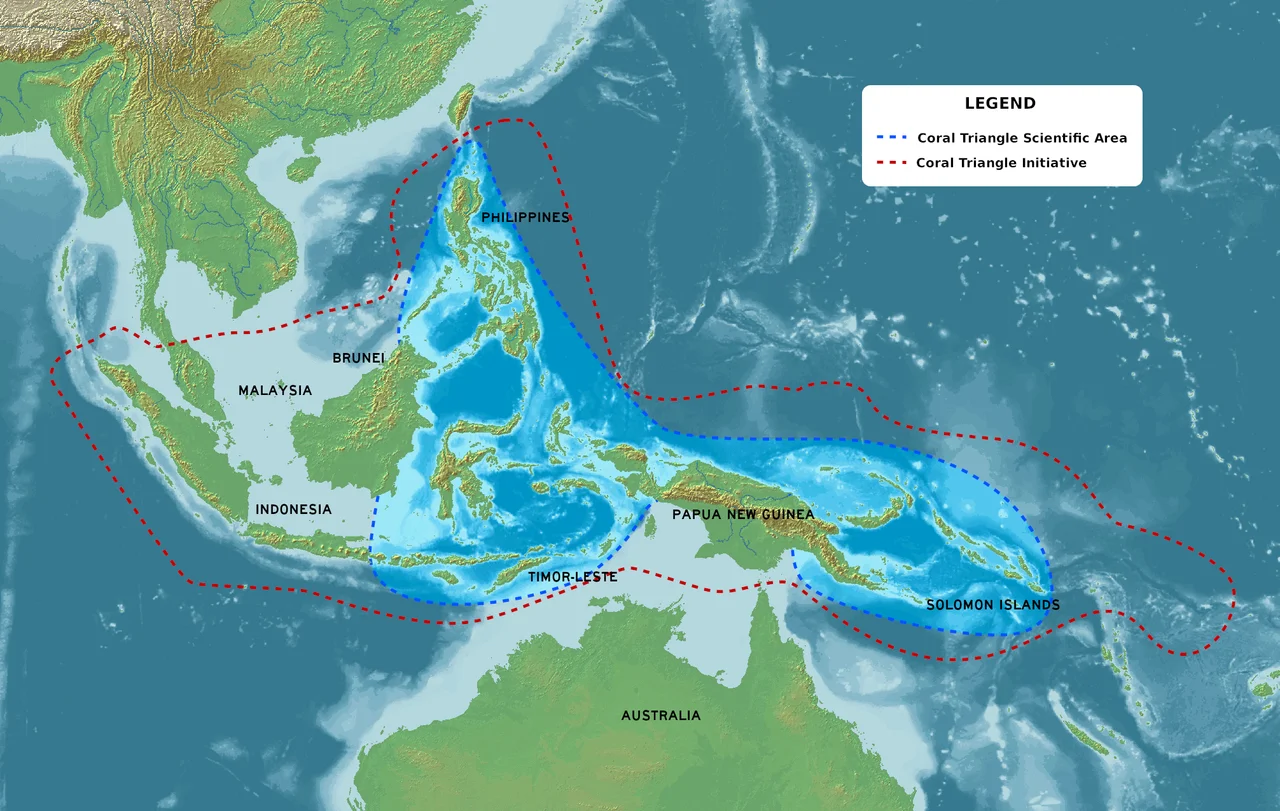
Somewhere in the waters off Raja Ampat, a coelacanth drifts through the darkness at 200 meters depth. This prehistoric fish, unchanged for 400 million years, was thought extinct until 1938. That it lives here, in the Coral Triangle, is almost redundant. Everything lives here. The roughly triangular expanse of tropical ocean stretching from the Philippines to the Solomon Islands to the eastern tip of Timor contains more marine species per square kilometer than anywhere else on the planet. Scientists call it the global epicenter of marine biodiversity. Divers call it the best water on Earth. The 120 million people who depend on its reefs for food call it home.
Numbers That Defy Proportion
The statistics are almost absurd. The Coral Triangle covers roughly 5.7 million square kilometers of ocean, about 1.6 percent of the planet's total oceanic area. Within that fraction live 76 percent of all known shallow-water reef-building coral species, more than 605 of the world's 798 documented species. Over 3,000 species of reef fish patrol these waters, representing 37 percent of the global total. Six of the world's seven sea turtle species nest on its beaches or feed in its seagrass meadows. The region hosts the world's largest mangrove forests. Raja Ampat alone, at the northwestern tip of Papua, contains 553 coral species, roughly 70 percent of the entire world's diversity concentrated around a single archipelago. The Asian Development Bank estimated in 2014 that the marine ecosystem generates roughly $1.2 trillion in economic value annually, with $3 billion in fisheries exports and another $3 billion from coastal tourism.
Why Here and Nowhere Else
Scientists have debated for decades why biodiversity peaks so dramatically in this particular patch of ocean. Three competing theories offer different answers. The 'centre of origin' model proposes that species evolved here first and then dispersed outward to colonize peripheral habitats. The 'centre of overlap' model suggests that species from the Indian and Pacific oceans, originally separated by geological barriers, gradually expanded their ranges until they converged in this central zone. The 'centre of accumulation' model argues the reverse: species that evolved on the periphery drifted inward over millions of years, accumulating in a biological crossroads. The truth likely involves all three mechanisms working simultaneously, amplified by the region's complex geography. Thousands of islands create countless niches. Deep trenches separate shallow reefs, promoting isolation and speciation. Warm equatorial currents circulate larvae across vast distances. The result is an engine of evolution that has been running for tens of millions of years.
Life in the Deep and the Shallows
A joint Indonesian-American expedition in 2008 revealed that the Coral Triangle's richness extends far below the sunlit shallows. Along the western ridge of the survey area, scientists discovered underwater active volcanoes at depths of 3,800 meters and approximately 40 previously unknown deep-sea coral species. Most were pale or white, lacking the symbiotic algae that give shallow-water corals their color. Around hydrothermal vents at 4,000 meters, they found thriving communities of shrimps, crabs, barnacles, and sea cucumbers adapted to conditions of crushing pressure and mineral-laden water. Above, in the warm surface waters, the contrasts are vivid. Whale sharks, the largest fish alive, filter plankton alongside parrotfish that grind coral into the white sand of tropical beaches. Harlequin ghost pipefish hover motionless against sea fans. Christmas tree worms spiral their feathery crowns from coral heads. The sheer density of life transforms every dive into a census that can never quite be completed.
A Reef Under Siege
The Coral Triangle feeds more people than any other marine ecosystem, and that dependency is precisely what threatens it. Approximately 2.25 million fishers work these waters, and the pressure shows. Destructive fishing practices, including blast fishing with homemade explosives and cyanide poisoning to capture live reef fish for the aquarium trade, have degraded reefs across the region. Coastal development smothers nearshore habitats with sediment. An estimated 95 percent of the Coral Triangle's reefs face at least one significant threat. Climate change compounds every local pressure: rising water temperatures trigger mass coral bleaching events, and ocean acidification weakens the calcium carbonate structures that corals build. Yet there are reasons for cautious hope. A 2021 report from the Global Coral Reef Monitoring Network found that the East Asian Seas region, which includes the Coral Triangle, was the only region globally where coral cover was substantially greater in 2019 at 36.8 percent than in 1983 at 32.8 percent, despite multiple bleaching events during the 2010s.
Six Nations, One Ocean
In 2007, Indonesian President Susilo Bambang Yudhoyono proposed a multilateral partnership to protect the Coral Triangle, bringing together Indonesia, Malaysia, the Philippines, Papua New Guinea, the Solomon Islands, and Timor-Leste in the Coral Triangle Initiative on Coral Reefs, Fisheries, and Food Security. The partnership established marine protected areas, promoted sustainable fishing practices, and began building the scientific infrastructure needed to manage such vast biodiversity. The World Wide Fund for Nature, The Nature Conservancy, and the Asian Development Bank have all invested heavily in conservation programs. Two reef systems within the Triangle have earned UNESCO recognition: Tubbataha Reef Natural Park in the Philippines and the Raja Ampat UNESCO Global Geopark in Indonesia. The scale of the challenge remains immense, but the political framework exists. Whether it can move fast enough to outpace warming seas and growing populations is the question that 120 million people are living with every day.
From the Air
The Coral Triangle spans a vast area of tropical ocean roughly bounded by the Philippines to the north, the Solomon Islands to the east, and Timor-Leste to the southwest, centered approximately at 1.7S, 129.0E. From altitude, the region is defined by island-studded seas of extraordinary blue clarity. Key landmarks include the Raja Ampat archipelago off Papua's Bird's Head Peninsula, the Banda Sea, and the volcanic islands of Maluku. Nearby airports include Pattimura (WAPP) on Ambon and Sultan Hasanuddin (WAAA) in Makassar. The Verde Island Passage in the Philippines, the Triangle's biodiversity epicenter, lies near Manila's RPLL. Expect tropical weather with afternoon convective buildup and excellent over-water visibility in the dry season.
Nearby Stories
- Maluku: A Traveler's Guide to the Spice Islands 36 km away
- The Spice Islands 51 km away
- Misool: Port of Kings 88 km away
- Where the Spice Routes Converged 113 km away
- The Ocean's Hidden Crossroads 119 km away
- Seram's Last Wilderness 124 km away
- The Islands That Made Wallace Faint 126 km away
- The Prayer That Became an Island 173 km away