
The Islands That Made Wallace Faint
When Alfred Russel Wallace opened the wings of a freshly netted butterfly on Bacan Island in 1859, he nearly fainted. The creature was enormous, its wingspan stretching wider than his hand, its color a fiery golden orange that shifted to opaline yellow and green when the light caught it at an angle. He named it Ornithoptera croesus, after the mythological king synonymous with wealth, and decades later he would still call the moment of its capture the greatest thrill of his collecting life. The butterfly was one species among hundreds that Wallace would document across the Moluccas, but Bacan was where discovery seemed to concentrate itself -- where forested volcanic slopes harbored birds and insects unknown to science, and where the line between the familiar and the extraordinary dissolved into damp equatorial air.
Sultanate at the Edge of Empires
Bacan was one of the four original kingdoms of Maluku, alongside Ternate, Tidore, and Jailolo, and its ruling elite converted to Islam in the late fifteenth century. When the first Portuguese trading fleet reached the Moluccas in 1513, they set up a post on Bacan, leaving seven men behind to buy cloves for the following year's expedition. What followed was a century of overlapping European ambitions -- Portuguese, then Spanish, who built a fort in 1606. The Dutch East India Company arrived in 1609 and established Fort Barnaveld, from which they imposed a monopoly that would shape the islands for three centuries. The VOC paid the Bacan sultan a stipend for the destruction of the island's clove trees -- compensation, in the colonial logic of the time, for eliminating competition. That stipend was actually higher than the salary of the Dutch Governor on Ternate, though it amounted to barely a ninth of what the Sultan of Ternate received. Power was relative in these waters, and Bacan always orbited larger forces.
Wallace's Living Laboratory
Wallace arrived in the Moluccas in the late 1850s and kept a house in the region for three years, using it as a base for journeys east. Bacan's forested slopes proved spectacularly productive. Beyond the golden birdwing butterfly, he discovered the standardwing bird of paradise -- Semioptera wallacii -- a creature with splendid green breast feathers and a pair of long white plumes that stuck straight out from each shoulder like pennants. He described it as "a new Bird of Paradise of a new genus quite unlike anything yet known, very curious and very handsome." He also documented the Moluccan cuscus and what would later be identified as the world's largest bee, Megachile pluto. These discoveries helped crystallize the biogeographic boundary that now bears his name: the Wallace Line, separating Asian and Australasian fauna. Bacan sits firmly on the Australasian side, its wildlife more closely related to New Guinea's than to Java's, despite the thousands of miles of sea between them.
Schemes That the Soil Rejected
Colonial powers and entrepreneurs repeatedly tried to extract wealth from Bacan beyond spices, and the land repeatedly refused. Gold washing had been practiced since at least 1774, and in the mid-nineteenth century, twenty skilled Chinese miners were brought from western Borneo to accelerate production. No rush materialized. An attempt at coal mining followed, using Japanese convicts imprisoned by the Dutch as labor. Several tons were extracted before the grade was judged too poor to continue. Then, beginning in 1882, an Amsterdam merchant cleared plantation land for vanilla, coffee, tobacco, and potatoes. The soil was wrong. Floods destroyed one planting, drought took another, rot consumed a third, and insects and rodents finished what remained. After more than a decade of heavy investment, creditors forced him out in 1900. His successors fared no better. Meanwhile, the islanders continued what had always worked: gathering pearl and mother-of-pearl from the surrounding waters and harvesting dammar resin from the forests.
Languages Slipping Away
The linguistic landscape of Bacan reflects the same layered complexity as its political history. Several non-Austronesian languages survive here, including Galela, Tobelo, and Ternate -- Papuan-origin tongues that predate the Malay and Indonesian languages now dominant across the archipelago. Near the capital Labuha, a distinct creole called Bacan Malay once served as the everyday language of the Bacan people. By 2012, only a handful of speakers remained. The Sirani community, descendants of mixed Portuguese-Indonesian heritage, adopted semi-European dress during the Dutch period and celebrated Sundays with dancing and music. Most of Bacan's Roman Catholics converted to Protestantism under colonial pressure. Today, the islands hold roughly 118,000 people across a dozen administrative districts, their daily lives conducted largely in Indonesian, the national lingua franca that smooths over the older linguistic textures still faintly audible beneath it.
From the Air
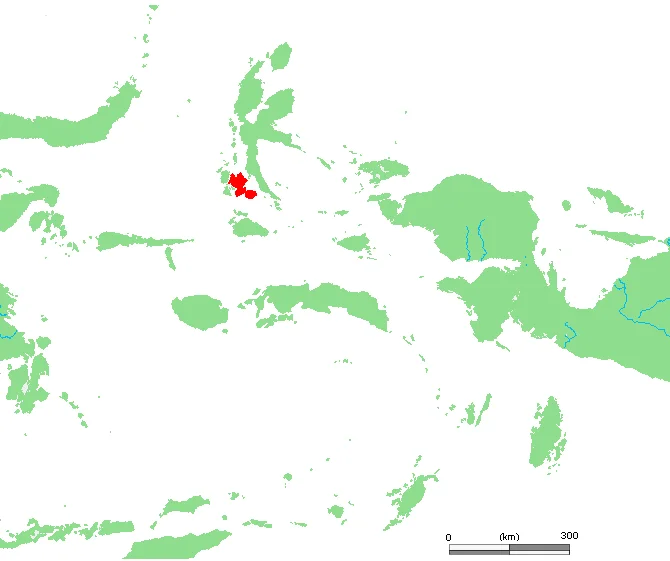
Coordinates: 0.615S, 127.515E. The Bacan Islands appear as a mountainous, heavily forested archipelago south of Ternate and southwest of Halmahera. The main island's distinctive isthmus connecting its two halves is visible from altitude. Nearest major airport is Sultan Babullah Airport (WAMH) in Ternate, approximately 100 km north. The volcanic peaks of Ternate and Tidore are visible landmarks to the north. Best viewed at 10,000-15,000 feet for island group overview.
Nearby Stories
- Kayoa 45 km away
- The Island Nobody Is From 82 km away
- The Ocean's Hidden Crossroads 96 km away
- Maluku: A Traveler's Guide to the Spice Islands 125 km away
- Twenty-Five Thousand Islands Between Two Worlds 140 km away
- The Spice Islands 154 km away
- The Sea That Swallows Itself 168 km away
- Bitung 276 km away