
The Island Nobody Is From
Every person on Obi Island came from somewhere else. That fact, unremarkable for a city but extraordinary for a 2,542-square-kilometer island in the heart of Indonesia's Maluku archipelago, shapes everything about the place. There are no ancestral claims to the land, no origin myths rooted in the hills, no indigenous language unique to its shores. The Tobelo and Galela peoples arrived first, paddling south from Halmahera. Then came the Ternate, Tidore, Makian, Butonese, Buginese, Makassarese, and Javanese, each group layering its customs onto an island that belonged to none of them. What drew them was the same thing that draws people still: Obi's prodigious natural wealth, from the clove trees that scent its hillsides to the nickel deposits that now fuel the global electric vehicle revolution.
Hills, Springs, and an Empty Interior
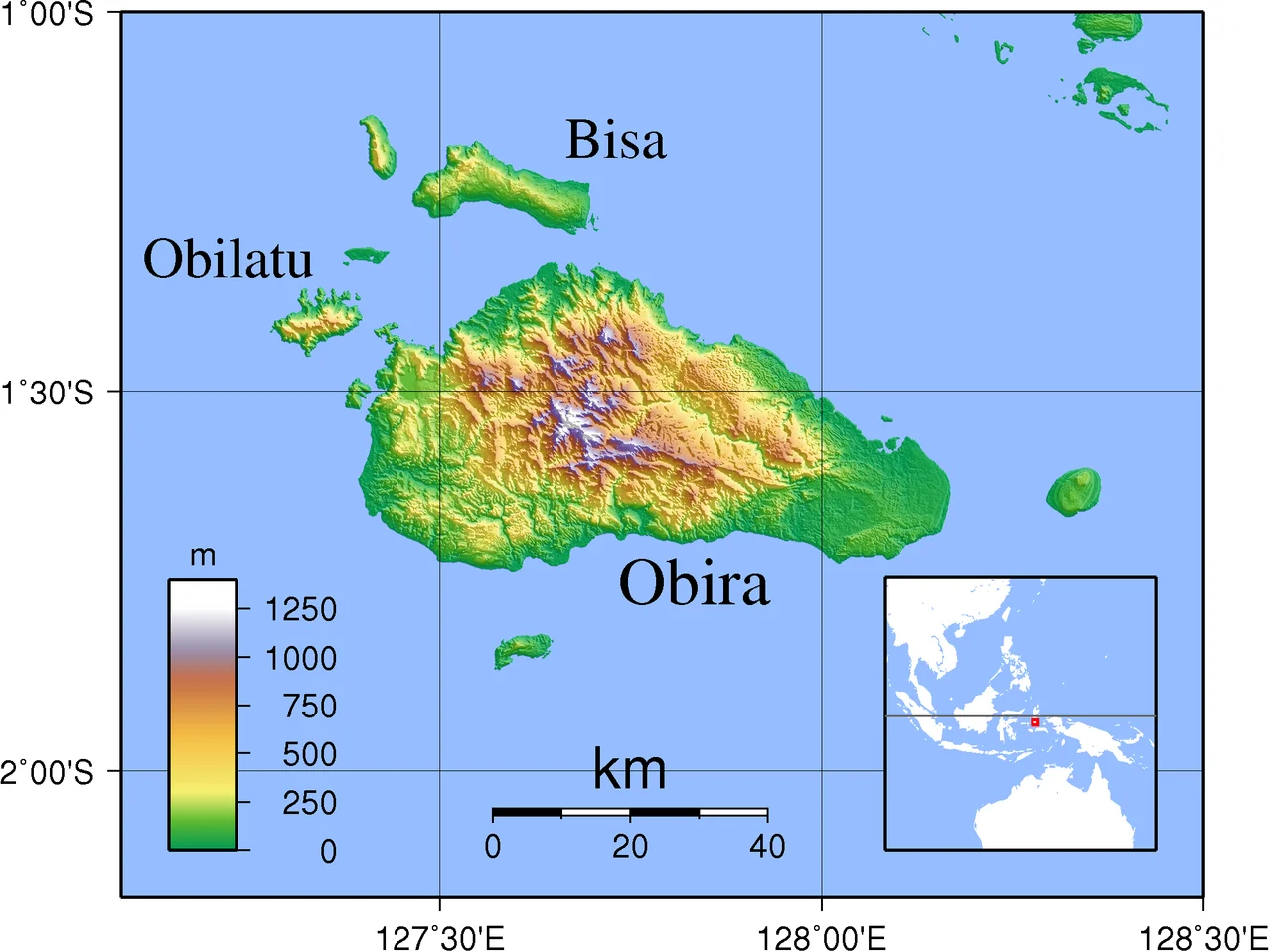
Obi is the largest island in the Obi Islands group, sitting south of Halmahera in North Maluku province. The Molucca Sea stretches to the west, the Seram Sea opens to the south, and Bacan Island lies to the north. The topography is relentlessly hilly, a terrain that feeds numerous springs and rivers flowing outward from the interior toward a surprisingly short coastline. On the western side, Lake Karo occupies the island's largest depression. Nearly all permanent settlements hug the coast, a pattern established by the earliest migrants who depended on fishing and small-scale farming. The highlands remain largely empty except for temporary encampments: mine workers on rotation and clove farmers who ascend during harvest season to tend their trees, then descend when the picking ends. The island's total area, measured at 3,048 square kilometers including surrounding islets, encompasses a constellation of smaller islands, including Obilatu, Bisa, Gata-gata, Latu, Woka, and Tomini.
Cloves and the Scent of Fortune
Obi sits within the original Spice Islands, the only region on Earth where cloves grew wild before European colonization. The island's plantation economy still centers on cloves, nutmeg, coconut, and pepper. For farmers, a single ton of harvested cloves can yield approximately 70 million Indonesian rupiah after deducting labor and harvesting costs, a figure that explains why families trek into the hills each season despite the difficult terrain. The harvest is labor-intensive work conducted on steep slopes, with workers handpicking the aromatic flower buds before they bloom. But agriculture, however storied, is no longer the island's economic engine. That distinction now belongs to what lies beneath the soil.
Nickel and the Price of Progress
Obi Island sits atop one of Indonesia's largest laterite nickel deposits, and the consequences of that geology have transformed the island over the past two decades. The Harita Group opened massive mining and processing operations on the island's west coast, and today multiple companies extract nickel ore from Obi's hills. The numbers are staggering: the mining and quarrying sector contributed 3.44 trillion rupiah to South Halmahera Regency's gross domestic product in 2024, while downstream manufacturing, largely nickel processing, contributed 11.49 trillion rupiah. The nickel refined here feeds the batteries of electric vehicles made by Mercedes-Benz, Tesla, BMW, and Toyota. But the environmental costs have been severe. For each ton of nickel produced through high-pressure acid leaching, roughly 120 tons of waste tailings are generated. Reports have documented water source contamination near processing facilities, and the island's once-pristine marine environment has suffered from runoff. Fishing communities that sustained generations of coastal settlers now contend with degraded waters.
Wings at the Edge of Extinction
Obi's most famous native resident is not a person but a butterfly. The Obi Island Birdwing, an endemic species found nowhere else on Earth, gave the island its small claim to global scientific attention. These large, vivid insects depend on the island's tropical forest canopy, a habitat that has been steadily reduced by decades of logging and, more recently, by the expansion of mining operations. The birdwing's predicament encapsulates Obi's central tension: an island whose underground wealth attracts investment and people, while the extraction of that wealth erodes the ecosystems that make the island distinctive. Conservation efforts remain limited. The island's healthcare infrastructure tells a parallel story of remoteness: a single public health center with inpatient services, two part-time doctors, and six paramedical staff serve the entire population. Patients requiring serious care must travel by boat to Bacan Island. In a place where everyone arrived by choice or necessity, the question of what Obi will become remains genuinely open.
From the Air
Located at approximately 1.53S, 127.78E, south of Halmahera in the North Maluku region. From altitude, Obi presents as a dark green hilly island with a short, irregular coastline and visible mining scars on the western side. Lake Karo is identifiable on the western interior. The nearest significant airport is Sultan Babullah Airport (WAMH) at Ternate, roughly 200 km to the north. Bacan Island and its airstrip at Oesman Sadik Airport (WAMC) lie closer to the north. Approach with awareness of frequent convective weather in this equatorial zone. The surrounding smaller islands of the Obi group are visible at lower altitudes.
Nearby Stories
- Maluku: A Traveler's Guide to the Spice Islands 35 km away
- The Islands That Made Wallace Faint 75 km away
- The Amazon of the Seas 76 km away
- Twenty-Five Thousand Islands Between Two Worlds 88 km away
- The Ocean's Hidden Crossroads 115 km away
- When the Spice Islands Shook 188 km away
- The Sea That Swallows Itself 225 km away
- The Island That Imprisoned a Nation's Greatest Writer 228 km away