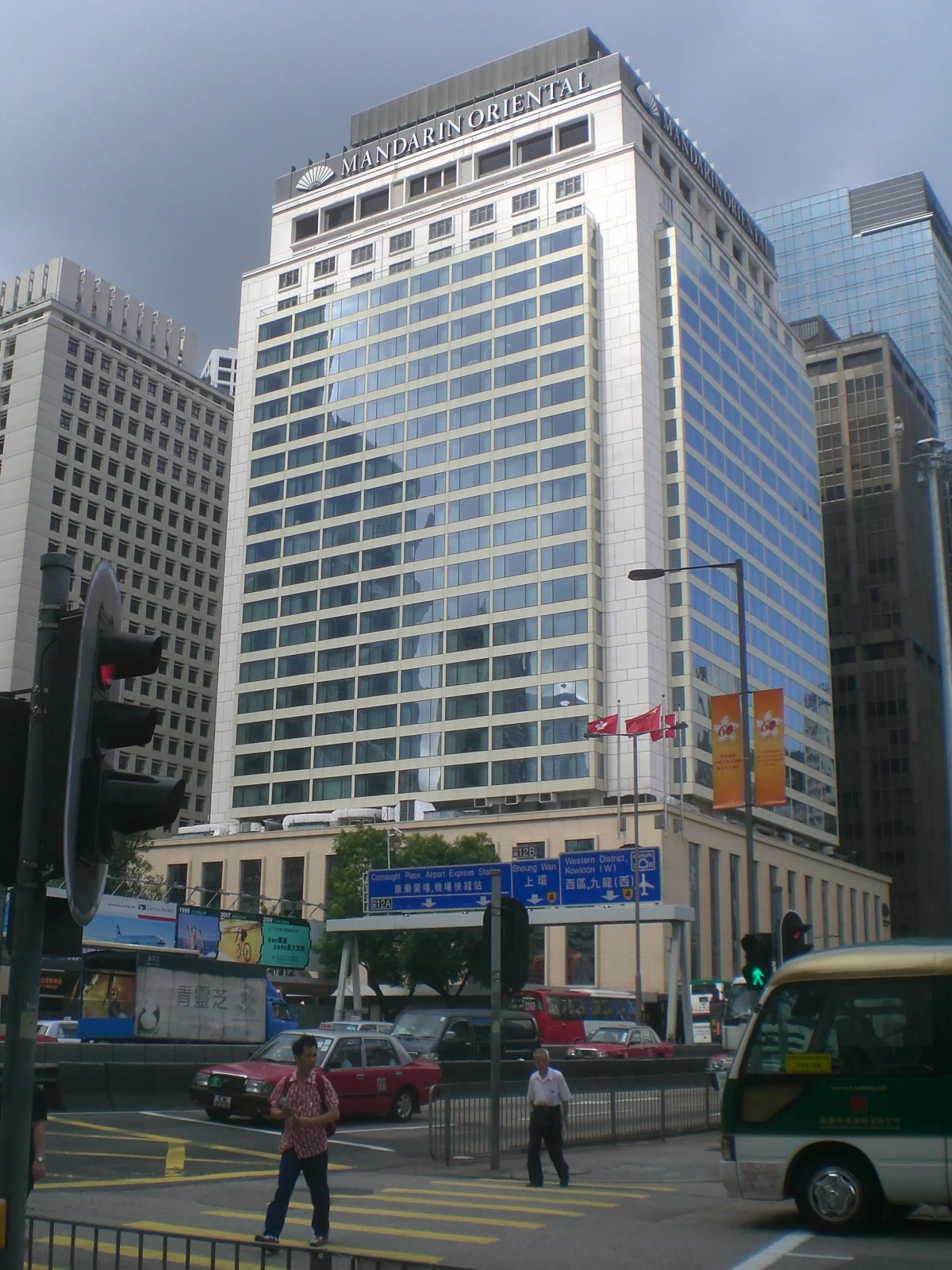

Mandarin Oriental, Hong Kong
The name was chosen by committee—specifically, by a nationwide American survey conducted while the building was still unfinished. The hotel's original name, Queen's Hotel, had been announced when construction began on 9 July 1960 on the site of the colonial Queen's Building in Central. Two years later, the South China Morning Post reported the change: American tourists, who made up the majority of the colony's visitors, preferred the exotic-sounding Mandarin. So the Mandarin it became—a name selected not in Hong Kong but somewhere in the United States, shaped more by imagination than geography.
The Tallest Building in the Colony
When the Mandarin opened to the public on 1 September 1963, celebrating its grand opening on 24 October of that year, it was the tallest building in Hong Kong at 27 storeys. That distinction would not last—Hong Kong's skyline was already gathering momentum—but in 1963 the Mandarin defined the city's vertical ambition. The building was designed by Leigh & Orange, the architectural firm whose work appears repeatedly in Hong Kong's colonial and post-colonial built environment. Interior design was by Don Ashton. From its opening until 1974, that height record held, long enough to fix the hotel's identity in the city's imagination as the address that set the standard.
Firsts That Mattered
Two claims from the Mandarin's early years say something about what luxury meant in 1963. It was the first hotel in Hong Kong to offer direct dial telephones—a technical amenity that now seems almost quaint, but which in the early 1960s represented genuine convenience for business travelers managing international calls from their rooms. More significantly, it was the first hotel in Asia to include a private bath in every guestroom. That second claim requires a moment to register: across an entire continent, no hotel had made a bath standard before the Mandarin did. Whether guests used it as a status signal or simply as a convenience, the hotel had engineered a specific kind of distinction that its marketing would repeat for decades.
The Harbour That Moved Away
When the Mandarin was built, it stood adjacent to Victoria Harbour. That adjacency was not incidental—the waterfront location anchored the hotel's position as the place for shipping magnates, diplomats, and travelers arriving by sea to settle into the colony. But Hong Kong reclaimed land from the harbor on a scale that reshaped the city's geography, and over the years the water retreated. The harbor is now several blocks away from the hotel's front entrance, separated by streets and buildings that did not exist when the Mandarin's guests could look directly out at the ships. The hotel remained; the shoreline moved on.
Renaming and Endurance
In 1988, the hotel was renamed the Mandarin Oriental, aligning it with the Mandarin Oriental Hotel Group that had grown around the brand. The original name—simply The Mandarin—had carried the hotel through twenty-five years of Hong Kong history: the economic transformation of the 1960s and 1970s, the anxieties of the handover years, the consolidation of the territory as one of Asia's primary financial centers. The longer name the hotel carries now is recognizable around the world, but in Hong Kong the institution is older than the brand, and the building on Connaught Road Central has a specific gravity that the group name alone does not fully explain. An event space inside can accommodate up to 600 people, which says something about how the hotel functions in the city: not just accommodation, but a setting for the occasions that require a particular kind of address.
From the Air
The Mandarin Oriental sits at approximately 22.282°N, 114.159°E on Connaught Road Central in the heart of Hong Kong's Central district, on the northern shore of Hong Kong Island. Approaching from VHHH (Hong Kong International Airport, approximately 14 nautical miles to the west-northwest), the hotel is part of the dense Central commercial core visible just east of the IFC towers. At 1,000–2,000 feet on approach to the harbor, the building's 27-storey profile stands among far taller neighbors—context that illustrates how completely Hong Kong's skyline outgrew it. Nearby visual references include Exchange Square, the HSBC building, and the Bank of China Tower. VHHH is the primary airport; VMMC (Macau International) is approximately 40 nautical miles to the west.
Nearby Stories
- Lok Ma Chau Loop 2.3 km away
- Portas do Cerco 2.3 km away
- Kweilin Incident 17 km away
- Wanshan Archipelago Campaign 34 km away
- Nanxiong Formation 115 km away
- Battle of Nanpeng Island 148 km away
- Heyuan 169 km away
- Cape Maobitou 632 km away