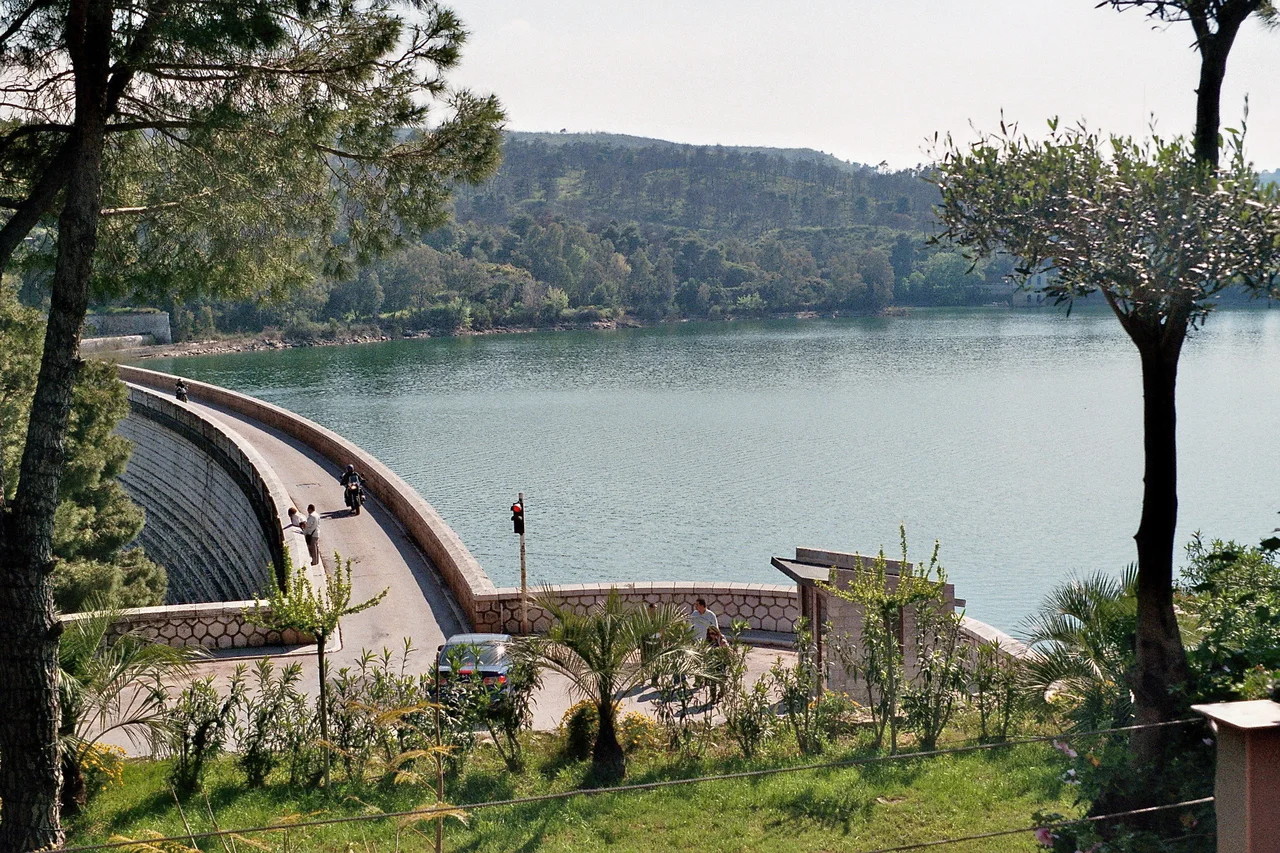

Marathon, Greece
The Soros stands ten meters high in the middle of the coastal plain. It is a tumulus - a burial mound - and beneath it lie the bones of 192 Athenian soldiers who died here on a September day in 490 BC, holding the line against an invading Persian army that outnumbered them perhaps three to one. The mound has been here for two and a half millennia. Visitors today can walk a short loop around it through a small park, with a marble memorial stele at the base inscribed with the names of the dead, family by family. The ancient Greeks did not normally bury soldiers on the battlefield - they were brought home for civic funerals - but at Marathon they made an exception. The dead at Marathon were honored where they fell. The mound is still there. The town goes about its business around it.
A Place Full of Fennel
The name comes from the herb. In Ancient Greek, fennel was marathon (μάραθον) or marathos (μάραθος), and Marathon literally means 'a place full of fennel'. The fennel still grows. Walk the coastal plain in late spring and you can crush the feathery leaves between your fingers and smell the same anise scent that gave the place its identity before any battle was fought here. In ancient times Marathon was one of four towns - along with Probalinthus, Tricorythus, and Oenoe - that formed the Tetrapolis, one of the twelve original districts of Attica before Theseus consolidated the region into a single state. The Marathonii claimed to have been the first Greeks to honor Heracles as a god, and they kept a sanctuary to him on the plain. Theseus was said to have come here to fight the Marathonian Bull, a creature ravaging the local fields - one of his early labors before founding Athens proper.
Pheidippides and the Race
The story most people know is mostly true and partly invented. After the Athenian victory in 490 BC, a herald named Pheidippides was sent to run from Marathon to Athens to announce the news - 26 miles, give or take, depending on the route - and supposedly collapsed and died after gasping out 'we have won' in the agora. The classical sources are actually messier than the legend; Herodotus has Pheidippides running not from Marathon to Athens but from Athens to Sparta (a much longer distance) before the battle, to ask for help. The deathbed announcement-run was a later embellishment. But when the modern Olympics were revived in 1896 and the founders wanted a long-distance race linking the new games to ancient Greece, the Marathon-to-Athens story was perfect. Spyridon Louis, a Greek water carrier, won that first marathon. The race has started here ever since, including at the 2004 Summer Olympics. The town and the distance are now welded together in global memory.
The Day Itself
On the day of the battle, perhaps 10,000 Athenian and 1,000 Plataean hoplites faced a Persian invasion force estimated at 25,000 or more. The Athenian general Miltiades thinned his center and weighted his flanks, then ordered the line to charge across the plain at a run - unprecedented for heavily armored hoplites. The Persians, expecting a slower advance, lost the battle in the wings and were driven back to their ships. About 6,400 Persians died, against perhaps 192 Athenians, whose names were carefully recorded by tribe and family. When the Persian fleet then sailed south to attack a defenseless Athens, Miltiades marched his exhausted men 26 miles back over the hills - a forced march in armor through one afternoon and night - so that the same Greek force met them when they arrived. The Persians turned around and went home. The Soros holds the men who paid for the strategy with their lives.
Schinias and the Dilessi Murders
Just southeast of town, the long sandy beach of Schinias stretches for kilometers along the Gulf of Marathon. It is one of Athens's favorite beaches, popular with windsurfers, and home to the Schinias Olympic Rowing and Canoeing Centre built for the 2004 Summer Olympics. The forest behind the beach is one of the few stands of stone pine left on the Attic coast. But not all of Marathon's modern history has been so cheerful. In 1870, a band of brigands kidnapped a party of British and Italian tourists at nearby Dilessi and murdered four of them when ransom negotiations broke down. The Dilessi Murders shocked Europe and badly damaged Greece's tourism reputation for a generation. For a while, the name Marathon - associated abroad with classical heroism - shared shelf space with reports of the killings. Modern Marathon has long since recovered. The story is mostly forgotten.
Lake, Tower, and Antenna
Drive west of the modern town and you reach the Marathon Dam, completed in 1929, which flooded a wooded valley to create Lake Marathon and supplied Athens with drinking water for thirty years. North of the lake, on the road toward Kapandriti, stand the ruined walls of a Frankish tower, evidence of the centuries when crusader nobles held estates across Attica. South of town, on a low ridge near Kato Souli, rises the 250-meter radio mast of the Hellenic Navy's transmission station - the tallest structure in Greece. From the antenna's base on a clear day you can see the Soros to the north, the Aegean to the east, and Mount Pentelicus to the southwest. Three timescales coexist in one view: ancient burial mound, medieval fortress, twentieth-century engineering, and a steel mast still broadcasting today.
From the Air
Marathon is at 38.1533°N, 23.9619°E, on the eastern coast of Attica about 40 km northeast of Athens. The Marathon plain forms a distinctive coastal flatland between the sea and the foothills. Cruising 4,000-7,000 ft offers views of the Soros tumulus on the plain, Lake Marathon to the west, and the long beach of Schinias to the southeast. Nearest airport: Athens International (LGAV) about 35 km south. Watch for the Kato Souli radio mast - 250 m, tallest structure in Greece.
Nearby Stories
- German Submarine U-565 2.2 km away
- Castle of Cuppa 6.7 km away
- Zoodochos Pigi Church, Dervenosalesi 7.6 km away
- Brauron 9.1 km away
- Anthedon (Boeotia) 9.2 km away
- Battle of Andros (1790) 26 km away
- Andros 32 km away
- Aegean Sea 60 km away