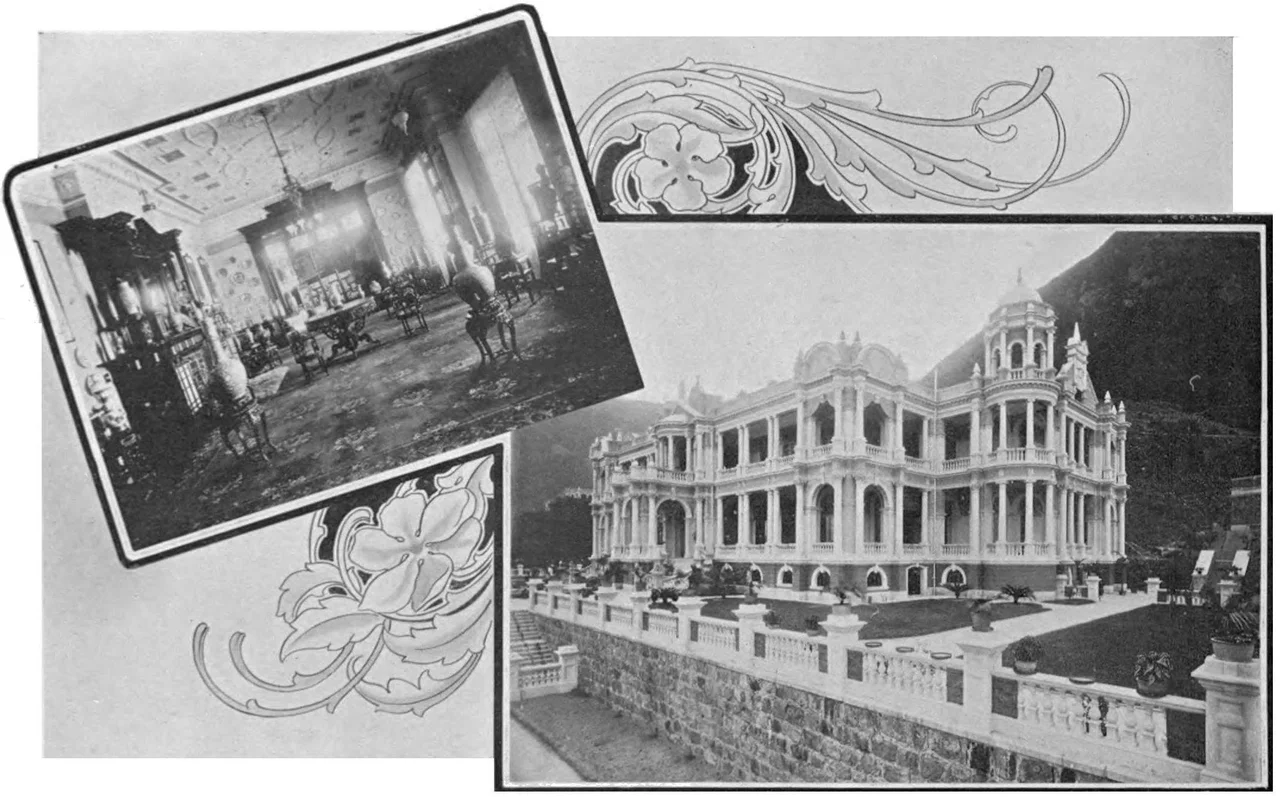

Marble Hall (Hong Kong)
Sir Catchick Paul Chater chose his site carefully. Five hundred feet above Victoria—higher than almost anyone else had thought to build—he placed the house that would bear its materials in its name. The marble came from quarries in Italy and Greece, finished in Belgium before making the voyage east. Between 1901 and 1904, it rose at 1 Conduit Road into what historians have consistently described as one of the finest private residences ever constructed in Hong Kong. The name was not a boast so much as a plain description of what you were entering.
The Man Who Built It
Paul Chater was one of the defining figures of colonial Hong Kong's business world. Born in Calcutta to an Armenian family in 1845, he arrived in Hong Kong as a young man and built a fortune through banking, land, and the commercial networks that made the colony work. He was co-founder of Hongkong Land, the property company whose buildings shaped Central for generations. His philanthropy was real and visible—the reclamation project that created Chater Road, the land gifts that gave Hong Kong its praya, his funding of public institutions. By the time Marble Hall was completed in 1904, he was Sir Paul Chater, knighted for his services to the colony, and he had the resources to build exactly the house he envisioned.
Stone from Two Continents
The logistics of Marble Hall were a statement in themselves. Marble quarried in Italy and Greece, finished in Belgium, shipped to Hong Kong, hauled up a hillside to Conduit Road—this was not simply building a house but assembling an argument about what a house could be. The external walls were stuccoed brick, but that exterior contained an interior organized around a magnificent staircase of Italian marble, finished in teak and mahogany. Leigh & Orange designed the structure, the same firm that worked on the Mandarin Oriental and the HKU Main Building. In their hands, Marble Hall became the residential counterpart to the civic grandeur they were expressing in other commissions across the colony.
Gardens, Gatehouse, and the View from Above
Five hundred feet above sea level meant something in Hong Kong's pre-air-conditioning era. The mid-levels offered escape from the humidity and heat that pressed down on the harbor and the streets of Victoria below. Marble Hall had extensive gardens—a luxury of space unimaginable at harbor level—and a gatehouse marking the entrance to the property. From those gardens, the view across the harbor to Kowloon would have been unobstructed, the entire working machinery of colonial commerce spread out below. Chater lived here surrounded by the city he had helped to shape, at an elevation that gave him a literally elevated perspective on it.
What Remains of a Lost Masterpiece
Marble Hall itself is gone. Like many of Hong Kong's grandest colonial-era private buildings, it did not survive the pressures of land value and redevelopment. The Marble Hall Gatekeeper's Lodge—the structure that marked the entrance to the estate—still exists, a surviving fragment that testifies to the scale of what was once here. The loss matters because Marble Hall represented something beyond personal display: it was evidence of what the colony's wealth, its connections to European craft and materials, and its architectural ambition could produce at their highest expression. Historians keep returning to it precisely because it is gone, and what we have are descriptions rather than the thing itself. The site at 1 Conduit Road is now part of Hong Kong's denser mid-levels fabric, the marble long since departed from this hillside.
From the Air
Marble Hall's site lies at approximately 22.278°N, 114.152°E in the Mid-Levels of Hong Kong Island, on the hillside above Central. From VHHH (Hong Kong International Airport, approximately 13 nautical miles to the west-northwest), approaching the harbor at 1,500–2,500 feet, the Mid-Levels appear as the dense residential band stepping up the northern slope of Hong Kong Island above the Central commercial district. Conduit Road runs through this zone roughly 500 feet above sea level. The gatekeeper's lodge, the surviving remnant of the Marble Hall estate, is not visible from altitude but the hillside location above the Central–Mid-Levels Escalator corridor gives a sense of where this residence once commanded its view. VHHH is the primary airport; the site is approximately 1.5 nautical miles south-southwest of Central's waterfront.
Nearby Stories
- Lok Ma Chau Loop 2.3 km away
- Portas do Cerco 2.3 km away
- Kweilin Incident 17 km away
- Wanshan Archipelago Campaign 34 km away
- Nanxiong Formation 115 km away
- Battle of Nanpeng Island 148 km away
- Heyuan 169 km away
- Cape Maobitou 632 km away