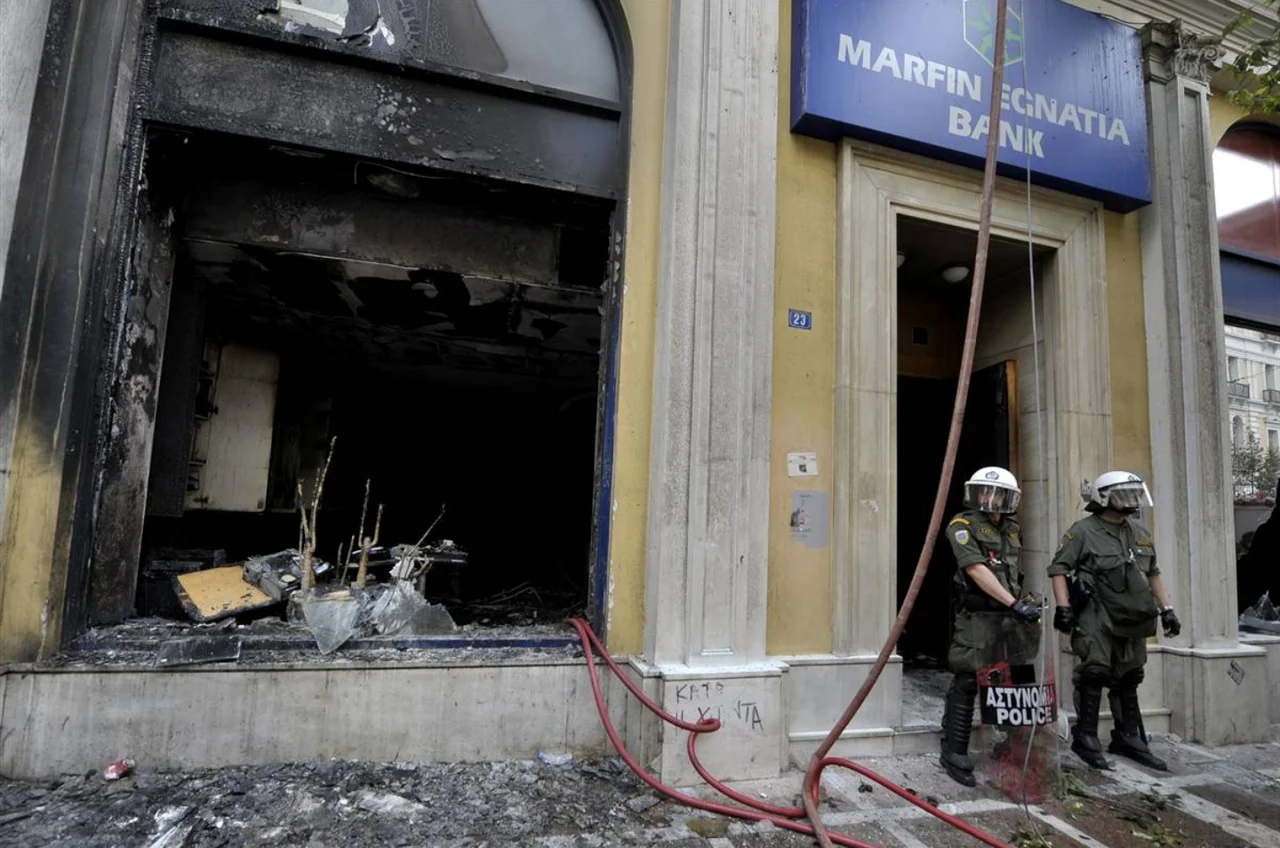

Marfin Bank Arson
Three names are fixed to a wall at number 23 Stadiou Street, in the center of Athens: Paraskevi Zoulia, Angeliki Papathanasopoulou, and Epaminondas Tsakalis. They were bank clerks. On the afternoon of 5 May 2010, they went to work as ordered, and they did not come home. Angeliki was 32 and four months pregnant. Epaminondas was 36. Paraskevi was 35. They died of suffocation on the third floor of a building set alight while perhaps a quarter of a million people marched outside. This is the story of the day Greece's economic crisis stopped being about numbers and became about three people who could not get out of a burning room.
A Country at the Breaking Point
By the spring of 2010, Greece was in free fall. Years of debt had caught up with the country, and a few days before, the government of George Papandreou had announced severe austerity measures - pay cuts, pension cuts, tax rises - as the price of an international bailout. The anger was immense and, by most accounts, widely shared. Major trade unions called a general strike for 5 May, and the march toward the Hellenic Parliament at Syntagma Square became one of the largest demonstrations in modern Greek history, with crowds estimated between 200,000 and 250,000. Most of those people came to protest peacefully. The vast majority never went near a bank.
The Fire
At around 2:05 in the afternoon, as the main march moved down Stadiou Street, a group of hooded attackers broke the windows of the Marfin Egnatia Bank branch at number 23 and threw Molotov cocktails inside. The reaction in the street was divided - some onlookers cheered, others shouted at them to stop. Smoke filled the building within minutes. Twenty-five to thirty employees were at work inside. Most escaped: a group climbed into a small skylight, broke through to the roof, and leapt to a neighboring building, smashing its window with a piece of wood to get in. But on the third floor, the flames cut off three of them. The medical examiner later concluded that smoke and toxic gases from burning plastics and paper overcame them almost at once.
The People in the Building
It is easy, with a tragedy framed by politics, to let the victims dissolve into a body count. They should not. Angeliki Papathanasopoulou was expecting her first child. Epaminondas Tsakalis and Paraskevi Zoulia were colleagues who, like her, had been told to come to work despite the general strike and the obvious risk of violence on the streets that day. They were not symbols of austerity or resistance. They were employees doing their jobs, and they had been given an instruction that would prove fatal. Across the political spectrum, the killings were condemned. Even the people who had marched against the same measures recoiled from what had happened to workers caught in the middle.
Justice, Slowly
No one was ever convicted of throwing the firebombs. An anarchist suspect was tried for the deaths but acquitted for lack of evidence, and the people who actually set the fire were never identified. Justice, when it came, pointed instead at the bank. In a separate trial that concluded in July 2013, Marfin's chief executive, the building's security officer, and the branch manager were found guilty of the negligent homicide of the three employees, the injury of 21 others, and a long list of failures in fire safety and staff training. The locked exits, the missing precautions, the order to work through a dangerous day - these were the conditions that turned an attack into three deaths.
What Remains on Stadiou Street
Years later, a memorial plaque was placed on the building, and each 5 May the names are read again. The Marfin fire became a kind of wound in the memory of the crisis years - invoked by everyone, owned by no one, a reminder that economic catastrophes are never only abstractions on a spreadsheet. Walk down Stadiou Street today, between Syntagma and Omonia, and the city moves on around you as cities do. But the address remains. Three people went to work here and did not survive the afternoon, and the simplest, most honest thing the place asks of a visitor is to remember that they were real.
From the Air
The site sits at 37.9791 N, 23.7322 E on Stadiou Street in central Athens, a short walk from Syntagma Square and the Hellenic Parliament. From the air, the dense neoclassical core of Athens unfolds beneath the Acropolis to the south. Athens International Airport (LGAV) lies about 30 km east-southeast. Best appreciated at low altitude on a clear day; central Athens haze can reduce visibility in summer.
Nearby Stories
- Great Sand Beach 5 km away
- Battle of Delium 7.7 km away
- Tower of Aliartos 9 km away
- HMHS Britannic 10 km away
- Saronic Gulf 15 km away
- Sousaki Volcano 17 km away
- Sanctuary of Apollo Maleatas 24 km away
- Skyros 66 km away