
Margam Country Park
In January 2026, archaeologists working in the deer park at Margam announced they had found the largest Roman villa in Wales. The find had been waiting under the grass for fifteen centuries, well-preserved precisely because nobody had ever ploughed it or built on it - because for most of those fifteen centuries, what stood above the villa was a Cistercian monastery, then a Tudor mansion, then a neo-Gothic country house, then a public park. The team's name for the discovery was "Port Talbot's Pompeii." That might be optimistic. What it certainly is, is a reminder of how Margam works: a Welsh estate where every layer of the past has been built on top of an older one, and almost nothing has been thrown away.
Stones Before Stones
The high ground above the modern motorway has been worth defending for a long time. Mynydd y Castell - an Iron Age hillfort enclosing 2.7 hectares in a D-shape - sits on an isolated hill 500 metres east of where the abbey would later stand. Across the valley, Half Moon Camp guards another summit. Both predate everything else at Margam by something like two thousand years. When the Romans arrived in the first century AD, they built their villa down on the flatter ground, sheltered by the same hills the Iron Age people had picked. By the time the Cistercians arrived in 1147 the villa had been gone for centuries, but the contour of useful land had not moved. The monks built where defensibility and good soil had always pointed people, and they built big - the spectacular twelve-sided Chapter House of Margam Abbey is one of the finest of its kind in Britain.
Sir Rice Mansel's Inheritance
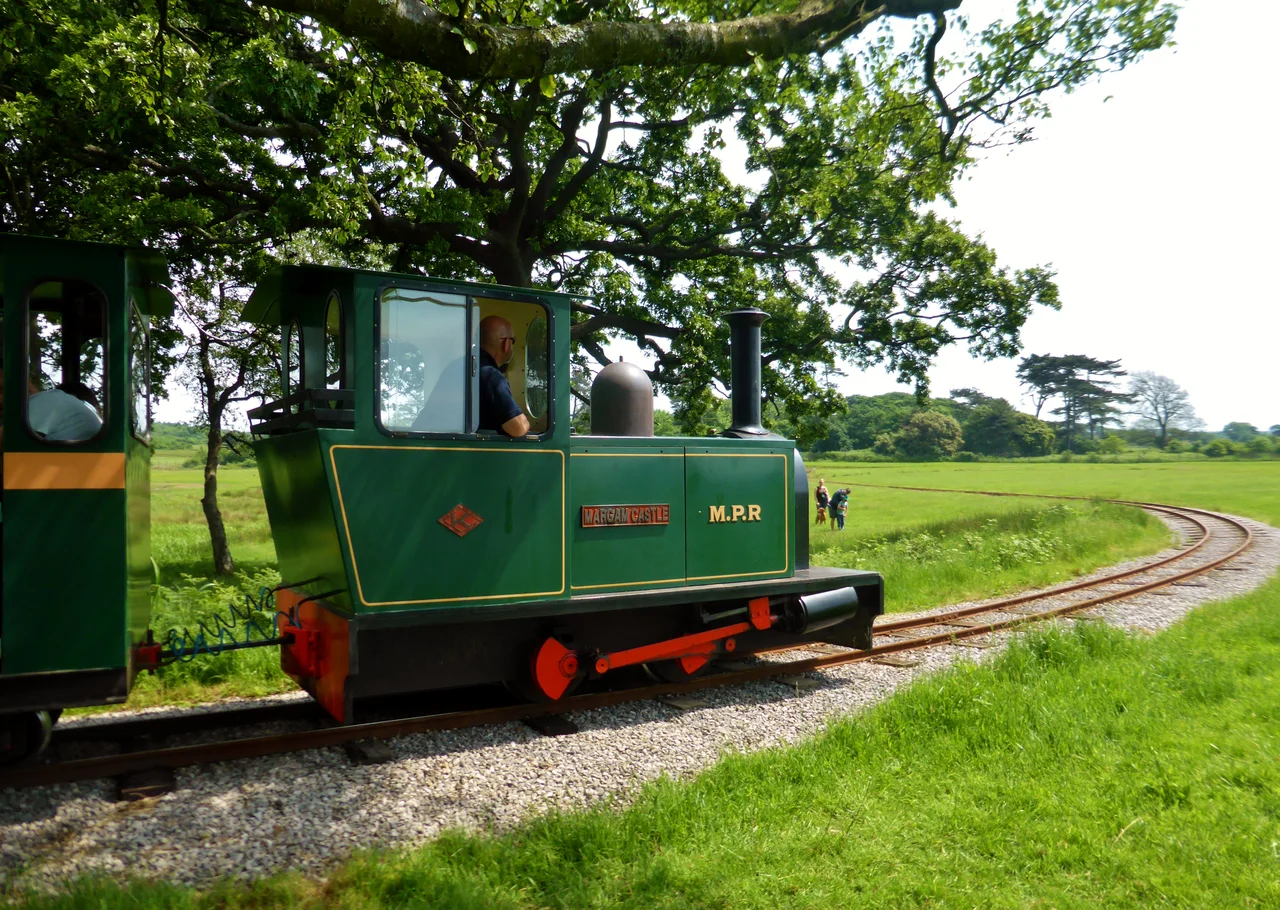
Henry VIII closed the abbey in 1536. Four years later, Sir Rice Mansel bought the lot - the ruins, the lands, the whole monastic footprint - and built a Tudor mansion on what had been the monastic ranges. The Mansels held Margam through the Civil War and into the eighteenth century, when the estate passed through marriage to the Talbots. The Talbots were the family who would transform the place from a working county residence into something approaching a small kingdom. In 1793, the architect Anthony Keck completed the Orangery, designed to house the Talbots' famous citrus collection. It came out 327 feet long, described at the time as "longer and more capacious than any other in Great Britain." It still holds that distinction. In the 1830s, Christopher Rice Mansel Talbot tore down the Tudor mansion and built a Tudor Gothic one in its place, calling it Margam Castle - all turrets and chimneys and steep roofs, the kind of country house Victorian wealth produced when it wanted to look ancient.
Of Peacocks, Pere David's Deer, and the Doctor
The Talbots left for Penrice in the nineteenth century, but the deer stayed. They have been at Margam since at least Norman times - around 230 fallow deer, 60 red deer, and 30 Pere David's deer brought in during the 1990s as part of a breeding programme for a species that no longer exists in the wild in China. Peacocks wander the lawns and shriek at intruders. Rare-breed Glamorgan cattle graze fields nearby. In 1973 the estate was bought by Glamorgan County Council; it opened to the public in 1977. In 1985 it briefly hosted a sculpture park with works by Henry Moore, Barbara Hepworth, and Elisabeth Frink - that has closed - but the park remains the one the public voted Britain's favourite Green Flag site in 2013, out of nearly 1,500 candidates. Doctor Who has filmed here three times: the Sontaran two-parter in 2007 and "Rogue" in 2023. The Tardis lands well in Margam's mixture of ruined abbey, Gothic mansion, and woodland.
The Radar on the Escarpment
Walk the inland section of the Wales Coast Path through the park and you will pass three flat-topped concrete buildings high on the escarpment above the M4. They are easy to miss, and that was the point. From 1941, as German bombers and shipping prowled the Bristol Channel, the Margam station was part of the Chain Home Low network - the second generation of British radar, built specifically to detect low-flying aircraft and surface vessels that the original Chain Home had missed. The buildings housed generators and control equipment; a large rotating antenna once sat on the roof. The station is a Scheduled Ancient Monument now, sharing the listing with the abbey ruins below it. Two layers of British defence, the medieval and the wartime, on the same patch of ground.
The View From Above
From a few thousand feet, Margam reads as a long green wedge between the M4 motorway and the Port Talbot steel works to the south. The Orangery is the easiest landmark - a long, low rectangle of pale stone catching the sun. North-east of it, the dark mass of Margam Castle climbs out of the trees. The Iron Age earthworks of Mynydd y Castell sit clearly on their isolated hilltop east of the abbey ruins. Pause your scan there and remember what's below the deer park grass: a Roman villa, undisturbed, waiting. Across the channel, the brown smoke of the steelworks anchors the south-eastern horizon.
From the Air
Located at 51.563N, 3.726W, about two miles east of Port Talbot and immediately north of the M4 motorway. Nearest airports are Cardiff (EGFF, about 20 nautical miles east-southeast) and Swansea (EGFH, about 10 nautical miles west-northwest). Best viewed at 2,000-3,500 feet AGL on a clear day. The 327-foot-long Orangery is the most distinctive structure from the air; Margam Castle sits in trees to the north-east, with the abbey ruins between them. The escarpment to the east, with the WWII radar station, marks the inland edge of the park. The Port Talbot steelworks immediately south is unmistakable and a useful reference.
Nearby Stories
- Brecon and Merthyr Tydfil Junction Railway 2.4 km away
- Abergwili 3.6 km away
- Whiteford Lighthouse 7.1 km away
- Llanthony Priory 13 km away
- Hinkley Point C nuclear power station 14 km away
- Porlock 15 km away
- Brecon Beacons National Park 20 km away
- Moreton House, Bideford 35 km away