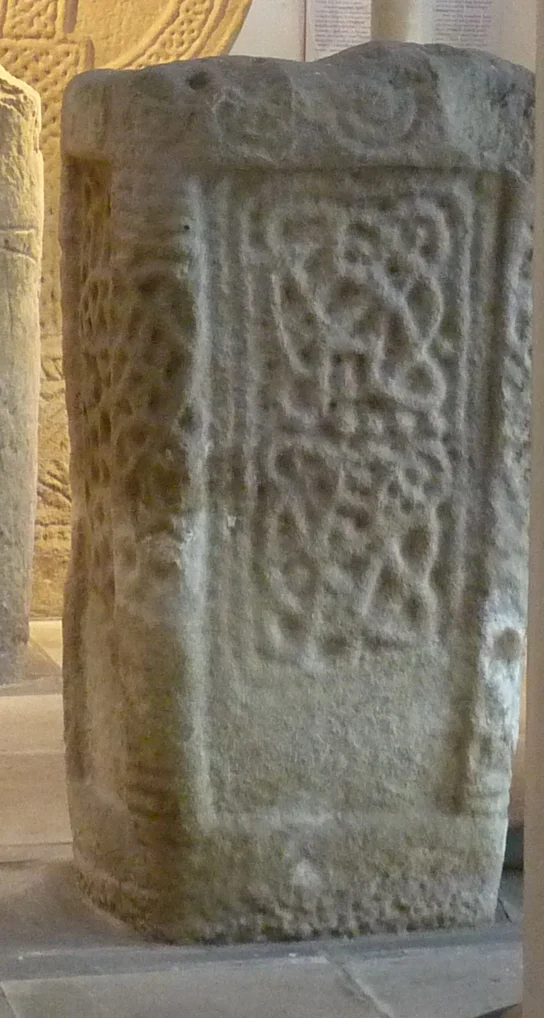

Margam Stones Museum
Two of the stones were once used as a footbridge. People walked across them for years, abrading the inscriptions and the knot-work patterns into a near-illegible blur, until somebody in the late seventeenth century looked down and realised what they were standing on. That detail tells you almost everything about Margam Stones Museum. It is a small Victorian schoolhouse on the western edge of the Margam estate, holding around thirty carved stones - and the stones themselves are arguably the most important collection of early medieval Welsh Christian carving anywhere in Britain. They survived because the people who carved them mattered, then because the people who came next did not know any better, then because a nineteenth-century family with an antiquarian streak decided to gather them up before they all became footbridges.
The Earliest Voices
Seventeen of the stones predate the Norman conquest. The oldest is a Roman milestone, set up in the reign of Maximinus II Augustus in the early fourth century, its abbreviated Latin still legible: IMPCAESAR FLAVIO MAXMINO INVICTO AUGUSTO. From the sixth century comes the Kenfig Stone - known by local tradition as Bedh Morgan Morganwg, the sepulchre of Prince Morgan - a 1.35-metre pillar of Old Red Sandstone carrying both Latin and Ogham inscriptions to a man named Pumpeius son of Carantorius. Ogham is the angular notched script the Irish brought to western Britain in late antiquity; finding it on a Welsh stone is like finding two languages of mourning carved on the same headstone. The script itself runs as notches along the edge of the pillar, the way you would carve initials on the corner of a beam.
The Cross of Conbelin
The masterpiece is the Cross of Conbelin, also called the Sanctuary Stone. It was carved some time between 950 and 1050 AD, two and a half metres of locally-quarried Pennant sandstone reaching almost the height of two men. Its head is a great stone disc 1.07 metres across - a wheel-cross with knot-work arcs and a central boss, designed to be seen from a distance and read up close. Carved figures flank the central cross on the shaft: a robed man holding what appears to be a book, taken to be St John with his gospel, and a smaller female figure understood as the Virgin Mary. Below them, a hunting scene unfolds across the massive pedestal - originally the front face, somehow reversed at some point in the stone's long life so it now sits at the back. Around the upper rim of the wheel runs an inscription: SODNA CRUCEM FECIT. Sodna made this cross. A second inscription names Conbelin as the one who erected it. Two names, more than a millennium old, still legible on stone.
The Footbridge Crosses
The Cross of Ilci and the Cross of Ilquici were found together in 1693, doing duty as a farm footbridge at Cwrt Dafydd, south of Margam. Both are cart-wheel crosses - similar form to Conbelin's though smaller, both made from the same Pennant sandstone. Both are catastrophically worn. The inscriptions, where they survive at all, survive in fragments: ILCI FECIT HANC CRUCEM IN NOMINE DEI SUMMI - Ilci made this cross in the name of God most High - and PETRI ILQUICI...HANC CRUCEM, naming a cross of St Peter erected by an Ilquici for the soul of someone whose name the centuries of footsteps removed. They are damaged but they are present. Without the seventeenth-century recognition that put a name on what was being walked over, they would have ended as gravel.
How a Collection Becomes a Museum
The Cistercian abbey at Margam was re-founded in 1147 by Robert of Gloucester, swept away by Henry VIII's commissioners in 1536, and acquired by the Mansel family. In 1786 it passed by marriage to the Talbots, and it is the Talbots who began, during the nineteenth century, to gather the standing crosses and inscribed stones scattered across the surrounding farms. Initially they were placed in the grounds of Margam Castle and around the abbey's Chapter House. In 1892 Emily Talbot gave the collection to the nation. In 1932 they were moved into the present building - a former church schoolroom - and labelled the Margam Stones Museum. Cadw, the Welsh historic environment agency, reworked the museum in the 1990s, putting the pre-Norman stones on the ground floor and the abbey memorials in the upper gallery: a clear division between the early Christian Welsh culture that produced the wheel-crosses and the Cistercian and post-Reformation memorials that came later.
Where the Museum Sits
From the air, the museum itself is an unprepossessing single-storey schoolhouse roughly fifty metres west of the parish church of Margam Abbey - the nave that survived the Dissolution. The abbey ruins, including the twelve-sided Chapter House, sit immediately east. North of them, the wedge of Margam Country Park climbs to the escarpment and the Iron Age hillforts. The museum is small enough that aircraft will not see it; the abbey church and ruined Chapter House next door are what you look for. Once you have those, the schoolhouse - and the stones inside - are a hundred-foot walk away.
From the Air
Located at 51.563N, 3.731W on the western edge of Margam Country Park, immediately west of Margam Abbey and the parish church. Nearest airports are Cardiff (EGFF, about 20 nautical miles east-southeast) and Swansea (EGFH, about 10 nautical miles west-northwest). The schoolhouse itself is too small to identify from altitude, but the abbey church (which retains its Norman nave) and the ruined twelve-sided Chapter House are clear landmarks just east. The Port Talbot steel works one mile south is unmistakable. Best viewed at 2,000-3,500 feet AGL in side-light.
Nearby Stories
- Brecon and Merthyr Tydfil Junction Railway 2.4 km away
- Abergwili 3.6 km away
- Whiteford Lighthouse 7.1 km away
- Llanthony Priory 13 km away
- Hinkley Point C nuclear power station 14 km away
- Porlock 15 km away
- Brecon Beacons National Park 20 km away
- Moreton House, Bideford 35 km away