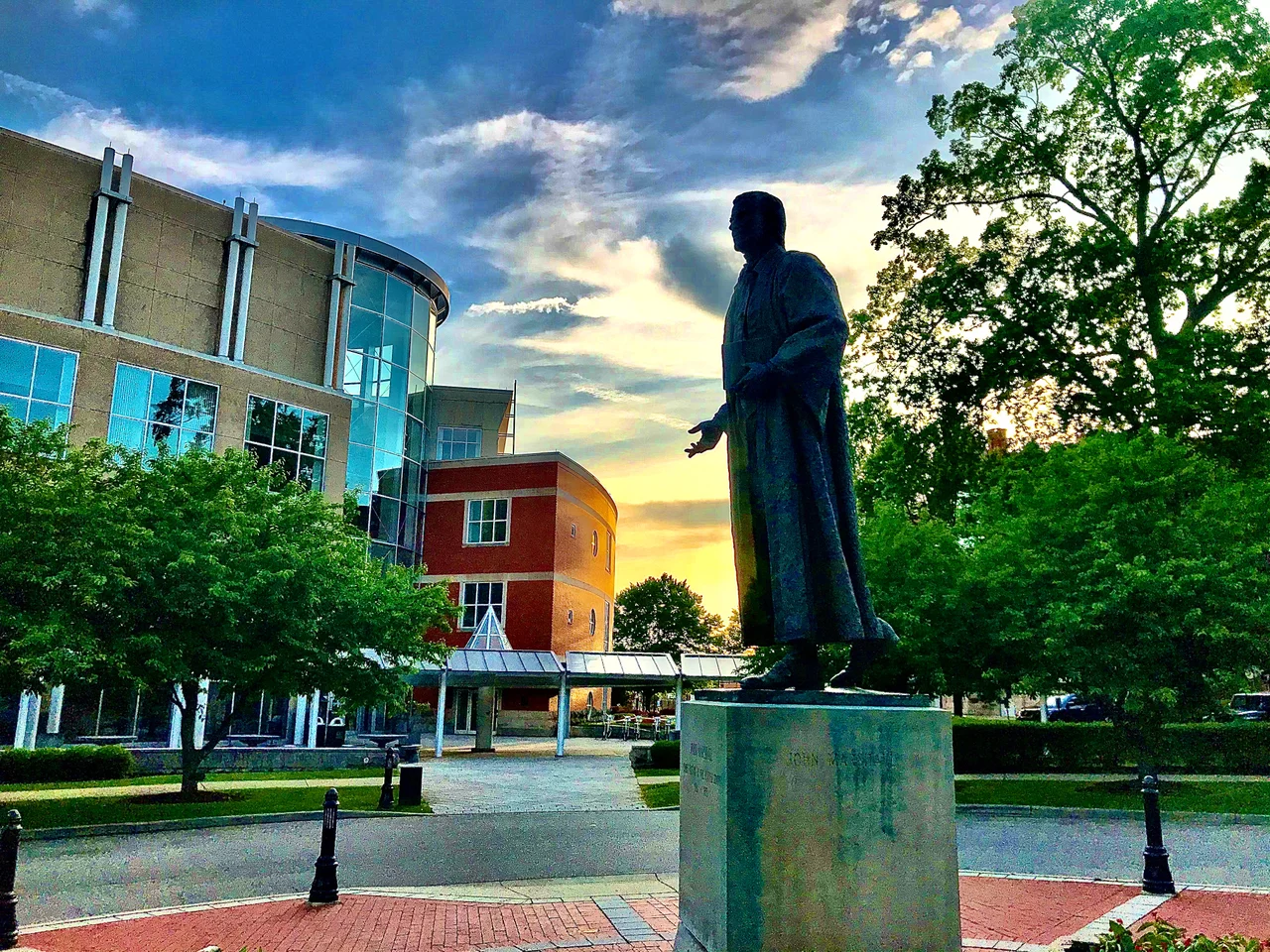

Marshall University
November 14, 1970, was a Saturday. Marshall University's Thundering Herd football team had just lost a close game 17-14 to East Carolina in Greenville, North Carolina. On the flight home, Southern Airways Flight 932 clipped trees on approach to Tri-State Airport and crashed nose-first into a Cabell County hollow. All 75 people aboard were killed - 37 team members, 5 coaches, fans, supporters, and the flight crew. The crash remains the worst sports-related air disaster in American history. It defined Marshall in a way no university wants to be defined. The Memorial Fountain on the Student Center Plaza is turned off every year on November 14 and stays dry until the first day of spring football practice. The story of Marshall is the story of how an institution and its city kept going after a loss they had no way to absorb.
Founded by Subscription
Marshall began in 1837 as a private subscription school - meaning local families literally paid for it themselves - founded by residents of Guyandotte and the surrounding area. Local attorney John Laidley hosted the meeting that led to the founding of Marshall Academy, named for Laidley's friend John Marshall, the fourth Chief Justice of the United States. The school sat on land called Maple Grove, then in the state of Virginia. The Virginia General Assembly renamed it Marshall College in 1858. The Civil War nearly closed it. When West Virginia broke away from Virginia in 1863, the school suddenly found itself in a new state, and in 1867 the West Virginia Legislature re-established it as the State Normal School of Marshall College - a teacher training facility. The path from frontier subscription school to research university took 124 years.
Becoming a University
Marshall did not become a university until March 2, 1961, when the West Virginia Legislature elevated it formally. The change had been argued for decades. By that point Marshall had been offering master's degrees since 1938 in six fields including chemistry, education, history, political science, psychology, and sociology. The university would not begin granting doctoral degrees until 1994. The School of Medicine opened in 1977 as the first professional school. The Joan C. Edwards School of Medicine, the Drinko Library, the Robert C. Byrd Biotechnology Science Center, and the more recent Brad D. Smith Center for Business and Innovation have followed in a steady expansion that has transformed a small teaching college into a Carnegie R2 doctoral research university with 16,500 students.
The Crash
The Marshall football program had been struggling. The 1969 athletic department faced scandals over recruiting violations, and both football and basketball coaches had been fired. The Thundering Herd entered 1970 trying to rebuild. The November 14 trip to Greenville for the game against East Carolina was supposed to be routine. The plane never reached its hangar. The Memorial Fountain at the heart of campus, built years later, names the 75 dead. Coach Jack Lengyel was hired to lead the 1971 Young Thundering Herd - a team built from injured players who had not made the trip, sophomores from the freshman team, players the NCAA allowed to play varsity through a special waiver, and athletes recruited from other Marshall sports programs. They won two games. The story became the 2006 Matthew McConaughey film We Are Marshall. In 2023 West Virginia made November 14 an official state Memorial Day.
Old Main and the Bricks
Old Main, the oldest building on campus, is actually a complex of five connected buildings whose construction stretched from 1868 to 1907 - the additions added over four decades as the school grew. It anchors the campus visually and institutionally, serving as the primary administrative building. The bricks of Marshall, like the institution itself, are layered. The 20-square-block campus sits east of downtown Huntington, with the academic quadrangle pedestrianized at its center. Marshall Memorial Fountain, the Memorial Student Center, the Joan C. Edwards Performing Arts Center, and Joan C. Edwards Stadium - home to Thundering Herd football - shape the daily experience of being on campus. Roughly 16,500 students, 200 student organizations, and a Greek life that has weathered its own scandals fill the space year-round.
Famous Sons and Daughters
The alumni list includes some of the most accomplished West Virginians of the past century. Robert C. Byrd received an honorary degree from Marshall and went on to become the longest-serving U.S. Senator in history. Billy Crystal attended Marshall and went on to nine Oscar-hosting gigs, six Emmys, and a Tony. Randy Moss caught more touchdown passes in a season than any NFL receiver before him. Hal Greer made the NBA's 50th and 75th anniversary teams. Michael W. Smith won three Grammys. The Society of Yeager Scholars, named for Chuck Yeager - the first pilot to break the sound barrier - awards medallions containing flecks of the same metal as the Bell X-1 that Yeager flew. The Yeager scholarship competition is fierce. Marshall accepts 97 percent of undergraduate applicants but the Yeager scholars are a much smaller and more selective group within them.
From the Air
Located at 38.425 degrees north, 82.421 degrees west, in central Huntington, West Virginia, directly east of the downtown commercial district. Recommended viewing altitude 3,500 to 5,500 feet AGL for clear views of the campus and surrounding city grid. Nearest airport is Tri-State (KHTS), about 4 nautical miles east-northeast - the same airport where the 1970 crash occurred. The Marshall campus is identifiable from above by the pedestrianized academic quadrangle and the green athletic fields. Joan C. Edwards Stadium is a major visual landmark to the southwest.
Nearby Stories
- Battle of Scary Creek 6 km away
- Portsmouth 7.2 km away
- Fred M. Vinson Museum and Welcome Center 14 km away
- Staats Mill Covered Bridge 24 km away
- Lake Tight 25 km away
- Battle of Blair Mountain 32 km away
- Lower Shawneetown 35 km away
- The Kentucky Meat Shower: When Flesh Fell From a Clear Sky 68 km away