
Martin Luther King Jr. Memorial
The address is 1964 Independence Avenue. The number is not arbitrary. It commemorates the Civil Rights Act of 1964, the federal law that struck down segregation in public accommodations and gave the executive branch the tools to enforce equal protection. King had stood on the steps of the Lincoln Memorial the year before, in August 1963, and told a crowd of 250,000 about a dream. The Memorial that bears his name sits in a sightline between the Lincoln he addressed and the Jefferson who wrote the Declaration he kept invoking. Walk in from the north side and you pass through a Mountain of Despair - two great wedges of granite cleaved apart - and emerge on the other side, on the Tidal Basin, where a 30-foot figure of King has been carved out of a third wedge that seems to have been pushed forward from between the other two. He is reading. He is unfinished. He is looking out across the water at Jefferson, and behind him, on a 450-foot curving wall, fourteen of his sentences run along the granite.
The Fraternity's Long Project
The memorial began as a fraternity project. King had been initiated into Alpha Phi Alpha as a doctoral student at Boston University in 1952, and he stayed connected with the chapter through the rest of his life. After his death, members of Alpha Phi Alpha began lobbying for a national memorial. It took decades. In 1996, Congress finally authorized the Secretary of the Interior to permit the fraternity to establish a memorial on Department of Interior land in Washington. The fraternity had until 2003 to raise $100 million and break ground - a deadline they did not meet. In 1998, Congress chartered the Washington, D.C. Martin Luther King Jr. National Memorial Project Foundation as a nonprofit to manage the work. In 1999, the U.S. Commission of Fine Arts approved the four-acre site at the northwest corner of the Tidal Basin. ROMA Design Group, a San Francisco firm, won the international design competition out of nearly 900 entries from 33 countries. Ceremonial groundbreaking came on November 13, 2006. Construction did not begin in earnest until December 2009.
Stone of Hope
The phrase comes from King's I Have a Dream speech: With this faith we will be able to hew out of the mountain of despair a stone of hope. ROMA's design literalized the metaphor. A 30-foot figure of King emerges from a 30-foot block of pale pink granite, as if cleaved from the larger Mountain of Despair that visitors pass through on entering. The sculpture was carved in China's Fujian Province by Lei Yixin, a Chinese sculptor working with collaborator Wang Xiangrong. King's pose was based on a photograph by Bob Fitch, the staff photographer for the Southern Christian Leadership Conference, who had captured King leaning against his office desk in front of a photograph of Mahatma Gandhi. The light pink granite was chosen so the carving's detail would remain visible at night, and to contrast with the darker Mountain of Despair stones. The selection of a Chinese sculptor working in Chinese stone, for a memorial to an American civil rights leader, generated debate before the memorial opened. The choice held.
The Drum Major Inscription
The first version of the Stone of Hope carried a paraphrase on its north face: I was a drum major for justice, peace and righteousness. King had said something close, but not identical, in a sermon at Atlanta's Ebenezer Baptist Church on February 4, 1968 - two months before his death. The actual line was longer and contained a critical conditional: If you want to say that I was a drum major, say that I was a drum major for justice. Poet Maya Angelou objected publicly that the abridged version made King sound arrogant, calling it a paraphrase that made the speaker look like a giant block of stone of self-promotion. The National Park Service agreed the paraphrase distorted the original meaning. In August 2013, the inscription was removed from the granite - carved away and replaced with horizontal striations matching the rest of the sculpture's texture. The memorial now bears no quote on that face.
Fourteen Sentences
The Inscription Wall runs 450 feet in a curve along the Tidal Basin. Fourteen quotations from King's speeches, sermons, and writings are carved into its granite. A Council of Historians including Maya Angelou, Lerone Bennett, Clayborne Carson, Henry Louis Gates, and Marianne Williamson helped select them, though the memorial's executive architect later noted Angelou did not actually attend the meetings where the choices were made. The selected quotes stress what the National Park Service brochure describes as King's four primary messages: justice, democracy, hope, and love. The earliest comes from 1956, during the Montgomery bus boycott. The latest is from a sermon King delivered at the Washington National Cathedral four days before his assassination. The cut letters were designed by Nicholas Benson, the Rhode Island stone carver whose family workshop has cut the inscriptions on Arlington memorials for three generations.
Postponed by Hurricane
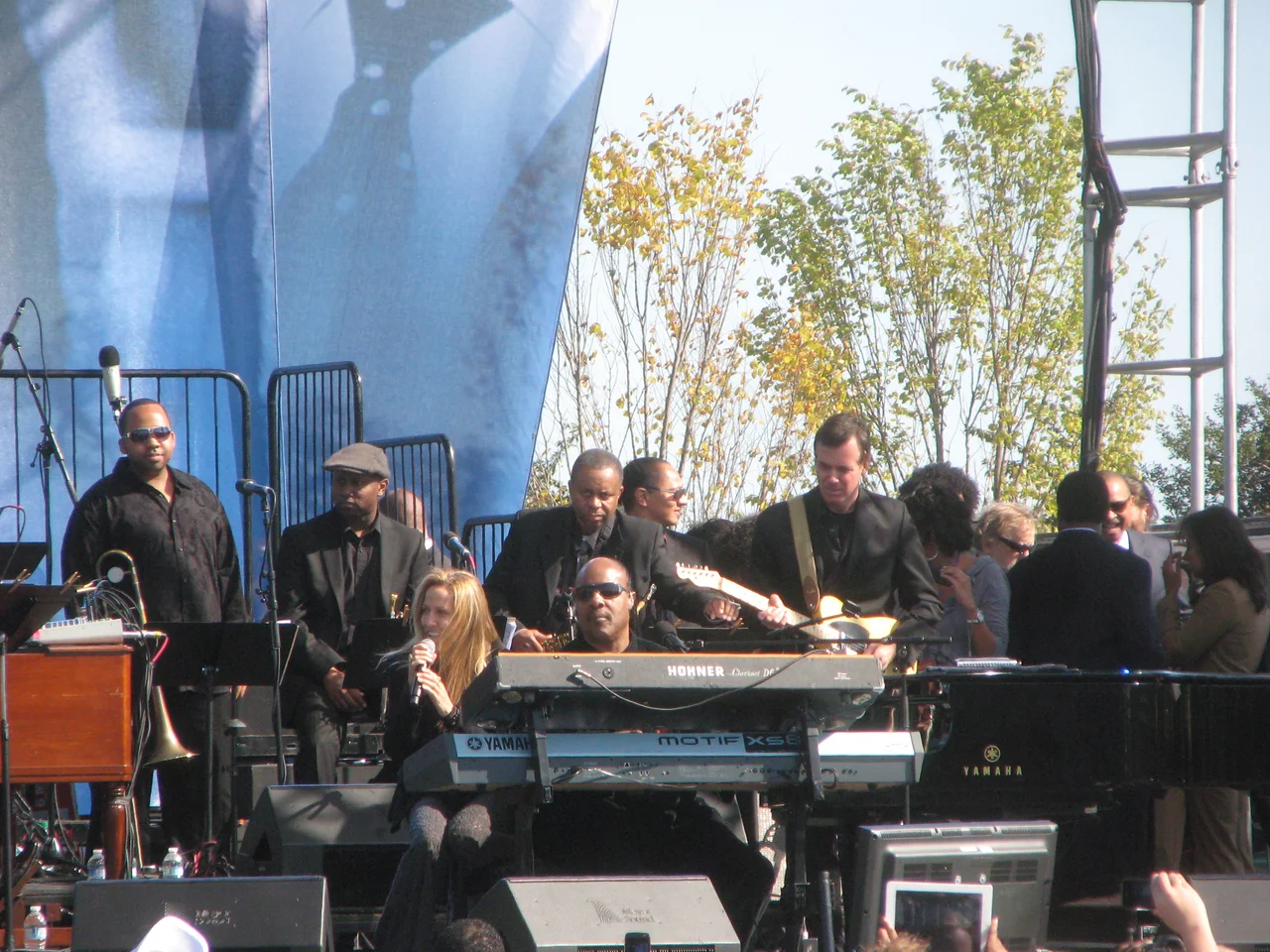
The dedication had been scheduled for August 28, 2011 - the 48th anniversary of King's I Have a Dream speech. Hurricane Irene, churning up the Atlantic seaboard, forced a postponement. The memorial opened to the public on August 22, and four days later, on August 28, it officially became a unit of the National Park Service. The formal dedication finally took place on October 16, 2011 - the 16th anniversary of the 1995 Million Man March on the National Mall. President Barack Obama spoke. The audience included John Lewis, Jesse Jackson, Andrew Young, members of the King family, Jamie Foxx, and George Lucas, who had been one of the project's major donors. Stevie Wonder and Sheryl Crow performed at the pre-dedication concert. Aretha Franklin sang. King was the first African American honored with a memorial on or near the National Mall, and only the fourth non-president to receive such a memorial in Washington. The total cost ran to about $120 million. The memorial has been free to visit, 24 hours a day, since the day it opened.
From the Air
The Martin Luther King Jr. Memorial sits at 38.8861 N, 77.0444 W, at the northwest corner of the Tidal Basin in West Potomac Park, on a sightline between the Lincoln Memorial (northwest) and the Jefferson Memorial (southeast). Best viewed from 1,500 to 2,500 feet AGL. The pink granite Stone of Hope is visible from above as a distinct vertical element along the basin's edge, with the Mountain of Despair stones flanking the entry. Reagan National (KDCA) lies two nautical miles south. The memorial sits inside the Washington Flight Restricted Zone; GA overflight prohibited. The Tidal Basin cherry blossoms in late March or early April frame the memorial with their canopy.
Nearby Stories
- Gunston Hall 1.1 km away
- 2023 Baltimore Shooting 4.9 km away
- Battle of Middleburg 6.6 km away
- Crownsville Hospital Center 10 km away
- Battle of Loudoun Heights 13 km away
- First Battle of Rappahannock Station 20 km away
- Howard County, Maryland 21 km away
- Harriet Tubman Underground Railroad 50 km away