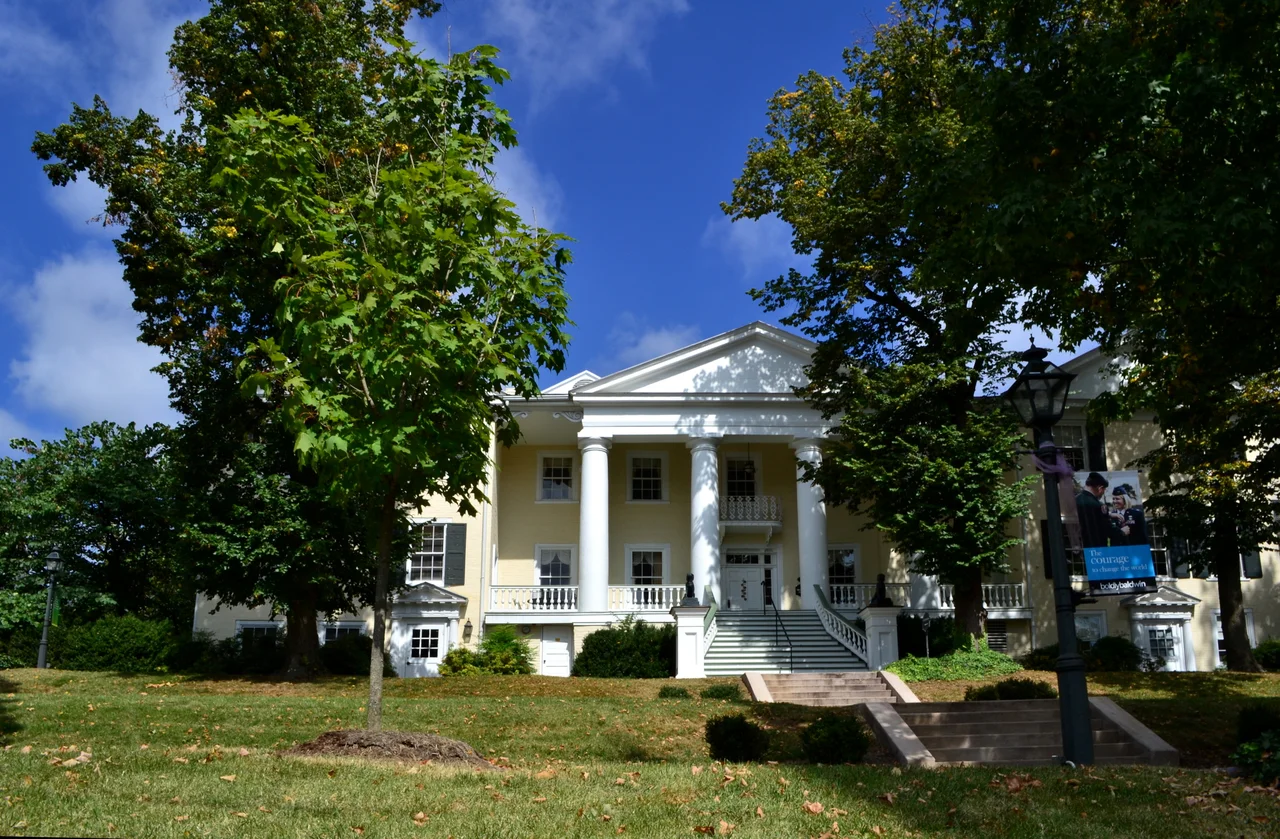

Mary Baldwin University
There is exactly one all-female corps of cadets in the world. They drill in formation on a small hilltop campus in downtown Staunton, in uniforms that descend from the Staunton Military Academy boys who used to drill on the same grounds. The Virginia Women's Institute for Leadership, founded in 1995 at the Commonwealth's request, sits inside Mary Baldwin University - which itself was founded in 1842 as the Augusta Female Seminary. Several other institutions claim a longer continuous history of women's education, but few have stretched the idea farther: an early-college program that accepts twelve-year-olds, a Shakespeare and Performance MFA partnered with the American Shakespeare Center, and a cadet corps with no analog anywhere else.
From Seminary to University
Rufus William Bailey founded the Augusta Female Seminary in 1842 as a Presbyterian school in the Shenandoah Valley. Mary Julia Baldwin enrolled as one of the early students. In 1863, in the middle of the Civil War, she was named principal. While most schools in the region shut down for the duration of the war, Baldwin kept the seminary running - no small feat with the Confederate and Union armies sometimes within marching distance of Staunton. She remained at the head of the school for decades. In 1895, the trustees renamed the school in her honor. In 1923, it became a four-year college. In 2016, it became Mary Baldwin University. The arc - from antebellum seminary to modern research-adjacent institution - has been continuous, though not without its ruptures.
Slow Integration, Faster Reinvention
Mary Baldwin admitted its first Black students in 1963, formally ending its policy of admitting only white women - a date that names the institution's place in segregation's long history rather than apart from it. Co-education came incrementally. Men were admitted as day students in the mid-1970s, but men did not move into residence halls until 2017, and that change drew vocal opposition from alumnae who wanted the women's college to remain women's-only. The compromise was structural: the historic Mary Baldwin College for Women persists as a single-sex residential program within a larger co-educational university. In 1976, when the neighboring Staunton Military Academy closed, the college bought its campus, expanding from 19 to over 50 acres. Cadets and women's college students now share the same hilltop.
Programs Without Peers
The Program for the Exceptionally Gifted, founded in 1985, admits academically advanced girls aged 12 to 16 who have completed sixth through tenth grade but not yet finished high school. PEGs live in their own dorm, named for past president Cynthia Tyson, but take regular classes alongside traditional-age students. A required philosophy course called Knowing the Self is the one exception. Many PEGs finish a bachelor's degree in four years - sometimes earning a college degree by age 17. Mary Baldwin also runs the only graduate program in Shakespeare and Performance in the country, jointly offered with the American Shakespeare Center; graduates have gone on to doctorates, tenure-track faculty positions, and professional theatre. In 2012, the Heifetz International Music Institute relocated its summer programs to the Mary Baldwin campus.
The Hilltop and Its Future
The main building, completed in 1844, has stood at the top of the campus for over 180 years and has been on the National Register of Historic Places since 1973. Every October since 1898, the university has marked Founders Day to honor Bailey and Baldwin. Every autumn the campus celebrates Apple Day, when students glean a local orchard for fruit that goes to area food pantries. The athletic teams are the Fighting Squirrels, an unserious mascot for a place that takes most things seriously. The institution has not stopped wrestling with what kind of school it should be. In August 2025, President Jeffrey Stein resigned after just two years; in November of the same year, the university discontinued seventeen academic minors, including creative writing, African-American studies, and physics, drawing pushback from alumni and faculty. What a university chooses to keep - and what it cuts - reveals its sense of itself. That sense is, at Mary Baldwin, still being argued out.
From the Air
Located at 38.1547N, 79.0675W on a hilltop in downtown Staunton, Virginia, in the Shenandoah Valley. The campus is compact, centered on the historic Main Building of 1844; the former Staunton Military Academy grounds extend the campus to the north. Recommended viewing altitude is 3,500 to 5,500 feet for views of the campus in context with downtown Staunton. Nearest airport is Shenandoah Valley Regional (KSHD) about 4 nm north; Charlottesville-Albemarle (KCHO) is 30 nm east. Watch for valley haze in summer.
Nearby Stories
- Rockingham County 4.8 km away
- Shenandoah: The Skyline Drive Through America's Oldest Mountains 5.6 km away
- 2023 Virginia Cessna Citation Crash 16 km away
- Highland County, Virginia 16 km away
- Montpelier 20 km away
- Fork Union Military Academy 26 km away
- Battle of Greenbrier River 28 km away
- Alleghany County, Virginia 53 km away