
Mary Cairncross Reserve
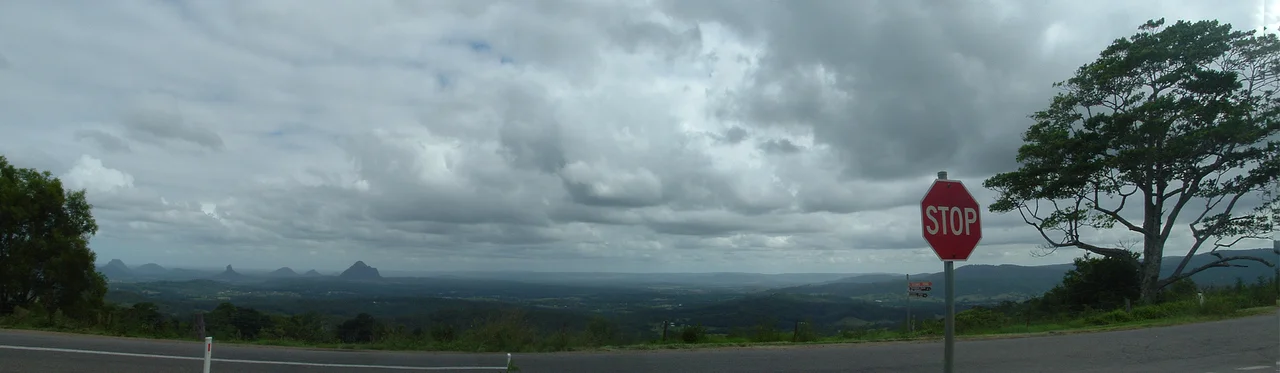
Step off the lawn at the lookout and the view stops you cold: across the valley, the Glass House Mountains rise from the plain like the broken teeth of a giant, sheer-sided spires of rock standing alone above the cane fields. Turn around and walk into the trees, and the world closes in to green. Strangler figs throttle their host trees in slow motion. A small wallaby called the red-legged pademelon freezes on the path, then vanishes. This is Mary Cairncross Reserve, a fragment of subtropical rainforest on the Blackall Range above Maleny, and it survives for one reason: three sisters decided their corner of the mountain was worth more standing than felled.
A Gift in a Mother's Name
In the 1870s this range was timber country, and the rainforest fell to the axe, prized above all for its Australian red cedar, the soft red 'cedar' that built colonial Queensland. The land that is now the reserve was bought in 1902 by Andrew Joseph Thynne as an investment. But his family chose to protect rather than profit. In October 1941 his three daughters, Bessie, Mabel, and Mary Thynne, transferred about a hundred acres to the local Landsborough Shire Council through a deed of trust, to be kept as a public reserve. They named it for their mother, Mary Thynne, born Mary Cairncross in 1848. From the 1950s the Rotary Club of Maleny took up the cause, cutting walking tracks and tending the bush over decades of volunteer labour.
A Whole Forest in Fifty-Five Hectares
The reserve is small, just 55 hectares, perched high on the range, but it packs astonishing life into that compass. Botanists have catalogued 107 species of tree alone, along with 50 vines, 26 shrubs, 30 herbs, three palms, and 21 kinds of fungi. The animal list runs to 139 bird species, eleven marsupials, twenty lizards, fourteen snakes, fourteen frogs, and three bats. Listen and you may hear the deep, liquid 'wollack-wa-hoo' of the wompoo fruit-dove, one of Australia's most spectacular pigeons, or the cat-like wail of the green catbird hidden in the canopy. The strangler figs are the forest's great drama, germinating high in a host tree and sending roots earthward to slowly envelop and outlive it.
Mountains That Were Once Molten
The view that makes the reserve famous is geology laid bare. The Glass House Mountains are volcanic plugs, the hardened cores of ancient volcanoes whose softer outer rock eroded away over some twenty-six million years, leaving the resistant stone standing alone. The rich volcanic soil they shed is part of why the surrounding rainforest grows so lush. To the Jinibara and Kabi Kabi peoples these peaks are sacred ground, woven into stories passed down across countless generations. Lieutenant James Cook gave them their English name on 17 May 1770; the bare spires, he wrote, reminded him of the glass furnaces of his native Yorkshire. From the reserve's lookout they line the horizon, a row of stone sentinels over the coastal plain.
The Reserve Today
Mary Cairncross is no longer just a patch of saved scrub but a place built for people to meet the forest. The Sunshine Coast Council and a corps of volunteers run a discovery centre and natural-history education centre, where visitors learn the rainforest before walking into it. The current Rainforest Discovery Centre, opened in 2017 by the Governor of Queensland, has won a string of architecture and sustainability awards for treading lightly on its setting. Walking tracks loop through the trees; a cafe looks out toward the mountains. Nearly a century on, the sisters' quiet act of preservation has become one of the Sunshine Coast hinterland's most loved places, a living forest and a grandstand view, given freely and kept for everyone.
From the Air
Mary Cairncross Reserve sits at 26.78 degrees South, 152.88 degrees East, high on the Blackall Range east of Maleny in the Sunshine Coast hinterland, roughly 88 km north of Brisbane and 30 km inland from Caloundra, at an elevation of around 440 metres. Sunshine Coast Airport (YBSU) lies about 30 km northeast, Caboolture Airport (YCAB) about 30 km southeast, and Brisbane Airport (YBBN) roughly 70 km south. The unmistakable navigation landmark is the cluster of Glass House Mountains just to the southeast, isolated volcanic spires that are visible for tens of kilometres and that the reserve's lookout faces directly. From the air the reserve appears as a dark island of dense rainforest canopy atop the green ridge of the range, distinct from the cleared dairy and farming country around Maleny. Best viewed in the clear winter months, as this elevated range draws cloud and rain.
Nearby Stories
- Moreton Island 16 km away
- Abbey Museum of Art and Archaeology 27 km away
- Aarhus Historic Shipwreck 27 km away
- Noosa National Park 40 km away
- Main Range Railway 51 km away
- Bunya Mountains National Park 68 km away
- Hornet Bank Massacre 296 km away
- HMS Porpoise (1799) 527 km away