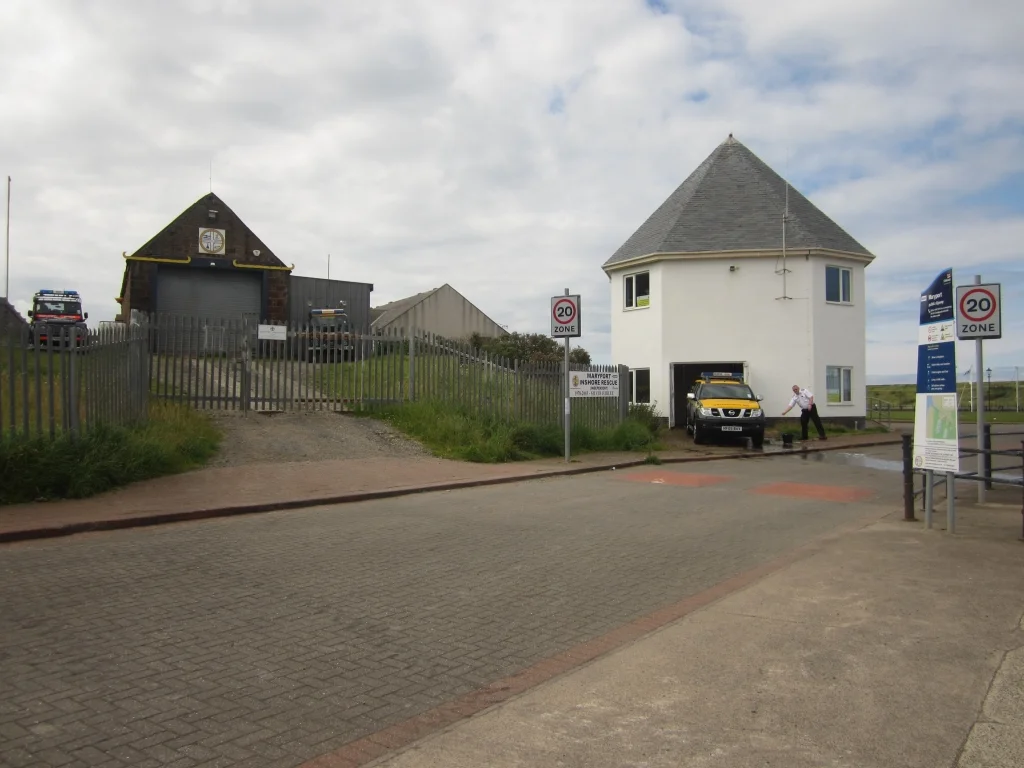

Maryport Lifeboat Station
On 9 October 1940, the wind picked up so fast on the Solway Firth that one herring drifter, the Mourne Lass, lost a single hour against her fleetmates and was caught alone in a gale. She was spotted from shore at 18:30, about two and a half miles out, her propeller fouled in her own nets and her mizzen sail in shreds. The Maryport lifeboat launched at 19:47 and struggled even to clear the harbour. Coxswain Thomas Quayle Reay brought back four exhausted crewmen, guided home to harbour by the harbour master's flashing torch. Reay had already won the RNLI Bronze Medal six years earlier for a rescue off Workington in another gale. The Mourne Lass service earned him a second-service clasp to that medal. He is the kind of name that runs through this station's history.
The Henry Dixson Arrives
In October 1865, the RNLI's monthly journal The Lifeboat reported that a station had been established at Maryport. A new boathouse had gone up on the harbour, and a 32-foot self-righting Pulling and Sailing lifeboat had arrived, equipped with both sails and ten oars and a launching carriage to get her down to the water. The boat had travelled to Cumberland on the rails of three different railway companies: the London and North Western, the Lancashire and Yorkshire, and the Whitehaven and Furness. The cost of the entire establishment had been defrayed by a gift of £550 from Henry Dixson of Manchester. At the ceremony on the lifeboat's arrival, the boat was named the Henry Dixson. The next two lifeboats at Maryport, by contrast, were Civil Service lifeboats, funded by an official charity set up by civil servants more than 150 years ago to support the RNLI.
Coxswain Reay
On 17 January 1934, the steamship SS Plawsworth of Newcastle-upon-Tyne dragged her anchors in a southwest gale and was driven ashore off Workington. The Priscilla Macbean, Maryport's first motor lifeboat, launched at midday and found the steamer stern-first to the shore, offering no shelter to a rescue boat on either side. The lifeboat had to set her own anchor and veer down to the vessel, damaging her own rudder in the process. With a poorly handling boat, Coxswain Reay still managed to bring her alongside for 42 minutes and take off 13 of the steamer's crew. The Master and four men stayed aboard. The lifeboat landed her survivors at Workington and went out again after repairs. By the time she returned, the steamer had shifted enough that the remaining crew could wade ashore at low tide. Reay received his first RNLI Bronze Medal for that night. The Mourne Lass service in 1940 brought him his second-service clasp.
Closure and Return
By 1948, silting of Maryport harbour was making lifeboat launches increasingly difficult. The RNLI decided to re-establish a station at Workington, which had been closed in 1905, and to close Maryport in 1949. The Joseph Braithwaite, the last all-weather lifeboat at the station, named for a Wigton native whose legacy had funded her in 1934, was transferred to the relief fleet and finally sold from service in 1952. She turned up most recently in a back garden in Barry, South Wales in 2019. The closing was not the end of the story. In 1978, with local support, a lifeboat service was re-established at Maryport. It was originally called the Maryport Inshore Rescue Boat and is now known as Maryport Rescue. The boathouse it operates from is the same building put up by the RNLI in 1865, now modified and extended.
Maryport Rescue Today
The current station operates the E-ON Spirit of Maryport, a Marine Specialist Technology Rescue 900 rigid inflatable boat, in service since 2008, along with a smaller Zodiac inflatable. In 2017, the team took delivery of a refurbished Talus MB-H amphibious tractor from the RNLI: a watertight, fully submersible vehicle originally designed to launch all-weather lifeboats through water, sand, and mud. The service is co-ordinated by Belfast Coastguard and holds Declared Facility status with His Majesty's Coastguard. Alongside the lifeboat, Maryport Rescue operates a Flood and Swiftwater Search and Rescue team, working closely with Cumbria Police and Cumbria Fire and Rescue. The charity received the King's Award for Voluntary Service in 2023. On 15 April 2013, work began on a £450,000 project to modify the 1865 boathouse for modern use. Sometimes preservation looks like new fittings inside very old walls.
The 1934 Naming
The naming ceremony on 27 September 1934 for the last all-weather lifeboat at Maryport drew an estimated twenty thousand people. Among them was John Murray, the last surviving member of the 1865 crew of the Henry Dixson, the original lifeboat at the station. His presence at the ceremony, almost seventy years on, was the kind of moment that anchors a community's memory of itself. Generations of Maryport volunteers had carried his crew's tradition forward, and a new one was about to take it on. The new boat was the Joseph Braithwaite, single-engined and 35 feet and 6 inches long, funded from the legacy of a Wigton man who had wanted to be remembered. He was. So was John Murray. So was Coxswain Reay.
From the Air
Maryport Lifeboat Station sits at 54.715 N, 3.504 W on Marine Road at Maryport harbour, on the Cumbrian coast facing the Solway Firth. Recommended viewing altitude is 1,500 to 3,000 feet AGL. The boathouse is on the south side of the harbour entrance. The town of Maryport, the harbour walls, and the Cumbrian Coast Line railway are all visible from the air. The Roman fort site at Alauna lies on a hill immediately north. Workington is about 6 miles southwest. The nearest airport is Carlisle Lake District (EGNC). The Solway Firth coastline extends north toward Allonby and south toward Whitehaven.
Nearby Stories
- Wast Water 6.4 km away
- Ecclefechan 6.7 km away
- Dundrennan Abbey 7.7 km away
- Penrith 11 km away
- RAF Spadeadam 13 km away
- Kenmure Castle 18 km away
- Kendal 19 km away
- Ramsey Bay 32 km away