
Penrith
On 12 July 927, every king who mattered in Britain came to a meadow near Penrith. Athelstan, King of the Anglo-Saxons. Constantine II, King of Scots. Owain, King of the Cumbrians of Strathclyde. Hywel Dda, King of Wales. Ealdred, Lord of Bamburgh. They met at Eamont Bridge, or at the nearby monastery at Dacre, or perhaps at the old Roman fort at Brougham, the chronicles do not quite agree. What they did agree there became, in effect, the founding moment of England: a recognised border at the River Eamont, with Penrith on the English side. Eleven centuries later, the town is still working out what that meant.
The Red Hill
The name itself is debated. Some derive it from Cumbric pen, head or chief, and rid, ford, meaning chief ford or hill ford. Others prefer pen plus rhudd, the Welsh word for crimson, meaning red hill. The red interpretation matches the geology beautifully. Penrith is built almost entirely from the red sandstone of the Eden Valley, the same stone that gives the town its warm rust-orange tone in late afternoon light, the same stone that crops out as Beacon Hill above the town, the same stone that was used in St Andrew's Church and the Tudor House and the old market crosses and the ruined castle. Whatever the etymology, Penrith looks red, and from above the town glows like rusted iron against the green of the Eden valley.
Prehistoric Crossroads
People settled here long before the Romans came. Mayburgh Henge, just south of town, is a massive prehistoric earthwork with a single surviving standing stone. King Arthur's Round Table is another henge nearby, despite the Arthurian name. Long Meg and Her Daughters, a few miles north-east, is one of England's most striking Neolithic stone circles, with Long Meg herself standing apart from the ring. Together with the Little Round Table, Little Meg, and the stone circles at Leacet Hill and Oddendale, these form one of the most important groups of prehistoric ritual sites in the region. The Romans recognised what the Neolithic builders had already known: this was the natural crossing of two major routes, north-south through the Eden Valley and east-west across the Pennines via the Stainmore Pass. They built forts at Brougham, called Brocavum, and at Voreda, five miles north on Beacon Hill, the route still followed today by the A6 and A66.
Vikings, Saxons, and Borders
After Rome left in the 5th century, the area became part of a patchwork of Celtic kingdoms, perhaps the legendary Rheged, perhaps something else. By the 7th century Angles arrived from Northumbria, leaving settlement names ending in -ham and -ton: Askham, Barton, Clifton, Stainton. From around 870, Vikings from Norse Dublin and the Hebrides settled the higher ground, leaving -by and -thorpe names: Melkinthorpe, Langwathby, Lazonby, Ousby. The Penrith Hoard of Viking silver brooches was found at Flusco Pike just outside town. The Giant's Grave and Giant's Thumb in St Andrew's churchyard, a group of two cross-shafts and four hogback stones plus a small cross dating from around the 920s, fuse Christian and Norse motifs. They may commemorate Owain ap Dyfnwal, the Strathclyde Cumbrian king. After 1092 the Normans took the area, and Penrith became Crown estate as Penred Regis, then was even handed over to the King of Scots from 1242 to 1295 in exchange for renouncing claims further south.
Yorkist Capital, Jacobite Way Station
In the 15th century the castle was built and Richard, Duke of Gloucester, the future Richard III, made Penrith his northern base in the 1470s, using it to manage the Scottish frontier and the warring local factions. After the Wars of the Roses the Cliffords of Brougham and Appleby, the Dacres, the Musgraves of Edenhall, and the Lowthers all jockeyed for power in what was effectively a frontier zone. The Pilgrimage of Grace rebellion of 1536-1537 saw eight Penrith townsmen executed. The Civil War passed through but did not damage the town badly, though Major-General Lambert held it for Parliament in 1648 before being pushed out by Scottish Royalists. Then came the Jacobite risings. In 1715, the local militia failed to stop the Jacobite army on Beacon Fell. In 1745 Bonnie Prince Charlie himself stayed at the George Inn on Devonshire Street on 21 November during the southward march, and again on the retreat in December. The Battle of Clifton Moor, just south of Penrith on 18 December 1745, was the last significant military engagement on English soil.
Modern Penrith
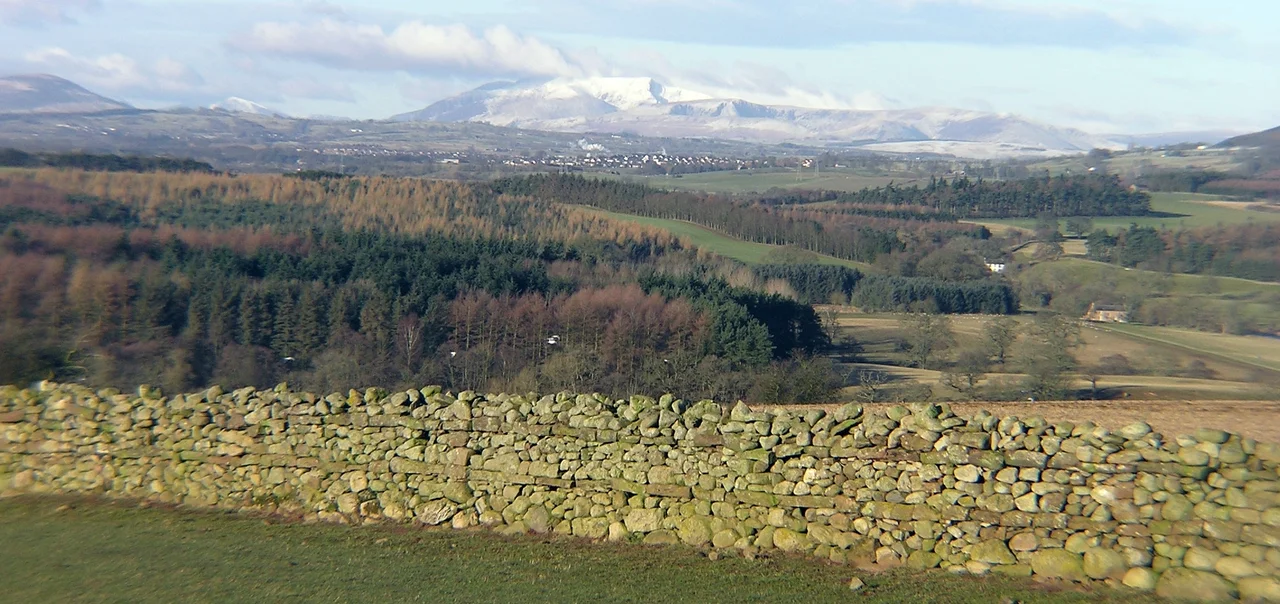
The town has grown into a market town of about 17,000 people, with shops along Middlegate, Devonshire Street and the Market Square, and the great outdoor market that still takes place every Saturday beside the M6 at Junction 40. Penrith is on the West Coast Main Line, with Avanti West Coast trains running through to London Euston and Glasgow Central, and TransPennine Express services to Manchester Airport. Industries are mostly agricultural and tourism-related. Cranstons butchers, For Farmers animal feed, and Fylde Guitars, the renowned handmade guitar maker founded by Roger Bucknall in 1973, all operate here. The town's Mayday Carnival, Winter Droving festival in late October with its torch-lit procession, and the Penrith Agricultural Show first held in 1834 anchor a year of community events. Beacon Hill still rises north-east of town, its bonfire beacon last lit in 1804 against the threat of Napoleonic invasion. From its summit on a clear day you can see most of the Eden Valley, the North Pennines, and parts of the northern Lake District, the sweep of country that Penrith has always sat at the centre of.
From the Air
Located at 54.6661°N, 2.7559°W in the Eden Valley, about 3 miles outside the eastern boundary of the Lake District National Park and 17 miles south of Carlisle. The town sits between the Rivers Petteril and Eamont, just north of the River Lowther, with Beacon Hill rising to the north-east. The West Coast Main Line, M6 motorway, A66 east-west trunk road and A6 all converge here. Nearest airports: Carlisle (EGNC) about 16 nm north-west, Newcastle (EGNT) about 53 nm north-east. Best viewed from 2,500-4,000 ft AGL to see the red sandstone town in its Eden Valley setting, with the Lake District fells to the west and Cross Fell on the Pennine skyline to the east.
Nearby Stories
- Yorkshire Dales National Park 5.8 km away
- Honister Pass 7.8 km away
- Bowes Castle 9.4 km away
- Levens Hall 11 km away
- Black Combe 13 km away
- Hexham 14 km away
- Kirtlebridge Rail Crash 23 km away