
Kirtlebridge Rail Crash
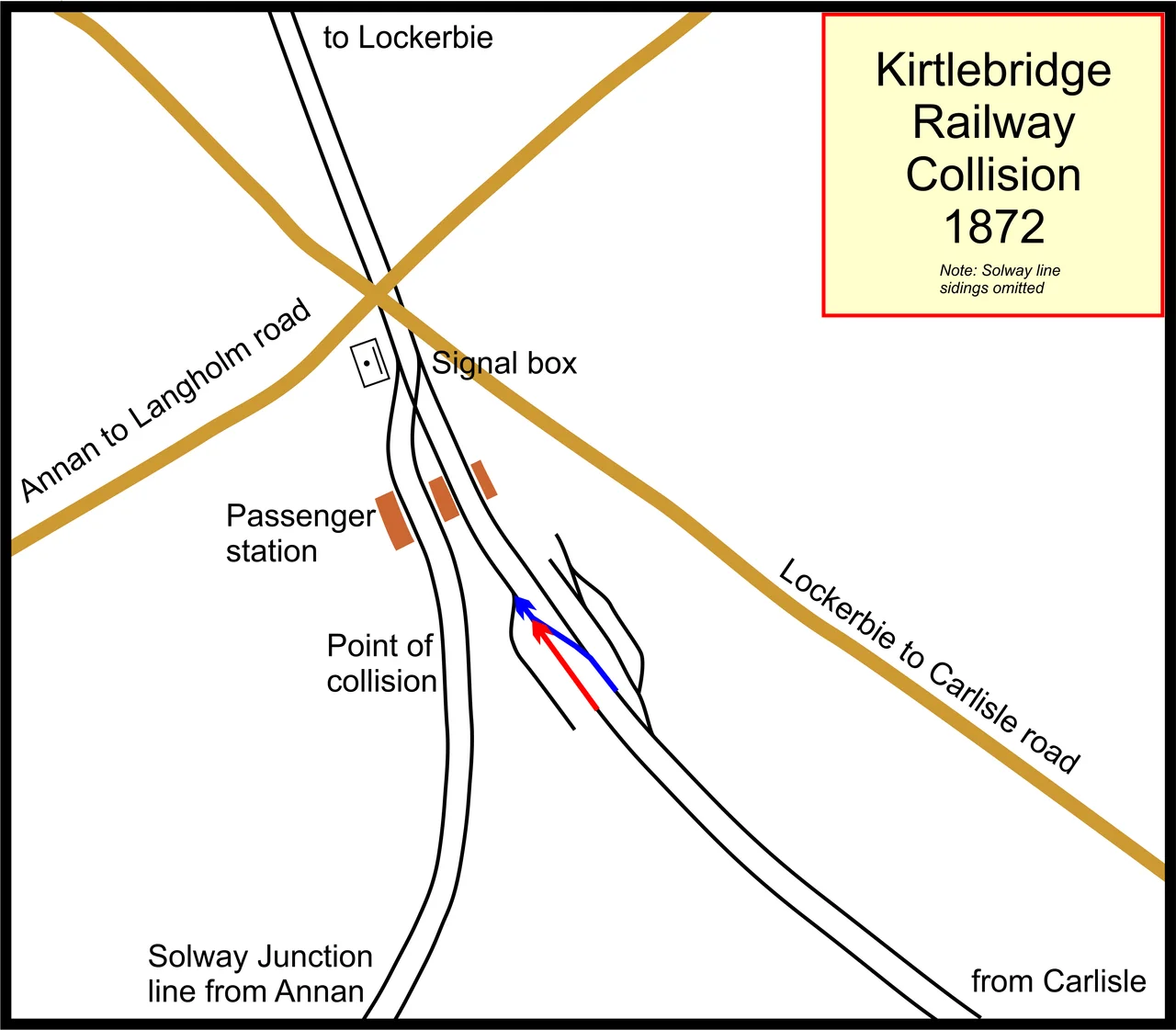
On the morning of 2 October 1872, the men working Kirtlebridge station in Dumfriesshire were running late. The northbound goods train from Carlisle had arrived behind schedule, the sidings were cramped, and the only way to make space for an awkward cut of wagons was to push them out onto the up line and back through a crossover. It was an ordinary, fiddly piece of shunting. The signalman in the box at the north end of the station did not have a clear view of what was happening at the points south of the platforms. The block telegraph that would have let him refuse the next train was simply not installed on the main line. As the wagons were still being propelled across the down rails, a Glasgow-bound express - running its journey in the ordinary way, distant signal cleared - came round the right-hand curve at forty miles an hour and could not stop. The fireman shouted; the leading engine ploughed into the side of the train ahead.
The Engine Driver and Ten Passengers
Eleven people died at the lineside that morning. One more, terribly injured, lingered and died after Major-General Henry Tyler of the Railway Inspectorate filed his report. Twelve in total. Among the dead was the driver of the express, killed at his regulator in the seconds after his fireman thought he managed to call out 'Pull up!' The rest were ordinary travellers - men, women and possibly children riding the early down train from Carlisle towards Glasgow and Edinburgh, names that have largely slipped out of public memory but each of them a passenger who had bought a ticket that morning expecting to arrive somewhere by lunchtime. Many of those who did not die instantly died within an hour, as Tyler put it grimly, 'or on their being taken out of the debris.' A doctor and a nurse happened to be on the train and worked over the injured in the wreckage; a large staff of medical men was telegraphed for from the surrounding towns.
Telescoped Coaches
The mechanical horror of the crash was as much about the trains as the impact. The leading engine of the express came to rest across the up line, slewed round so that it pointed back the way it had come. Its tender mounted the platform; the second engine settled in its proper alignment as if nothing had happened to it. But the wooden coaches behind, pushed by the weight of the train and meeting the unyielding mass of the locomotive, telescoped - one carriage driving into the next like a closing spyglass, splintering panels and pinning passengers in a tangle of timber and ironwork. The Times demanded that the railway companies finally fit proper buffers and couplings strong enough to resist that kind of compression. It would take many more deaths, at Kirtlebridge and elsewhere, before they did.
The Signals That Were Not There
The cause was almost embarrassingly simple. The points and crossover at the south end of the station were operated by ground levers, not interlocked with the home signal. So the home signal could read clear even when the main line was blocked. The block telegraph - the system that lets one signal box know whether the next section ahead is occupied - was in use on the small Solway Junction branch that came into the station from the north, but had not been extended to the main line. The signalman could not warn other boxes. He could not even see what the shunters were doing. The Board of Trade's Railway Inspectorate had been pressing the companies to fit both interlocking and the block system for years. Tyler's report on Kirtlebridge repeated the demand. Within a few years it would become law. The station master, Corrie, was arrested and charged with culpable homicide and bailed within weeks; the inspector of permanent way, Gilmour, became wanted by the police for an unrelated murder allegedly committed at Shotts the day before the crash - a strange, sad coda to a strange, sad morning.
A Quiet Place Today
Kirtlebridge station closed to passengers in 1960 and the buildings are gone. The crash site lies in flat farmland a few miles south of Lockerbie, very close to where the A74(M) now crosses the West Coast Main Line. Express trains still streak past at well over a hundred miles an hour - bound, as that 1872 express was bound, for Glasgow and Edinburgh - but they run under continuous track circuiting, AWS, TPWS, modern signalling, and interlocking so thorough it would have seemed miraculous to the men working with ground levers and clear-eye-and-good-luck on the morning of the disaster. The twelve who died at Kirtlebridge are the reason a great deal of that miracle exists.
From the Air
The crash site sits at 55.05 degrees north, 3.21 degrees west, on the West Coast Main Line about 17 miles north of Carlisle and immediately east of where the A74(M) crosses the railway. From altitude the four-track motorway and parallel railway form unmistakable arrow-straight markers running south-east to north-west across the flat green Dumfriesshire farmland. Carlisle Lake District Airport (EGNC) lies about 20 nautical miles south; Glasgow Prestwick (EGPK) is roughly 55 nm north-west, Edinburgh (EGPH) about 65 nm north-east. Spring and autumn light pick out the line of the old Solway Junction branch as a slightly different green where it once curved away north toward the firth.
Nearby Stories
- Hawick 6.2 km away
- Dundrennan Abbey 6.6 km away
- Aspatria 9 km away
- Moniaive 11 km away
- RAF Spadeadam 16 km away
- Oliver Castle 16 km away
- Penrith 20 km away
- New Cumnock 20 km away