.jpg)
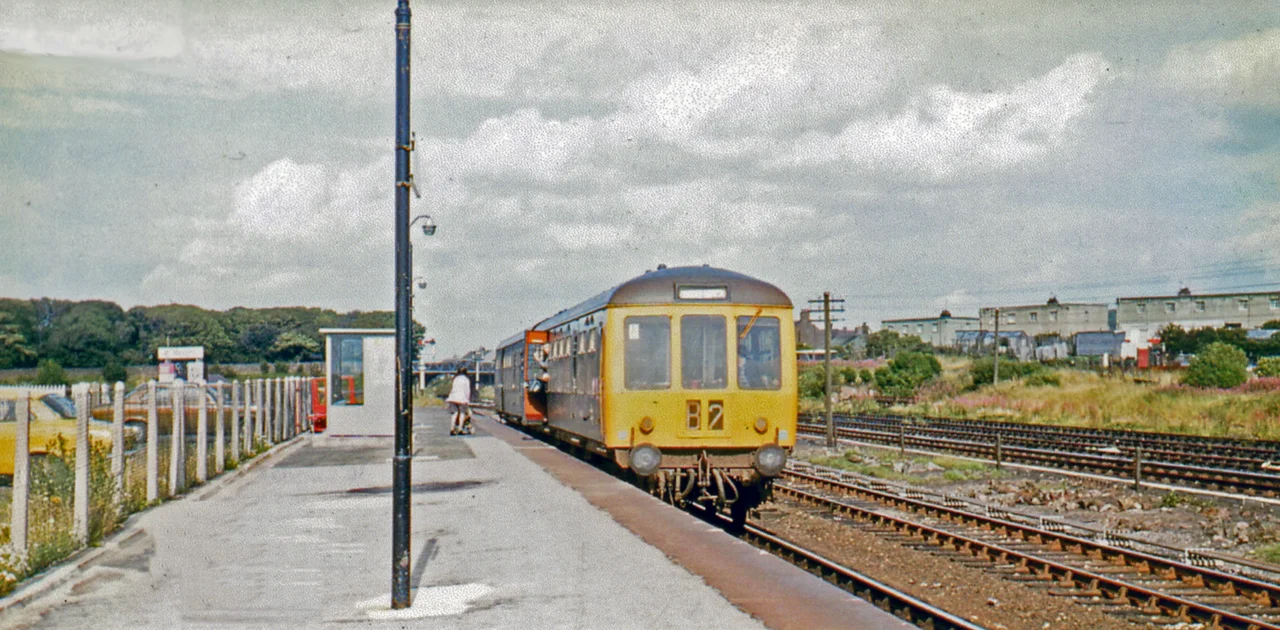
Maryport Railway Station
Most rural stations on a double-tracked line have two platforms, one for each direction. Maryport has one. To reach it, southbound trains have to cross over to the northbound line, stop, and then return to the southbound line further down the route. The arrangement causes delays whenever two trains arrive close together, and Network Rail plans to fix it in a future resignalling scheme. The quirk is a relic of railway history. Two companies served Maryport from the start: the Maryport and Carlisle Railway, which built the line northeast to Carlisle in stages between 1840 and 1845, and the Whitehaven Junction Railway, which extended south to Workington and Whitehaven in 1847. Their meeting point in the town never quite resolved into a tidy modern junction, and a hundred and eighty years of compromise still show in the layout.
Two Companies, One Town
The Maryport and Carlisle Railway was a small but independent local company. It built its line in instalments and kept its independence longer than most, surviving the great consolidations of the Victorian era and remaining its own railway until January 1923, when the grouping arrangements following the First World War folded it into the London Midland and Scottish Railway. The Whitehaven Junction Railway running south had a different fate. It was taken over in 1866 by the London and North Western Railway, a much larger company. For nearly six decades the small M&C ran into Maryport from the north, while the much larger LNWR ran into the same town from the south. The current station building dates from 1860 and replaced the original 1840 station built by the M&CR for its opening. The substantial station building once housed the old M&CR headquarters, but the whole structure was demolished in the 1970s.
An Eco-Shelter and a Closed Door
The station is now unstaffed. Passengers buy tickets on the train or from an automatic ticket machine on the platform. Step-free access is available, and train information is provided by digital screens and timetable posters. In the autumn of 2011, a new eco-friendly waiting shelter was erected on the platform at a cost of £120,000, replacing the more basic facilities that had served passengers for decades. The shelter was a small but meaningful upgrade to a station that handles a steady commuter flow but no longer sees the prestige services it once did. After the November 2009 Cumbria floods cut the line further south, an additional hourly shuttle service operated south from Maryport to Workington, free of charge, until it was terminated on 28 May 2010. The line itself has proved remarkably resilient.
An Hourly Lifeline
Northern Trains operates a generally hourly service today, northbound toward Carlisle and southbound toward Whitehaven, with most trains continuing to Barrow-in-Furness. There is no late evening service south of Whitehaven, and a few through trains operate via the Furness Line. In May 2018, Northern introduced a regular through Sunday service to Barrow, the first such service south of Whitehaven for more than forty years. Sunday services now run approximately hourly from mid-morning until early evening, with later trains terminating at Whitehaven. The change represented a major upgrade on the previous Sunday timetable of just four trains each way per day, and brought Maryport back into a fuller weekly rhythm with the rest of the Cumbrian coast.
Buses to the Smaller Places
Several bus routes stop in Maryport and provide useful connections for railway passengers. The bus stops on the A596 are only a short walk from the station. Route 60 begins in Maryport and runs northwest up the B5300 to Silloth, calling at Allonby, Mawbray, Beckfoot, and Blitterlees, giving residents of those smaller settlements their main link to a national railway. Other buses run north toward Carlisle, calling at Crosby and Aspatria. South they head to Workington via the Dunmail Park shopping centre, and east they go to Cockermouth. Between them, the routes weave Maryport's station back into the everyday life of its hinterland, where private cars and public transport still trade roles depending on the weather, the season, and the cost of fuel.
From the Air
Maryport railway station sits at 54.712 N, 3.495 W in the town of Maryport, on the Cumbrian Coast Line between Workington and Carlisle. Recommended viewing altitude is 1,500 to 3,500 feet AGL. The single platform is visible alongside the coastal railway alignment. Maryport harbour and the Solway Firth lie immediately west, with the Roman fort at Alauna on the hill to the north. The Lake District fells, including Skiddaw at 931 metres, rise to the southeast. The nearest airport is Carlisle Lake District (EGNC). The line follows the coast in both directions and is visible as a continuous feature linking Workington, Maryport, Aspatria, and Wigton to Carlisle.
Nearby Stories
- Wast Water 6.4 km away
- Ecclefechan 6.7 km away
- Dundrennan Abbey 7.7 km away
- Penrith 11 km away
- RAF Spadeadam 13 km away
- Kenmure Castle 18 km away
- Kendal 19 km away
- Ramsey Bay 32 km away