
Maryport
Humphrey Senhouse wanted a port, and he wanted his wife to know he loved her. So in 1749, with an Act of Parliament in hand and the muddy mouth of the River Ellen at his feet, he swept aside the old village name of Ellenfoot and christened the place after Mary, his wife. Maryport began life as a love letter written in stone, timber, and shipping receipts. Two centuries later, its Georgian terraces still climb the hill above the harbour, watching the Solway Firth pull tides in and out the way it always has - the way it did, in fact, when Roman auxiliaries marched these same fields nearly two thousand years ago.
The Western Anchor of an Empire
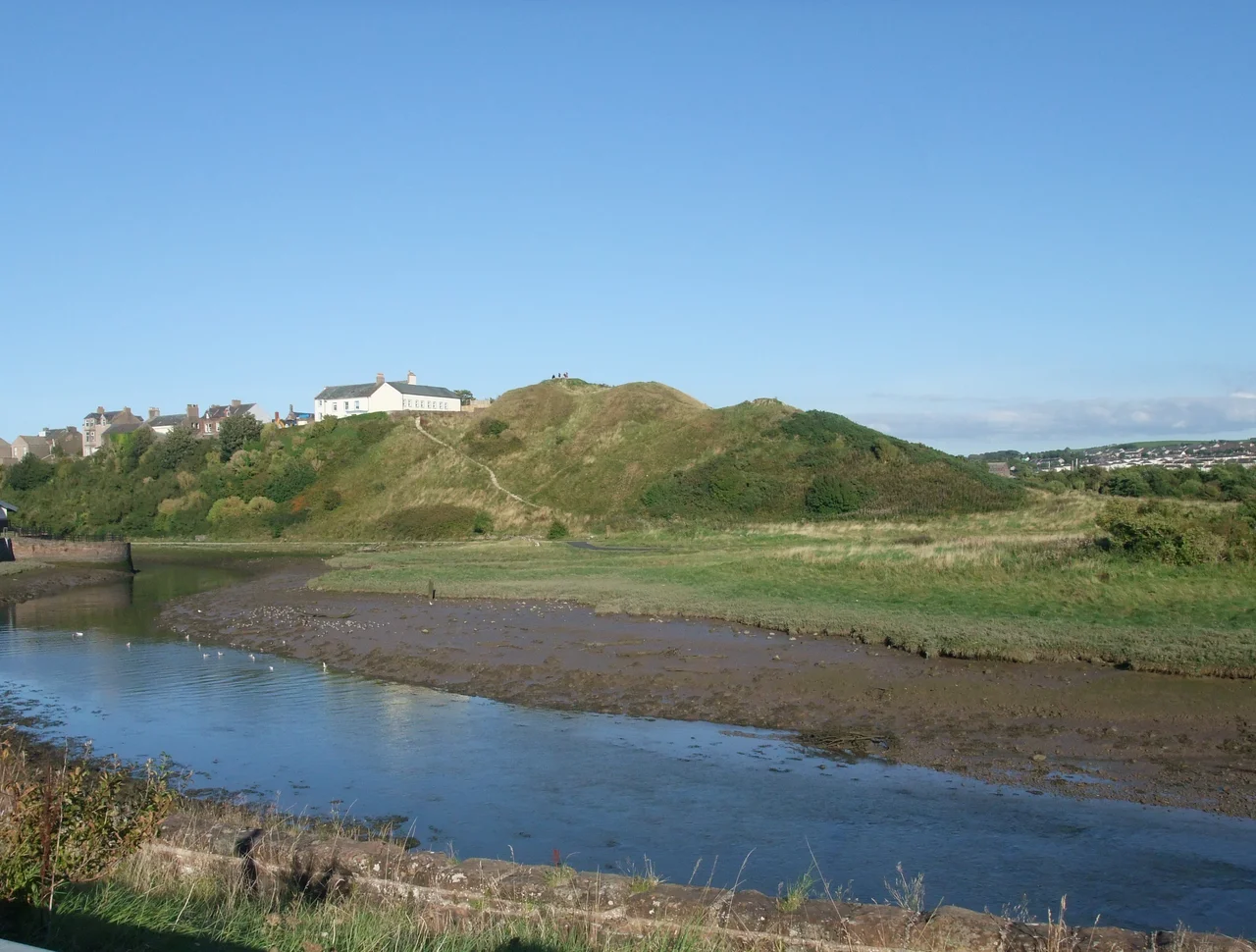
Long before Mary Senhouse, the Romans were here. Around 122 AD they built a fort they called Alauna on the bluff above the Ellen, anchoring the western end of Hadrian's coastal defences. The wall itself ended at Bowness-on-Solway, but the Romans understood that a determined raider could simply wade across the Firth at low tide. So they extended their watch down the Cumbrian coast in a chain of forts and milefortlets, and Alauna sat at the southern end of that chain - last in the line, first to see anything coming from the sea. Today the earthworks survive as low green ramparts in a sheep field. Beside them, the Senhouse Roman Museum holds one of Britain's most remarkable collections of Roman altar stones, dozens of them, each carved with a dedication to Jupiter Optimus Maximus. They were buried in pits near the parade ground, one fresh altar erected every year - a soldier's ritual, repeated and forgotten and now recovered.
Coal, Coke, and a Broadside Launch
Through the 19th century, Maryport ran on coal. The Maryport and Carlisle Railway, engineered by George Stephenson, opened in the 1840s and made it cheap to haul black rock from the Aspatria pits down to the docks. In 1846 the port shipped 213,152 tons of coal. By 1857, more than 340,000 tons. Shipyards multiplied along the river - Wood's yard, Ritson's yard - and Ritson's became famous for a quirk of geography: the Ellen was too narrow for ships to slip stern-first into the water, so Ritson's launched them broadside instead, sending entire hulls toppling sideways into the river in a single dramatic crash. It worked. Maryport-built ships sailed worldwide. One townborn boy, Thomas Henry Ismay, went on to found the White Star Line - the company that would later build the Titanic.
The Crash, and Forty Years of Silence
The collapse came suddenly. In 1927 a new deep-water dock opened at Workington, six miles south, and the Workington Iron and Steel works moved their imports there overnight. The Solway Blast Furnaces shut. By 1933 more than 57 percent of Maryport's insured workforce was out of work - 1,684 men with nothing to do and no prospect of work. The town, in the bleak official phrase, was "living on public funds." In 1936 twenty unemployed Maryport men set off on foot to join the Jarrow Crusade, the famous march to London demanding work. Two more joined from Cleator Moor and two from Frizington. The Maryport Marchers walked because there was nothing else to do. The last deep pit at Risehow closed in 1966, and the docks themselves closed to cargo in the 1960s. Maryport had been one of Britain's busiest coal ports. Then it was a memory.
Honest Reckoning
The Senhouse family who built Maryport were also slave-owners. William Senhouse, son of the town's founder, was appointed Surveyor General of Customs in Barbados in 1770 and bought a sugar plantation there. His brother Joseph ran a coffee plantation in Dominica. The wealth that paved Maryport's Georgian streets and dug its harbour was inseparable from the labour of enslaved people working thousands of miles away, in conditions chosen for them by men they would never meet. That story is part of Maryport too - present in the family papers, in the ledgers, in the names on the deeds - and the town's recent historical work has not shied away from it.
Blues, Lighthouses, and Mutineers
Today Maryport leans into its quieter pleasures. The old lighthouse, built in 1846 and Grade II listed, was restored and repainted in 2017 as part of a seaside-towns refurbishment initiative. A yacht marina has replaced the cargo berths. Every summer the Maryport Blues Festival brings names like Jools Holland, Van Morrison, and Buddy Guy to a stage at the edge of the Solway. The town's strangest claim to fame lies in its local connections: Fletcher Christian, the man who led the mutiny on HMS Bounty, was born at Eaglesfield near Cockermouth but grew up with family ties to this coast — the Christians held Ewanrigg Hall on the outskirts of Maryport. So was William Harrison, the first captain of Brunel's SS Great Eastern. For a town of fewer than 11,000 people, Maryport has put a remarkable number of ships - and stories - to sea.
From the Air
Maryport sits at 54.71 degrees north, 3.49 degrees west on the Solway Firth coast. From cruising altitude, look for the small lighthouse at the harbour mouth, Georgian street grid climbing the hillside, and the rectangular Roman fort earthworks on the bluff just north of town. Nearest airfields: Carlisle Lake District (EGNC) 24 nm north-east, Newcastle (EGNT) approximately 75 nm east. 2,500-4,000 feet provides good coastal views east toward the Lake District fells. The Solway weather changes quickly - clear mornings often shift to low cloud and rain by afternoon.
Nearby Stories
- Wast Water 6.4 km away
- Ecclefechan 6.7 km away
- Dundrennan Abbey 7.7 km away
- Penrith 11 km away
- RAF Spadeadam 13 km away
- Kenmure Castle 18 km away
- Kendal 19 km away
- Ramsey Bay 32 km away