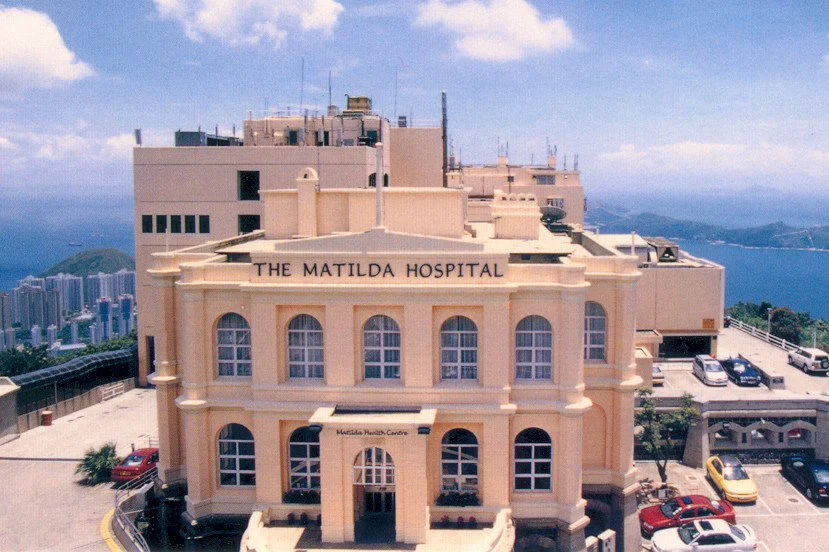

Matilda International Hospital
Granville Sharp was a banker, not a poet, but when he died in 1899 he left behind something more lasting than a fortune. His will directed that a hospital be built in memory of his wife, Matilda Lincolne Sharp, who had come with him to Hong Kong in 1858 and died there in 1893. The bequest asked that it be dedicated, simply, to her kind and caring ways. When Matilda Hospital opened on The Peak in 1907, it offered medical care free of charge to the poor — a granite-and-red-brick building designed to resemble a royal hunting lodge, perched above the city's harbor fog.
A Banker's Bequest
The Sharp family came from Romsey in Hampshire, England, one of those well-established county families that moved through the British Empire's commercial networks during the Victorian era. Granville Sharp arrived in Hong Kong as a banker and stayed. His wife Matilda died six years before him, and by the time his own death came in 1899, the bequest was ready: a hospital in her name, for the people of Hong Kong. Construction took nearly a decade, and in 1907 the first patients walked through its doors. The institution admitted them without charge, extending the kind of care Granville believed Matilda would have wanted. In those early years, the hospital served the poor and vulnerable of a colonial city still finding its shape.
A Lodge Above the Clouds
The building Sharp's will funded was no ordinary hospital block. Its architects designed a two-storey structure of granite and red brick intended to resemble a commodious royal hunting lodge — broad, solid, and set into the green slopes of Victoria Peak at roughly 380 meters above sea level. The maternity department followed eight years later, receiving its first babies in 1915. The Peak location brought its own character: cooler air, mist that rolled in from the South China Sea, views down through the urban density to the harbor. It also brought vulnerability. During World War II the main building sustained partial damage. It survived, and it was repaired. The original structure remains in use today, recognized by Hong Kong's Antiquities Advisory Board as a Grade II Historic Building. Three other structures on the 1.40-hectare campus — the old maternity block, Sharp House, and Granville House — carry Grade III historic status.
War, Merger, and a New Name
The hospital's middle decades were turbulent. Matilda served as a military hospital toward the end of the 1940s, a role that reflected both its physical capacity and its elevated, defensible location. In 1951, the institution merged with War Memorial Nursing Home and reopened under the statutory name Matilda Memorial & War Hospital. Over the following decades that long official name gradually gave way to the one in use today: Matilda International Hospital. The shift in name tracked a shift in identity — from a colonial institution shaped by a single bequest to a private, not-for-profit hospital without religious, commercial, or academic affiliation, serving patients from across Hong Kong and the wider region.
Care Across Borders
Contemporary Matilda operates well beyond the walls of its Peak campus. An in-town medical centre in Central handles health checks, antenatal care, specialist consultations, and minor procedures for patients who need proximity to the city's business core. The hospital's specialties include orthopaedics and spine surgery, women's health and maternity, general surgery, and ear, nose and throat services. In 2010, Matilda became fully accredited by the Australian Council on Healthcare Standards. Thirteen years later, in 2023, it became the first hospital anywhere in the world to receive ACHS accreditation with Outstanding Achievement — a designation that reflects the depth of its clinical systems and patient care quality. The Matilda Children's Foundation, an affiliated charitable organisation, funds and arranges life-saving surgery for children in need across Asia, continuing the spirit of the original bequest in a contemporary form.
High Above the Harbour
There is something quietly remarkable about the fact that this hospital has stood on The Peak for more than a century, its granite walls absorbing the weather rolling in off the South China Sea, its maternity ward welcoming babies as the city below transformed from colonial port to global financial center. The building Sharp built as a monument to his wife's kindness became an institution with a life of its own — caring for patients who likely know nothing of Matilda Lincolne Sharp, the woman from Hampshire who died in 1893 and gave the place its name. Her husband's grief became something practical and lasting: granite, red brick, and a hospital that still opens its doors.
From the Air
Matilda International Hospital sits on the slopes of Victoria Peak (The Peak) on Hong Kong Island at approximately 22.2597°N, 114.1490°E, around 380 meters above sea level. Approaching from the north over Victoria Harbour, the Peak massif is visible as the dominant high ground on Hong Kong Island. The nearest major airport is Hong Kong International Airport (VHHH), located on Lantau Island approximately 25 km to the west. At low altitude the distinctive granite-and-red-brick building complex is visible on the upper slopes of the Peak, just below the summit tram terminus. Recommend 2,500 feet or above when transiting the area; Victoria Peak tops out at 552 meters.
Nearby Stories
- Lok Ma Chau Loop 2.3 km away
- Portas do Cerco 2.3 km away
- Kweilin Incident 17 km away
- Wanshan Archipelago Campaign 34 km away
- Nanxiong Formation 115 km away
- Battle of Nanpeng Island 148 km away
- Heyuan 169 km away
- Cape Maobitou 632 km away