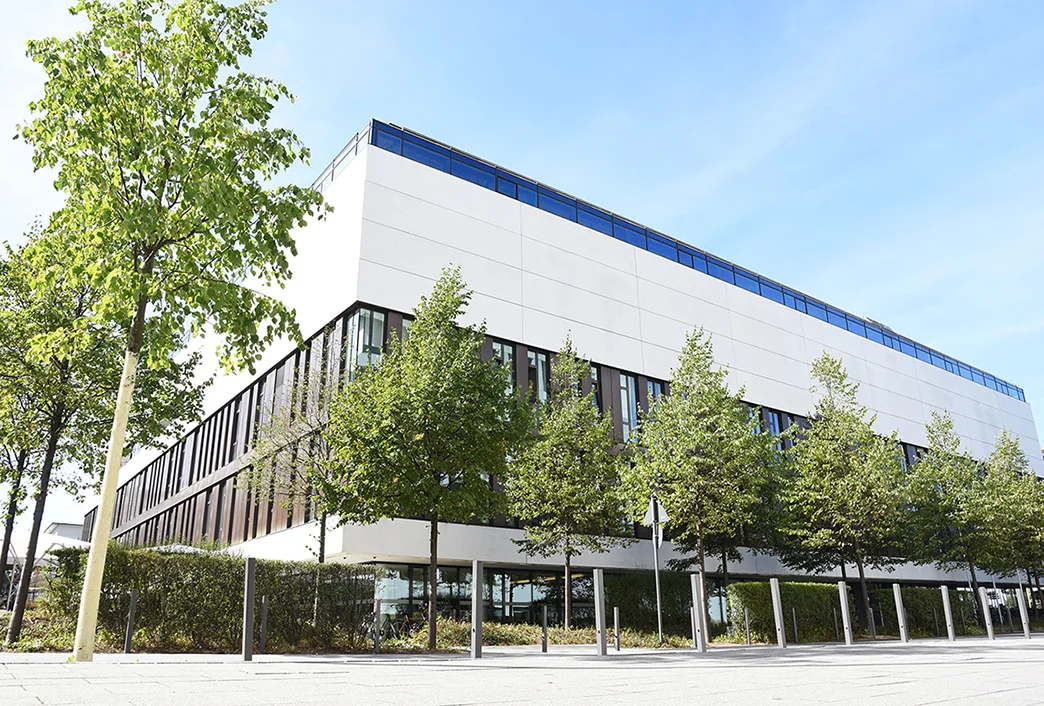

Max Planck Institute for Biology of Ageing
The roundworm Caenorhabditis elegans lives, on average, about two weeks. The fruit fly Drosophila melanogaster gets roughly 50 days. The African turquoise killifish — the shortest-lived vertebrate ever kept in a laboratory — burns through its entire existence in four to six months. On the western edge of Cologne, on the campus of the city's university hospital, researchers at the Max Planck Institute for Biology of Ageing work with all four of these organisms because their lives are short enough to watch from end to end. The hope is that what they learn from a worm or a fish will eventually help a human being get older without falling apart. That is the entire point of the building.
A Young Institute for an Old Question
The Max Planck Institute for Biology of Ageing was founded in 2008, making it one of the youngest of the more than 80 institutes that operate under the Max Planck Society. The foundation stone of its permanent research building was laid in 2010, and the doors opened in 2013. Three founding directors set the original research agenda: Adam Antebi from the United States, Nils-Göran Larsson from Sweden, and Linda Partridge from the United Kingdom. Thomas Langer joined as the fourth director in 2018, Anne Schaefer was appointed in 2021, and Linda Partridge retired in 2023, leaving behind a department she had shaped for fifteen years. The plan is for the institute to grow to a staff of about 350, with at least ten research groups and a fourth department still to come.
Why Worms and Yeast
Studying aging in humans is almost impossibly slow. A scientist who started a longitudinal study on the day they were born would still be running it on the day they died, and even then would have observed only one life. So the institute relies on model organisms: the mouse Mus musculus, the fruit fly Drosophila, the roundworm C. elegans, the African killifish Nothobranchius furzeri, and the yeast Saccharomyces cerevisiae. Each one offers something different. The mouse shares vast stretches of biology with us. The fly's nervous system is small enough to map in detail. The worm has only about a thousand cells and a fully sequenced genome. The killifish is a vertebrate that has compressed its entire lifespan into a single rainy season in a Mozambican puddle. The yeast multiplies overnight. Together they let the institute run experiments that would take generations in a human population in a matter of weeks.
A Cluster, Not an Island
The MPI for Biology of Ageing does not stand alone. It is the central anchor of a regional Life Science Cluster that links it to the Max Planck Institute for Metabolism Research next door, the Cluster of Excellence CECAD at the University of Cologne, and partner institutes in Bonn including the German Center for Neurodegenerative Diseases and the Max Planck Institute for Neurobiology of Behavior. Researchers move ideas and samples across these institutions the way a cathedral builder moves stone. The institute also runs the Cologne Graduate School of Ageing Research, founded in 2013, where doctoral candidates from around the world spend four years on a structured programme that ends with a degree from the University of Cologne. A Master Fellowship programme, added in 2019, brings in up to five exceptional Master's students each year.
What Comes Back to Patients
All this attention to flies and worms eventually has to circle back to people, and it does. The institute studies tissue samples from patients seen in the adjacent hospital, and it conducts research with long-lived families — the great-great-grandchildren of people who somehow reached 100 or beyond, looking for what their genomes might be doing differently. Research groups within the institute work on the mechanisms of DNA repair, on how cells age, on the role of mitochondria, on the surprising influence of immune cells in the aging brain. Some former group leaders have left to take up positions at Cornell, at Newcastle, and at Altos Labs — the company in California trying to translate aging biology into therapies. The line between fundamental science in Cologne and the wider hunt for a healthier old age has never been shorter than it is now.
From the Air
The institute sits on the University Hospital campus in the Lindenthal district of western Cologne, at roughly 50.926°N, 6.917°E. From above it appears as a compact modern research building amid the larger hospital complex, about 4 km west of the cathedral. The green corridor of the Stadtwald forest is the most obvious landmark immediately north. Nearest airport is Cologne Bonn (EDDK / CGN), 18 km to the southeast.
Nearby Stories
- Diamond Interchange: How a Simple Idea Reshapes Towns Like Julich 2.8 km away
- Dusseldorf-Unterbach 6.1 km away
- Baumwollspinnerei Ermen & Engels 11 km away
- RAF Bruggen 15 km away
- Hagen Open-air Museum 21 km away
- Belgium 130 km away
- Marcinelle Mining Disaster 173 km away
- Zwingenberg Castle 178 km away