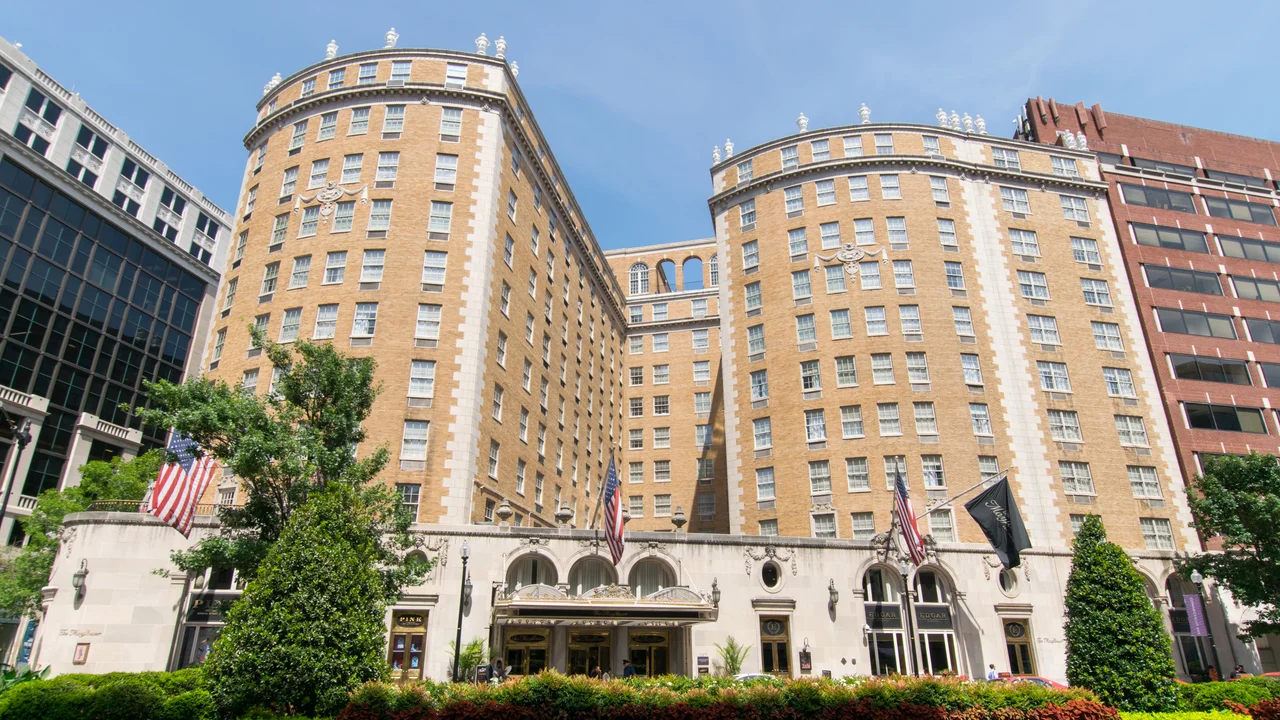

Mayflower Hotel
On June 19, 1942, German saboteur George John Dasch checked into Room 351 at the Mayflower Hotel and called the FBI. Two days earlier, a Nazi submarine had landed him on a Long Island beach with three other agents - Operation Pastorius, an effort to disrupt American war production through coordinated sabotage. Dasch had encountered a Coast Guardsman almost immediately on the beach, given him a bribe to go away, and decided the mission was finished. He took a train to Washington, walked into the Mayflower, and informed his comrades he was turning them all in. The hotel where one of the most cinematic counter-espionage acts of the Second World War unfolded had been, by then, less than twenty years old. It had also already hosted every presidential inaugural ball from Calvin Coolidge forward. The list of consequential nights at the Mayflower was already long. It would only grow.
Allan Walker's Convent
The block on DeSales Street between 17th and Connecticut Avenue had been the site of the Convent of the Visitation - a religious order that had owned the land since buying it for $50,000 in 1867. The nuns sold to developer Allan E. Walker in 1922. Walker, who had already built the Brookland neighborhood and several other Washington residential districts, planned an eleven-story, 1,100-room luxury hotel that would cost $6.2 million. He called it the Walker Hotel. The architects were Robert F. Beresford of Washington and the New York firm Warren and Wetmore, who had designed Grand Central Terminal. Indiana limestone clad the first three floors; rusticated brick and terra cotta covered the upper levels. The lobby received light from a coffered skylight and was anchored by four hand-wrought bronze torchères trimmed with gold. The hotel boasted more gold leaf than any building in Washington except the Library of Congress. The elevators had bronze doors embossed with images of the Pilgrim ship Mayflower. Before opening, the property was renamed in honor of those doors, and Allan Walker quietly disappeared from the masthead.
Calvin Coolidge's Ball
The Mayflower opened in February 1925, two weeks before Calvin Coolidge's second inauguration. The hotel hosted the inaugural ball that March 4. It would host the inaugural ball at every presidential inauguration through Ronald Reagan's in January 1981 - the last inaugural ball it has ever hosted. President-elect Herbert Hoover ran his pre-inauguration planning team out of Mayflower rooms in January 1928. Vice President Charles Curtis lived in one of the hotel's residential suites for his entire four-year term. President-elect Franklin Roosevelt spent the nights of March 2 and 3, 1933 - the eve of his first inauguration - in Suites 776 and 781. Earlier, in March 1931, Roosevelt's chief rival Al Smith had been undone at the Mayflower when DNC chairman John J. Raskob tried to force a wet plank into the platform that offended enough Southern dry Democrats to swing them to Roosevelt. The Grand Ballroom and the smaller halls have been the working machinery of American political nominations for a century.
The GI Bill in Room 570
Eighteen months after Dasch's defection in Room 351, a committee of the American Legion gathered in Room 570 from December 15 to 31, 1943. Their task was to draft legislation that would help returning servicemembers - many of whom had been the same age as the average Marine on Guadalcanal - reintegrate into American civilian life. Attorney Harry W. Colmery, a past national commander of the Legion, took the final pen and wrote the bill out by hand on Mayflower Hotel stationery. The proposed law was the Servicemen's Readjustment Act of 1944, soon known universally as the GI Bill. It would put millions of veterans through college, finance millions of homes, and reshape the American middle class. The text was handwritten in a hotel room. The stationery survives in Legion archives.
Hoover's Cottage Cheese
From 1952 until his death in 1972, FBI Director J. Edgar Hoover lunched at the Mayflower's Rib Room nearly every day. His companion was Clyde Tolson, the FBI's associate director. Hoover's order never varied: chicken soup, followed by a salad of iceberg lettuce, grapefruit, and cottage cheese, with buttered white toast on the side. He brought his own diet salad dressing. The staff knew to set him at a particular table away from the windows. When reporters appeared in the dining room, Hoover would slip out through the kitchen. The pattern held for twenty years. The hotel's bar - the Town and Country Lounge, which opened in 1948 - kept its own roster of regulars. In 2008, presidential hopeful Barack Obama was introduced to Hillary Clinton's leading donors at a Mayflower meeting on June 26, two weeks after he had clinched the Democratic nomination. The Mayflower has launched campaigns and ended them. Sargent Shriver announced his 1976 presidential run from the same property. Harry Truman told a 1948 Young Democrats dinner that he intended to seek a full term - and won.
Eliot Spitzer's Alias
On the night of February 13, 2008, New York Governor Eliot Spitzer checked into Room 871 under the name George Fox. He was reportedly paying $1,000 an hour for an escort from a service called Emperors Club VIP. The New York Times broke the story on March 10. Spitzer resigned the governorship two days later. The Mayflower had appeared in scandal coverage before - Judith Exner had claimed to meet John F. Kennedy at the hotel during his presidency, and Monica Lewinsky had been photographed with Bill Clinton at a Mayflower campaign event in 1996. The pattern repeats often enough that the hotel's name has become a kind of shorthand. The building has also weathered five bankruptcies, a near-demolition in the 1970s when investor William Cohen wanted to tear it down for a 20-story office tower, and a continuous chain of ownership changes that have run through Hilton, Stouffer, Nestlé, Hong Kong-based New World Development, and Marriott. Its current operator is Autograph Collection Hotels, a Marriott boutique division. The hotel sits two blocks north of Farragut Square, one block from the Farragut North Metro station, and still calls itself the Hotel of Presidents. The torchères in the lobby are still trimmed with gold.
From the Air
The Mayflower Hotel sits at 38.9044 N, 77.0399 W, on Connecticut Avenue NW between L Street and DeSales Street in downtown Washington. Best viewed from 1,500 to 2,500 feet AGL. The Indiana limestone facade reads as a distinct rectangular block within the downtown grid. The White House lies five blocks south; Farragut Square sits two blocks south of the hotel. Reagan National (KDCA) is four nautical miles south. The site sits inside the Washington Flight Restricted Zone; GA overflight prohibited. Aerial views require approved operations or vantage from beyond the FRZ.
Nearby Stories
- Gunston Hall 1.1 km away
- 2023 Baltimore Shooting 4.9 km away
- Battle of Middleburg 6.6 km away
- Crownsville Hospital Center 10 km away
- Battle of Loudoun Heights 13 km away
- First Battle of Rappahannock Station 20 km away
- Howard County, Maryland 21 km away
- Harriet Tubman Underground Railroad 50 km away