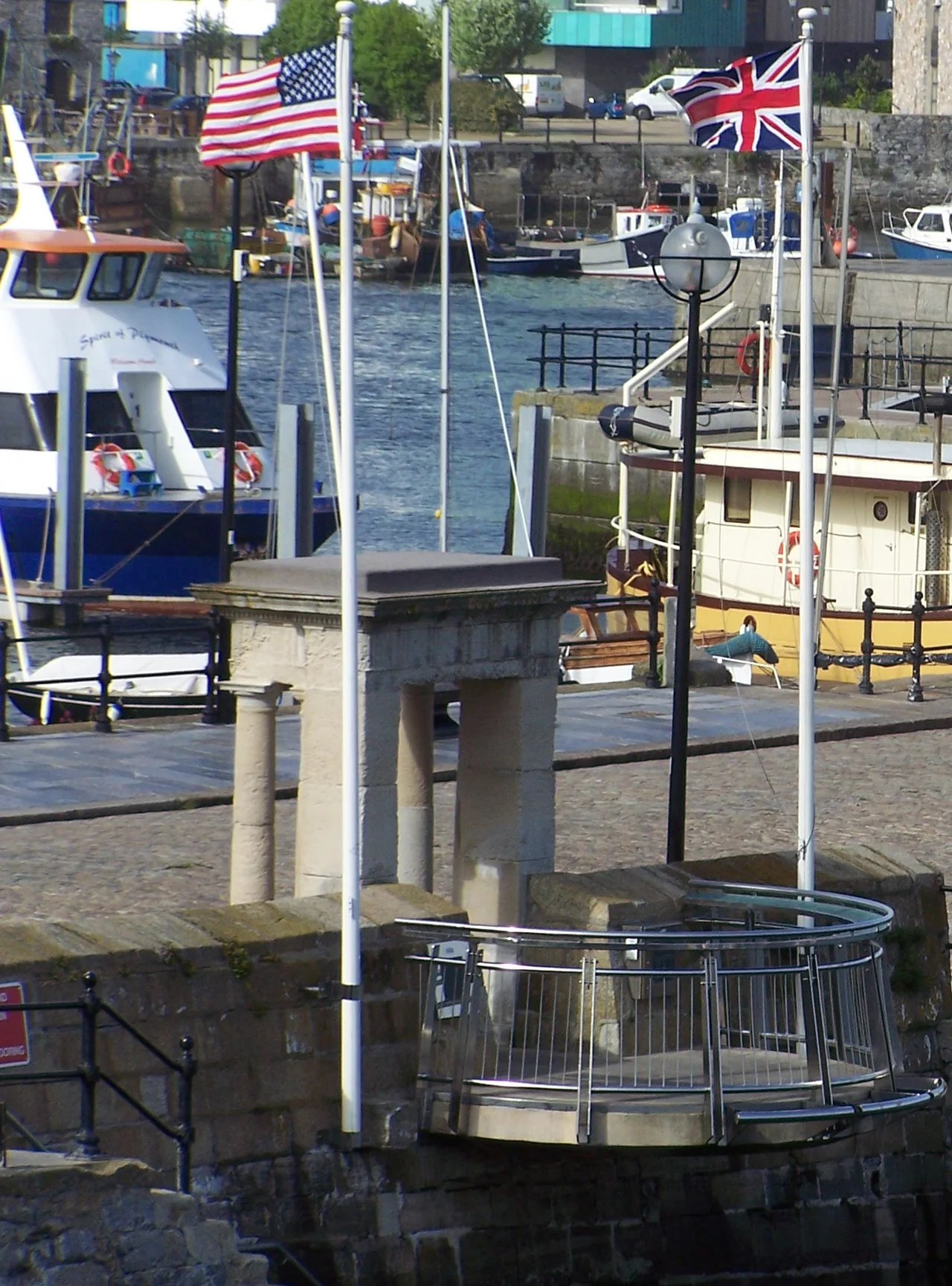

Mayflower Steps
The Mayflower did not really leave from these steps. Local historians are honest about that: the actual point of departure was probably about a hundred yards away, under what is now a Victorian pub called the Admiral MacBride. But for four centuries Plymouth has needed somewhere to commemorate the moment, and so a small commemorative portico with Doric columns of Portland stone, built in 1934, stands at the water's edge on the Barbican and marks the place where, on 6 September 1620, 102 passengers and 30 crew finally turned their backs on England.
Why Plymouth at All
The passengers had not planned to sail from Plymouth. Most of them came from East Anglia, from the separatist congregation that had spent the previous decade exiled in Leiden, and from London, where the financial backers and recruited tradesmen had joined the venture. They had left Southampton in August 1620 aboard two ships — the Mayflower and a smaller leaking vessel called the Speedwell. Twice the Speedwell forced them back to port. The second time, at Plymouth, they abandoned her, redistributed her passengers, and pressed on with one ship. The bad weather in the English Channel that drove them into Plymouth Sound was therefore not a stop on the route. It was an unplanned mercy. The Plymouth Gin Distillery on Southside Street, and the Island House on the Quay, both claim to have housed Pilgrims for the few days they sheltered there. Then the wind shifted, and they were gone.
The Crossing
The Atlantic in autumn is no place for a small wooden cargo ship. Sixty-six days of cold, of vomiting, of cramped berths, of a deckbeam splitting and being shored back with an iron screw the passengers had brought for a printing press. Two people died on the way; one baby was born and named Oceanus. The Mayflower made landfall not in the Virginia colony she had been chartered to reach but at the tip of Cape Cod on 21 November 1620, far north of her intended target. After exploring the coast for a month, the surviving Pilgrims chose a harbour the Wampanoag people called Patuxet and the English would call Plymouth, and they began to build.
The First Winter
About half the passengers and a similar fraction of the crew did not live to see spring. The Wikipedia source records the bare arithmetic; the lived reality was small one-room shelters, salt cod, scurvy, pneumonia, the New England cold that 17th-century English clothing was not made for. Of the 102 who had stepped aboard at Plymouth in September, only about 50 walked out of the first winter. Among the dead were Mary Allerton, Rose Standish, the captain's wife Dorothy May Bradford (who fell overboard before the colony was even built), and most of the children under ten. The colony survived because the survivors had no choice and because the Wampanoag, in a moment of generosity that the next half-century would not reward, decided to teach them how to plant corn.
The Patuxet Side of the Story
The land the Pilgrims chose to settle was not empty. Patuxet had been a thriving Wampanoag village until 1616-1619, when a series of epidemics — almost certainly introduced by earlier European fishing crews — killed most of its inhabitants. The Pilgrims walked into the cleared fields of the dead. Their interpreter and chief intermediary, Tisquantum (Squanto), had himself been kidnapped from Patuxet in 1614 by an English slaver named Thomas Hunt, sold in Málaga, and made his way back across the Atlantic to find his village gone. The Mayflower Compact, the founding document drawn up in Cape Cod Bay before the passengers came ashore, did not consult the Wampanoag. The peace treaty that Massasoit, sachem of the Wampanoag confederacy, negotiated with the colony in March 1621 lasted until his sons' generation. Within fifty-five years of the Mayflower's arrival, King Philip's War would end Wampanoag political independence and kill thousands. To stand on the Mayflower Steps is to stand at the start of a story that had two endings, not one.
What the Pier Holds
Today the Mayflower Steps are a small platform with a brushed-steel rail and a shelf of nautical bronze artwork explaining the history. Boat trips leave from here to circle Plymouth Sound and run up the River Tamar past HM Naval Base Devonport, where the Royal Navy's current submarine fleet is based. The Barbican around the steps is a working waterfront — narrow lanes, fish restaurants, the Plymouth Gin Distillery still in operation in its 18th-century buildings. The 1934 portico is modest. It does not try to settle the meaning of what happened here. It just marks the spot, more or less, and lets each generation of visitors bring their own reading. For some that reading is foundational: this is where America began. For others it is more complicated. Both readings stand at the rail together.
From the Air
Coordinates 50.366°N, 4.134°W mark the Mayflower Steps in the Barbican district of Plymouth, on the north shore of Plymouth Sound. The portico is best identified by its position immediately east of the Royal Citadel. Nearest airport: Exeter (EGTE) approximately 38 nm northeast; Plymouth City Airport closed to scheduled flights in 2011 and is not currently operational. Newquay Cornwall (EGHQ) is approximately 40 nm west-northwest.
Nearby Stories
- Davidstow Circuit 3.7 km away
- Golden Hind 3.9 km away
- Powderham Castle 4.4 km away
- Fowey Lifeboat Station 5.1 km away
- Okehampton Castle 12 km away
- Battle of Plymouth (1652) 19 km away
- Goonhilly Satellite Earth Station 44 km away
- German Submarine U-672 73 km away