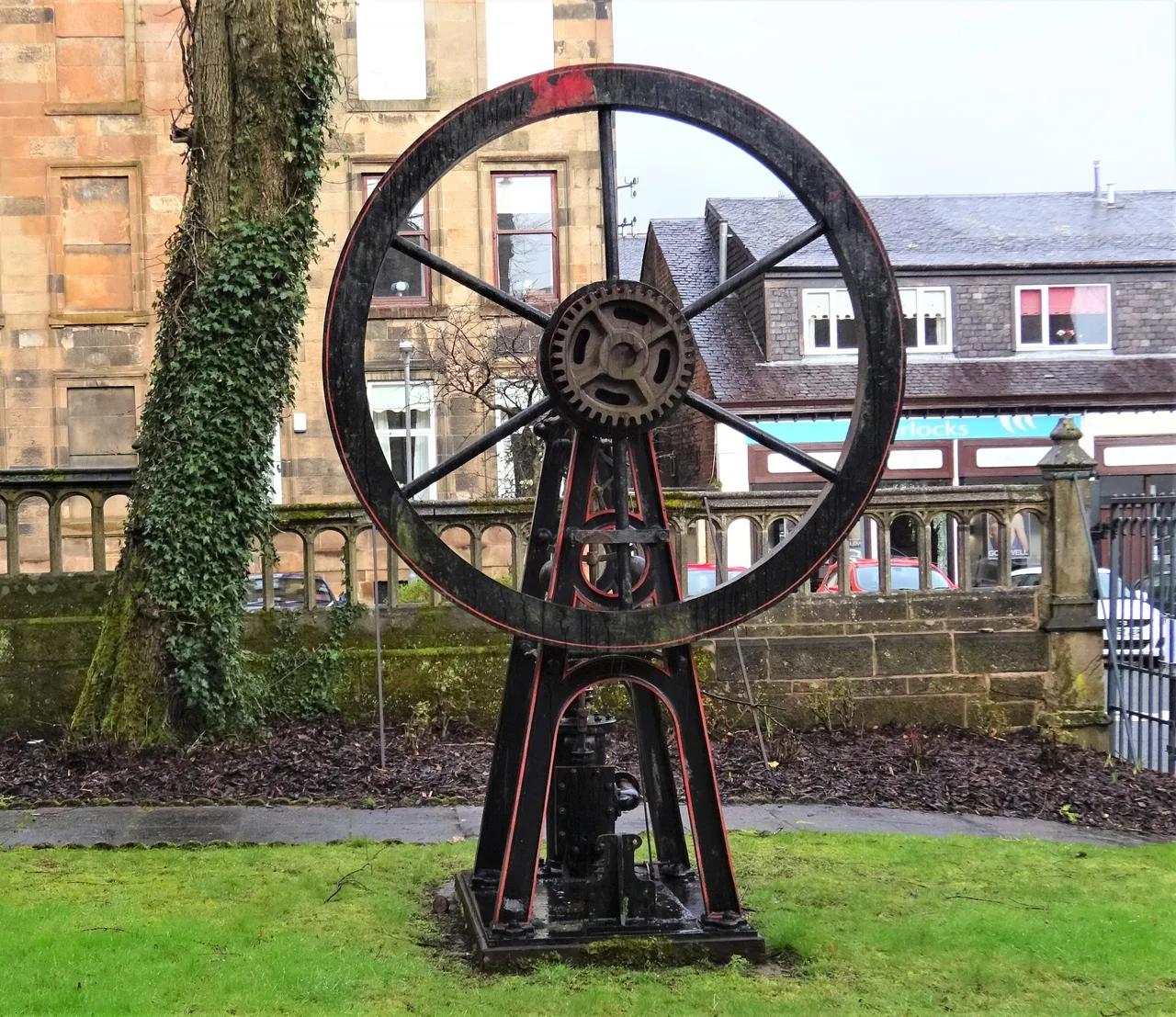

McLean Museum
The Greenock Philosophical Society began collecting curiosities — artificial and natural — in the early 19th century, and by 1816 those collections were sufficient to be called a museum, housed in the corner of the local library. The members added autographs and maps and prints and coins and medals and armour. They wrote to local ship owners and masters, asking what they might donate from voyages abroad. Sixty years later, a local timber merchant named James McLean paid for them to have a proper building of their own.
A Timber Merchant's Gift
James McLean was born in 1802 and made his money in timber, a sensible trade for a man living in a Clyde port that built ships. He was also a member of the Philosophical Society, which is presumably why, in 1863, he committed his fortune to constructing a lecture hall and museum building for the town. Work proceeded for thirteen years. The new building was finished by 3 November 1876. McLean himself was unable to attend the opening — he was already too ill — though he managed to visit beforehand and inspect the contents. He died in January of the following year. The museum carries his name, as do most of the streets around it, in the quiet Greenock fashion of acknowledging benefactors without making too much fuss about it. Thomas Struthers, a Glasgow geologist and naturalist, served as the first curator.
Mummies on the Clyde
Greenock would not be most people's first guess for a town with an Egyptology collection, but trade and donations took the museum to unexpected places. Until 1914, the McLean received a continuing flow of objects from the Egypt Exploration Society. Among the holdings are a mummy cartonnage from Herakleopolis Magna — the painted, plaster-and-linen body case used to cover a mummified person — and a temple stone from the Great Temple of Bast at Bubastis, the cat-goddess sanctuary in the eastern Nile Delta. The Egyptology gallery shares space with collections of British and Scottish art, including paintings by the Glasgow Boys and Scottish Colourists. The museum's early years saw it loan and borrow extensively from the Royal Albert Memorial Museum in Exeter and the National Gallery in London, building its reputation through cultural exchange.
James Watt's Town
The museum's most important holding, in the local sense, is its collection of objects connected with James Watt, the engineer whose improvements to the steam engine helped power the Industrial Revolution. Watt was born in Greenock in 1736, the son of a carpenter and ship's-instrument maker. The Watt collection sits at the heart of what the museum now formally calls the Watt Institution — an integrated complex that includes the art gallery, Watt Hall, Watt Library, and the Inverclyde Archives. Visitors can move from the museum entrance on Kelly Street through into the library that bears Watt's name, where the local archives hold the records of a town whose engineers and ship-owners and sugar refiners shaped the wider world.
Refurbished and Reopened
The complex closed for major refurbishment, reopening to visitors on 22 November 2019 after extensive work. As part of that £2 million renovation, the gallery, museum, lecture hall, and library were rebranded collectively as the Watt Institution, with new access between the buildings via the museum entrance on Kelly Street. Admission remains free. The complex now opens Wednesday to Saturday, ten in the morning until four in the afternoon — a reduction from its previous schedule, made for budgetary reasons rather than for lack of interest. The shop sells books and cards and museum-quality replicas. The internet access is free. Free curatorial tours run by appointment. For a free museum in a working town of forty thousand people, the McLean carries an impressive collection — a mummy, a Glasgow Boys gallery, and one of the world's most important engineers, all within ten minutes' walk of Greenock West railway station.
From the Air
The McLean Museum sits at approximately 55.95°N, 4.77°W in the Greenock West area of Greenock, on Kelly Street near the railway station. Recommended viewing altitude 2,000-3,500 ft. The building is a Category A listed Victorian structure in the town's grid west of the harbour. Nearest airport: Glasgow International (EGPF) 15 nm east. Other landmarks visible from the same approach include the Custom House on the waterfront, the Victoria Tower, and Lyle Hill with its Cross of Lorraine memorial west of town.
Nearby Stories
- Loch Sloy Hydro-Electric Scheme 1.7 km away
- Lochranza Castle 2.2 km away
- Dalgarven Mill – Museum of Ayrshire Country Life and Costume 5.6 km away
- Loch Fyne 8.9 km away
- Battle of Drumclog 10 km away
- Battle of Kilsyth 12 km away
- Battle of Lagganmore 15 km away
- Comrie 20 km away