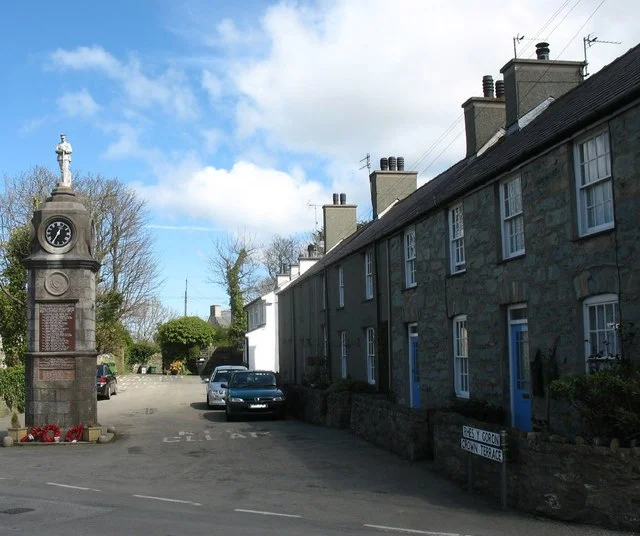

Mechell, Anglesey
Six medieval churches stand within the small north-Anglesey community of Mechell. Sixteen prehistoric sites, scheduled or otherwise, lie scattered across the same agricultural landscape - standing stones, burial mounds, hilltop enclosures, the remains of medieval mills and at least nine nineteenth-century chapels. The whole community, which takes its name from the sixth-century saint Mechell, holds 1,293 people across the dispersed villages of Llanfechell, Tregele, Llanfflewyn, Mynydd Mechell, Bodewryd, Rhosbeirio and Carreglefn. But the most consequential building in the parish through the second half of the twentieth century was none of these. The Wylfa Nuclear Power Station, on the north coast just outside the community boundary, generated electricity from 1971 to 2015 and was the sole substantial employer for several thousand people across northern Anglesey. After Trawsfynydd shut down, Wylfa was the only operating nuclear plant in Wales.
The Bones of the Land
Inland farms make up the bulk of Mechell, with a narrow strip reaching to the north coast east of Cemaes Bay through Llanbadrig community. To the east lies Cylch-y-Garn, to the south Tref Alaw and Rhosybol. The settlement pattern is dispersed - small clusters of houses around a chapel, a windmill, a row of cottages - rather than a compact village. Llanfechell is the largest. Tradition holds that Saint Mechell, a sixth-century Breton missionary, was buried somewhere in Llanfechell. The prehistoric sites attest to much earlier habitation. Pen-y-Morwydd Barrow rises on a hilltop between Llanfechell and Bodewryd. The Llanfechell Triangle Standing Stones - three Bronze Age uprights aligned north-west to south-east - stand a short walk from the village square. Cup-and-ring rock art was found on a packing stone of the Llanfechell standing stone north of the church, a kind of mark very rare in north Wales.
Mills and Methodism
Mechell's agricultural economy supported an impressive infrastructure of milling. The community once held four watermills and three windmills along the Afon Cafnan and its tributaries. Meddanen Water Mill and Melin Mechell Windmill sat close enough together that the same miller probably worked both, switching between water and wind as the weather allowed. Further south stood Pant y Gwydd windmill; to the west, along the river, Cefn Coch Water Mill and Windmill, the Pandy Cefn Coch fulling mill, and Cafnan Water Mill at the river mouth. Most are now ruins, the windmill towers sometimes converted into private houses. The chapels tell another story. Nine non-conformist meeting houses opened across the community in the nineteenth and early twentieth centuries - Calvinistic Methodist at Libanus, Independent at Ebenezer and Seion, Welsh Baptist at Calfaria, Welsh Calvinistic Methodist at Bethania and Bethlehem and Hephsibah. Most are closed now; Hephsibah Chapel at Rhosbeirio was converted into a house in 1985.
Wylfa
Wylfa Nuclear Power Station opened in 1971 on the coast 3 kilometres northwest of Llanfechell, paired with the older Trawsfynydd plant in Snowdonia as one of the two Magnox reactors in Wales. For forty-four years the twin reactor buildings dominated the north Anglesey skyline. They lifted electric output of the island to grid-scale and provided steady employment for several thousand engineers, technicians and support staff across the surrounding communities. The plant closed at the end of 2015. Decommissioning will continue for decades. Horizon Nuclear Power has proposed building 'Wylfa Newydd' - a new station on or near the existing site - though as of the most recent updates the project remains under consideration. The closure took a hard economic toll on Mechell and its neighbours. The villages remain; the farming continues; but the principal industrial employer of an otherwise quiet rural community is now a slowly decommissioning piece of infrastructure on a windswept coast.
The Diarist's Country
Of all the historical figures connected with Mechell, the most useful to historians is William Bulkeley (1691-1760), whose surviving diary covers daily Anglesey life from 1734 to 1760. He lived at Brynddu on the edge of Llanfechell. He noted weather, prices, harvest, gossip; he counted heads at chapel; he recorded who married whom. Through Bulkeley we know more about the texture of eighteenth-century life in this community than about most rural districts in Britain. The Bulkeley family - and their descendants - still hold Brynddu, now a 900-acre farming estate run by Robin Grove-White, former director of the Campaign to Protect Rural England. Plas Bodewryd, a Grade II*-listed fifteenth- or sixteenth-century hall house, sits in the parish of Bodewryd with additions in every century since. Together with the four medieval churches - St Mechell, St Fflewin, St Mary, St Peirio - the houses, mills and standing stones form a continuous human record of a small Welsh community that has stayed at roughly the same size, and roughly the same pattern, for the better part of a thousand years.
From the Air
Mechell community in the north of Anglesey, centred around 53.39 N, 4.45 W. The settlements are dispersed, with Llanfechell the largest village and others - Mynydd Mechell, Carreglefn, Bodewryd - scattered across an agricultural plateau. The Wylfa nuclear power station's distinctive twin reactor buildings on the coast 3 km northwest of Llanfechell are the most prominent navigation landmark in north Anglesey. Cemaes Bay lies on the coast immediately north-west of the community boundary. Nearest airports: Anglesey/Valley (EGOV) 11 nm west, Caernarfon (EGCK) 17 nm south-east. The land here is gently rolling, generally between 50 and 100 m elevation, with good visibility on clear days following Atlantic fronts.
Nearby Stories
- Llandudno Lifeboat Station 3.8 km away
- Glynllifon 6.1 km away
- German submarine U-1024 9.4 km away
- Irish Sea Bridge 11 km away
- Ysbyty Ifan 12 km away
- Irish Sea 18 km away
- Celtic Array 18 km away
- Birkdale Palace Hotel 56 km away