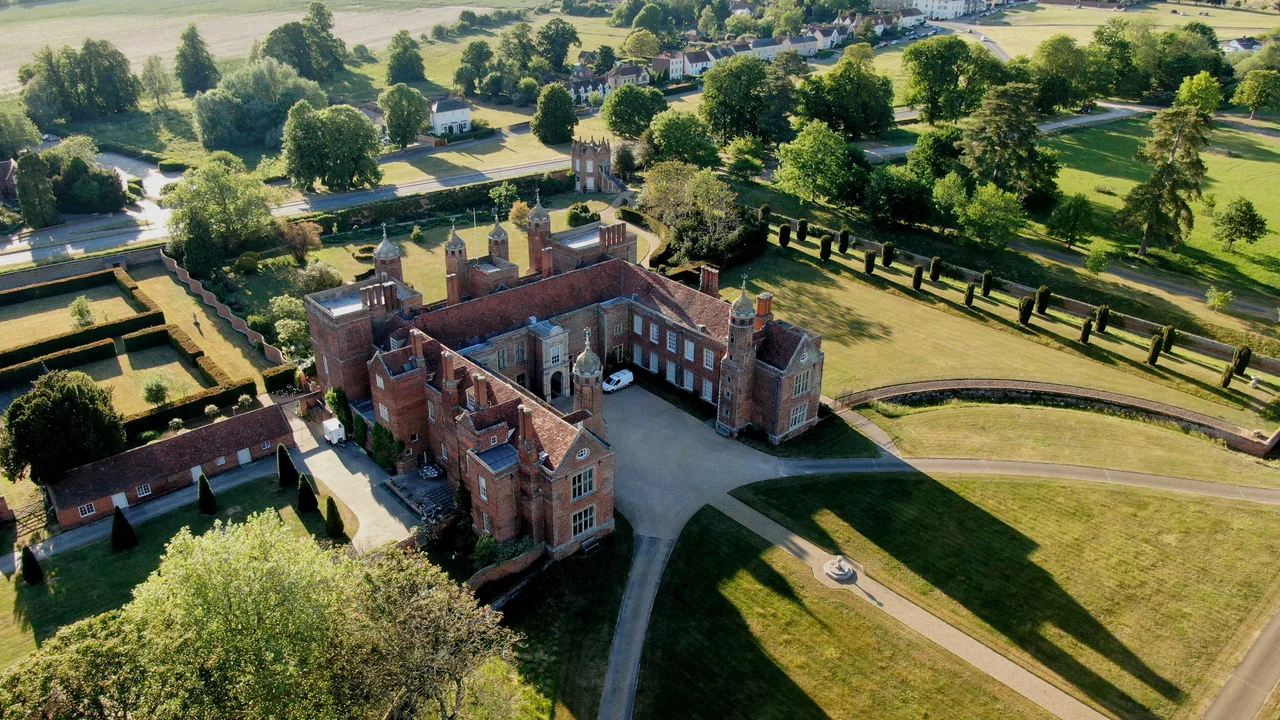

Melford Hall
Beatrix Potter used to come for the summer. She was a cousin of the Hyde Parker family who lived at Melford Hall, and from the 1890s onward she made regular visits to the great brick Tudor house at the edge of Long Melford. Some of her sketches and watercolours of the gardens survive at the house today. It is a small intimacy in an otherwise grand building: the woman who invented Peter Rabbit drew the box hedges and lawns of a country seat that had been continuously inhabited since before the Norman Conquest. That is the texture of Melford Hall. Each century leaves its layer; nothing quite gets erased.
From Abbots to Cordells
The hall was mostly built in the sixteenth century, but the core dates back to a medieval building held by the Abbots of Bury St Edmunds and in use since before 1065 - a few years before William of Normandy arrived. It has the same monastic roots as nearby Kentwell Hall. When Henry VIII dissolved the monasteries, the manor passed out of abbey hands. Mary I, the Catholic queen, granted Melford to Sir William Cordell, her Solicitor General and later Master of the Rolls. Cordell rebuilt the hall in the Tudor brick that still defines the building today. Elizabeth I, his half-sister and successor, visited him here in 1578 as part of her royal progress through East Anglia. From Cordell the hall passed through his sister to Thomas and Mary Savage before returning to another Cordell male line, and the seventeenth-century essayist James Howell described the place in a letter dated 1619, in the time of Elizabeth Savage, Countess Rivers.
The 1642 Riot
The Stour Valley Riots of 1642 were an explosion of anti-Catholic violence at the start of the English Civil War, when crowds across Essex and Suffolk attacked the houses of suspected Catholic landowners. Melford Hall was one of the targets. Elizabeth Savage, Countess Rivers, was a Catholic, the granddaughter-in-law of Cordell, and a member of the queen's circle. The mob ransacked the hall and damaged the building badly. The Savages eventually sold the estate, and in 1786 it was bought by Sir Harry Parker, 6th Baronet, the son of the admiral Sir Hyde Parker. The Hyde Parker family has lived there ever since.
Fire and Survivors
In February 1942, with the country in the middle of the Second World War, one wing of Melford Hall caught fire and was gutted. The rebuilding waited until after the war and kept the external Tudor brickwork while remodelling the interior in the spare 1950s style of the immediate post-war years. The hall opened to the public for the first time in 1955 under Ulla, Lady Hyde Parker. In 1958 Sue Ryder leased the south wing to house her holiday scheme for survivors of Nazi concentration camps, mostly Polish women whose lives had been broken by the camps and the war and who needed periods of rest and care that the British state was not providing. The Sue Ryder operation ran at Melford Hall for eleven years and eventually grew into the international Sue Ryder charity that still runs hospices and other care services across Britain.
National Trust
In 1960 the National Trust took over the hall, while the Hyde Parker family continued to live in part of it - a typical arrangement at the National Trust's stately homes, where the original family often retain rooms for their own use in exchange for opening the rest to visitors. The hall is generally open on weekend afternoons in April and October, and from Wednesday to Sunday afternoons during May to September. The Beatrix Potter connection means the children's collection at the hall draws a particular audience, and several of her original watercolours and sketches associated with the family are on display. The grounds host the Long Melford 'Big Night Out' on Guy Fawkes Night in early November, and from 2013 onward the annual LeeStock Music Festival.
The View
From the air, Melford Hall is unmistakable: a tall brick Tudor block with octagonal turrets at each corner, set in formal gardens just east of the long village green at the south end of Long Melford. The brick is the deep red of sixteenth-century English clay. The lawns around the house are large, and the parkland that surrounds it extends back toward the River Stour. Kentwell Hall, a similar Tudor house with similar roots, sits a mile and a half north on the other side of the village. Together they bracket Long Melford with five hundred years of wool-money architecture, neither of them in the kind of museum-preserved condition that demands the visitor pretend they are stepping into the past. Both still feel inhabited.
From the Air
Melford Hall stands at 52.08°N, 0.72°E, on the eastern side of Long Melford village green near the south end. The red-brick Tudor facade and four octagonal corner turrets are obvious from above, with formal gardens and parkland east of the house. The village's other great house, Kentwell Hall, sits 1.5 nm north on the opposite side of the village. Holy Trinity Church on its rise overlooks both. Sudbury 3 nm south. RAF Wattisham (EGUW) is 13 nm east; the wartime RAF Lavenham control tower at Alpheton lies 5 nm northeast.
Nearby Stories
- Ely Cathedral 6.2 km away
- Aldeburgh Festival 8 km away
- Bungay Castle 8.4 km away
- Thetford Castle 9.1 km away
- White House Farm murders 12 km away
- RAF Bottisham 12 km away
- North Weald Airfield 20 km away
- Broadstairs 55 km away