
Memorial Arch
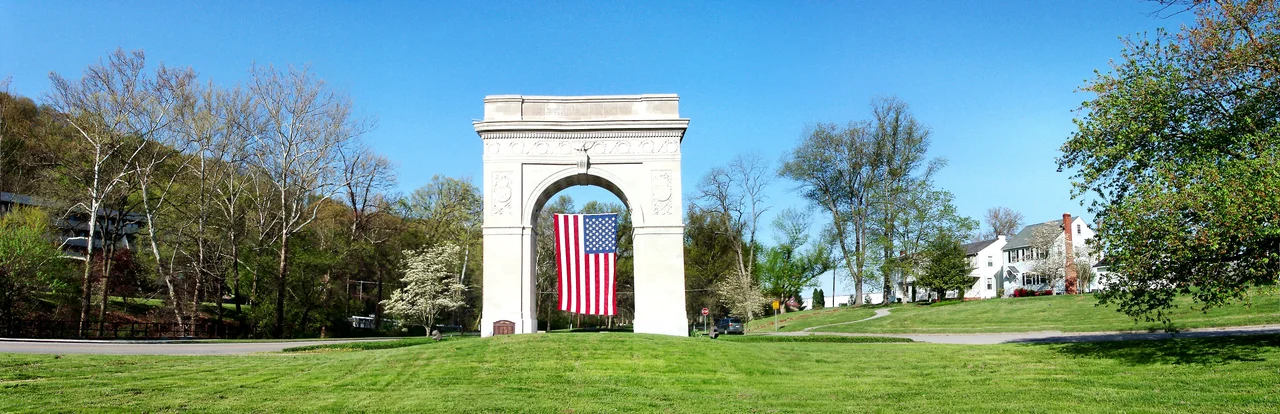
Cabell County, West Virginia, sent soldiers to France during World War I. Some came back. Some did not. When the war ended in 1918, surviving family members and community leaders organized the Cabell County War Memorial Association with a clear goal: build a permanent monument in Huntington's Memorial Park honoring both the dead and those who had served. The result was completed between 1924 and 1929 - the Memorial Arch, 42 feet high and 34 feet wide, built of gray Indiana limestone on a gray granite base, decorated with Classical Revival bas-relief carvings. It is the only triumphal-style arch in the state of West Virginia. The dead it honors have not been forgotten because the arch keeps remembering them for the community that built it.
The Association and the Idea
The Cabell County War Memorial Association formed in the years immediately after the Armistice with a specific charge: create a monument substantial enough to be worthy of the loss. The triumphal arch form, with its roots in Roman imperial monuments and its long modern American history - the Washington Square Arch in New York, the various state and city arches built after the Civil War - was an obvious choice. The form said something about scale and seriousness. It announced that the war this monument commemorated had been world-historical, not merely local. For a small West Virginia city to commission an arch was a statement of how the community understood its own sacrifice. The association raised the money over years and supervised the construction over a five-year period.
Built in Limestone
Indiana limestone is the workhorse American building stone of the early twentieth century. Quarried in the Bedford and Bloomington areas of southern Indiana, it has been used to build the Empire State Building, the Pentagon, the National Cathedral, and innumerable smaller civic monuments across the United States. It carves cleanly, weathers gracefully, and looks like the right material for a triumphal arch. The Huntington Memorial Arch sits on a gray granite base - harder, denser stone for the structural ground level - with the limestone rising above it. The arch measures 42 feet high, 34 feet wide, and 9 feet deep. The Classical Revival bas-relief carvings on the limestone faces depict figures and symbols associated with American military service and the specific themes of the Great War.
The Only One in the State
West Virginia has many war memorials. It has obelisks, statues, plaques, walls, and small monuments at courthouse squares throughout the state. It has only one triumphal arch. The Huntington Memorial Arch's status as the only such structure in West Virginia matters as a matter of architectural and cultural history. Triumphal arches require both ambition and money. They require a community confident enough to commission a major monument in a recognizable historical form, and prosperous enough to pay for the result. That Huntington could do this in the 1920s reflects the city's status at the peak of its industrial confidence - the same period that produced the Keith-Albee Theatre, the substantial downtown commercial buildings, and the elaborate Memorial Park itself. The arch was part of a broader civic moment that has not been quite matched since.
The 1980 Rededication
The arch was rededicated in 1980 - sixty-two years after the Armistice and fifty-one years after the original completion. By that point most of the Cabell County veterans of World War I were dead. The rededication formally extended the memorial's meaning to include all American military service across the twentieth century, while reaffirming its original focus on the soldiers of the First World War. The structure was listed on the National Register of Historic Places in 1981, formally protecting its architectural and historical significance at the federal level. The combination of rededication and registration - an act of community memory and an act of preservation law - reflects the broader American process of how older war memorials are kept meaningful as their original wars recede into history.
Memorial Park
Memorial Park is a green expanse in southern Huntington that anchors the arch as its centerpiece. The park sits south of the railroad tracks that bisect the city, near Ritter Park, in the residential neighborhoods between the downtown core and the wealthier hills above the city. Mature trees frame the arch from multiple angles. Walking paths converge near it. Civic events, particularly on Memorial Day and Veterans Day, still gather at the arch with appropriate ceremony. The park's name and its central monument keep the original purpose front and center. This is a place that exists, and continues to exist, because Cabell County wanted to remember its dead. From the air, the arch is one of the few specifically identifiable monuments visible from above in southern Huntington, even as a small structural punctuation in the park's landscape.
From the Air
Located at 38.406 degrees north, 82.463 degrees west, in Memorial Park in southern Huntington, West Virginia. Recommended viewing altitude 2,500 to 4,000 feet AGL for clear views of the park and the surrounding residential neighborhoods. Nearest airport is Tri-State (KHTS), about 6 nautical miles east. The arch sits at the center of Memorial Park, just southwest of Ritter Park, identifiable from above by its position in the green expanse and the converging walking paths.
Nearby Stories
- Battle of Scary Creek 6 km away
- Portsmouth 7.2 km away
- Fred M. Vinson Museum and Welcome Center 14 km away
- Staats Mill Covered Bridge 24 km away
- Lake Tight 25 km away
- Battle of Blair Mountain 32 km away
- Lower Shawneetown 35 km away
- The Kentucky Meat Shower: When Flesh Fell From a Clear Sky 68 km away