_01.jpg)
Menelaion
The inscription on a small bronze vessel, scratched in boustrophedon script — lines alternating left-to-right and right-to-left like an ox plowing a field — reads: 'Deinis offered to Helen, wife of Menelaus.' Someone carried this object up a low hill above the Eurotas valley, probably sometime in the 7th or 6th century BCE, and left it there as a gift to a woman they believed had once been real. That act of devotion, discovered roughly 2,600 years later by the archaeologist Hector Catling, is what makes the Menelaion extraordinary: it is a place where myth and archaeology intersect not as metaphor but as literal, physical evidence.
Helen's Hill
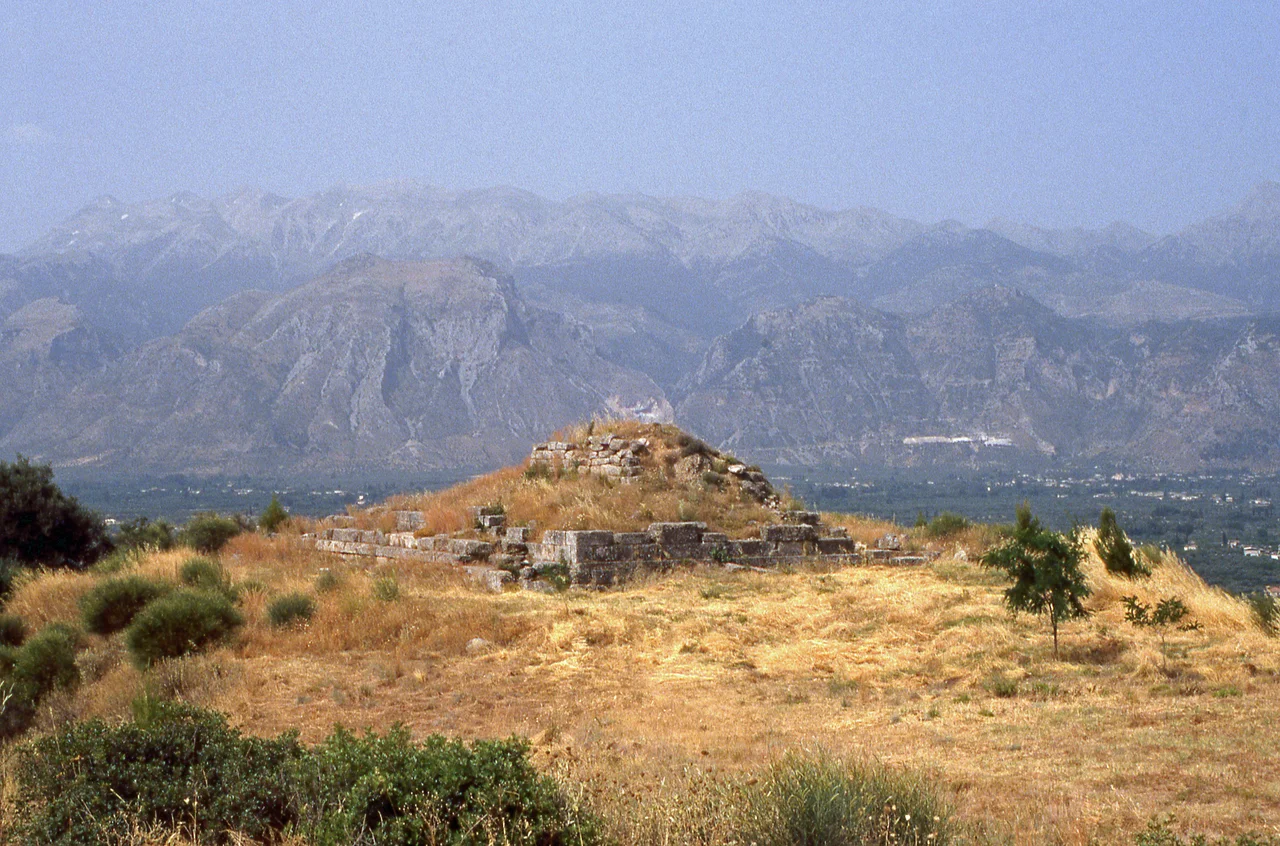
The Menelaion — the sanctuary of Menelaus — occupies a hill complex about 5 kilometers from modern Sparta, overlooking the broad floodplain of the Eurotas river. The ancient name for the area was Therapne. In Greek religious practice, heroes (and heroines) occupied a category distinct from gods: closer to human beings, capable of interceding in everyday life, rooted in specific places. Helen and Menelaus were among the most widely worshipped of all heroic pairs, with shrines at several sites across Greece. But the Menelaion at Therapne was their principal cult site in Laconia, and the archaeological evidence suggests that people were making offerings here from the 8th century BCE onward — roughly the same period when Homer's poems were taking their written form.
Mansions Before the Myth
Beneath the heroic cult lies something older and more surprising. Hector Catling's excavations, conducted several decades after the British School at Athens first dug here in 1909 and 1910, revealed three distinct Mycenaean structures on the ridge of the hill, dating back as far as approximately 1450 BCE. The oldest — Mansion 1 — was a building with three parallel units, its central section identified as a megaron, the great hall of a Mycenaean palace complex. It was destroyed, probably by earthquake, not long after it was built. Two subsequent mansions followed on the same site. Catling concluded that these structures were administrative centers, ancestors of the great palaces at Pylos, Mycenae, and Tiryns — which means that this hill above the Eurotas was inhabited by someone of considerable power roughly three thousand years before the first archaeologist set foot here.
Three Thousand Years of Worship
The classical-era sanctuary — the ruins that are visible today — dates from the 5th century BCE and was built on top of an earlier limestone structure from the 6th century, which was itself built over a still earlier phase of worship beginning in the late 8th or early 7th century BCE. Each layer replaced the one before it, but the continuity of devotion at the same spot is striking. Ludwig Ross, who excavated here in 1834, was the first to identify the site as the Menelaion and recovered lead votive figurines of the Laconic type. Nearly a century later, a cistern at the site yielded a blue limestone stele with an inscribed bronze statuette: 'Euthycrenes dedicated to Menelaus.' Two separate dedications to Helen, two to Menelaus. The hill had been receiving gifts for generations.
What Comes After Bronze
Richard Catling — Hector's son — continued work at Therapne in the 1980s, excavating a terrace on the south side of the hill. He found disturbed strata full of sub-geometric and early archaic votive offerings mixed with the walls and floors of a structure from the late 13th and 12th centuries BCE. Some of those votive objects were associated with the Mycenaean construction beneath them, suggesting that the people who began worshipping Menelaus and Helen here may have been doing so at a place already understood as ancient and significant — perhaps because ruins or traditions of the Bronze Age palace still shaped the landscape and the memory of the people living nearby. The hero cult, in other words, may have grown from a real Mycenaean presence. The line between myth and history runs somewhere through this hill, and archaeology keeps finding it harder to draw.
The View from Therapne
Stand on the Menelaion ridge on a clear morning and the Eurotas valley opens below you — the flat green farmland that was Sparta's breadbasket in antiquity, the gentle hills closing in from either side, the long spine of Taygetus rising to the west. Across the valley and slightly to the northwest, the ruined towers of Mystras are visible on their rocky spur. These are two very different worlds that share a landscape: the Bronze Age palace, the ancient heroic shrine, and the medieval Byzantine city all within sight of each other, layered across three millennia of continuous human attachment to this particular piece of ground.
From the Air
The Menelaion sits at approximately 37.066°N, 22.454°E on a low ridge east of the Eurotas river, about 5 km from modern Sparta and roughly 8 km east of Mystras. From the air, the site appears as a hilltop ruin on the eastern fringe of the Eurotas valley, with the river plain visible to the west and the Parnon range rising beyond. Nearest major airport: LGKL (Kalamata International), approximately 60 km to the west. Visibility in the Eurotas valley is typically excellent; afternoon winds funnel through the valley from the north.
Nearby Stories
- Iklaina 6.6 km away
- Kalamakia Cave Site 7.8 km away
- Cleomenean War 9.7 km away
- Epidaurus Limera 16 km away
- Leonidio 18 km away
- Lepreum 20 km away
- Franchthi Cave 30 km away
- El-Kouf National Park 448 km away