
Cleomenean War
When Cleomenes III heard that Aratus of Sicyon had led an army toward Belbina with torches and ladders under cover of night, he sent a cool message asking what Aratus intended. Aratus replied that he had come to stop the Spartans from fortifying the pass. Cleomenes wrote back: 'If it's all the same to you, write and tell me why you brought along those torches and ladders.' That dry exchange in 229 BC opened a seven-year war — but behind the military maneuvering lay something far more explosive than a border dispute. Cleomenes was not merely fighting for territory. He was attempting to rebuild Sparta from the inside out, erasing debts, redistributing land, freeing helots, and handing citizens equal lots — a social revolution waged simultaneously on the battlefield. It was among the most dramatic reform programs in Greek history, and it ended in catastrophe on a hillside called Sellasia.
The King Who Rewrote Sparta
Cleomenes came to power in a Sparta that had shrunk to a shadow of its former self. The citizen body had dwindled, land had concentrated in the hands of a few, and the ephors — five annually elected magistrates — held the power to check the kings at every turn. Cleomenes saw the rot and plotted a cure that would have terrified most Greek aristocrats.
In 227 BC, after a string of battlefield victories that left the Achaean League reeling, Cleomenes returned to Sparta with his mercenaries and sent loyal men ahead to kill four of the five ephors. Only one survived, fleeing to a temple. With the ephors gone, Cleomenes moved fast. He surrendered his own land to the state, compelling his stepfather, his friends, and eventually every citizen to do the same. He divided Spartan territory into equal lots and distributed them. He granted citizenship to some of the perioeci — the free, non-citizen class — swelling the army to 4,000 trained hoplites. He even adopted the Macedonian sarissa, the long pike that had made Philip II's phalanx nearly unstoppable.
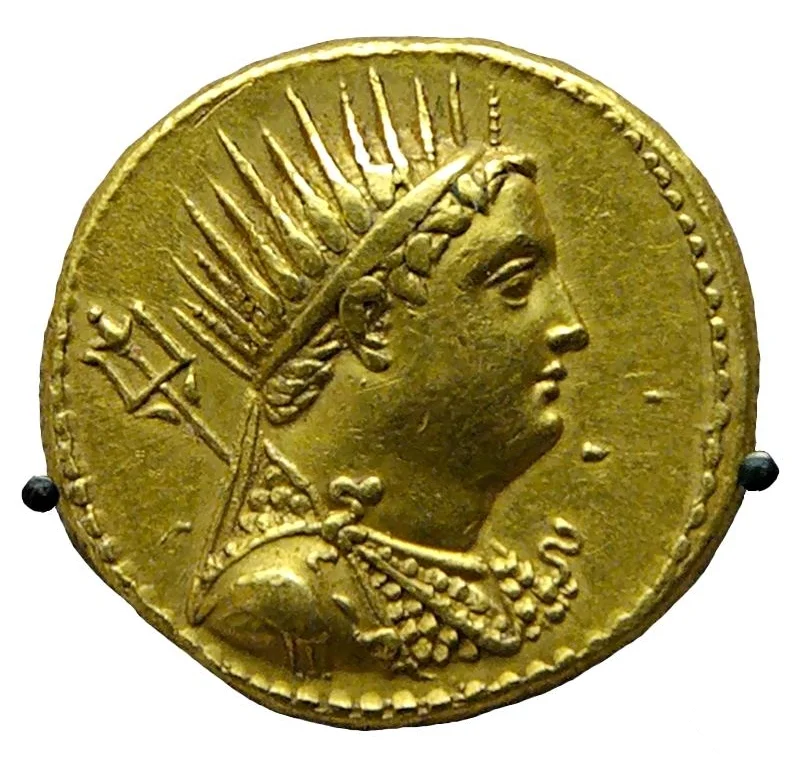
His brother Eucleidas was placed on the second Spartan throne, an unprecedented arrangement. Ptolemy III of Egypt, calculating that a resurgent Sparta served his interests against Macedon, began funding the campaign. For a moment, everything seemed possible.
Across the Peloponnese
The years from 227 to 224 BC saw Cleomenes sweep across the peninsula like no Spartan king before him. He took Mantinea with a night raid, crept his troops into the citadel, and expelled the Achaean garrison. He routed Achaean armies at the Battle of Dyme and at Ladoceia, where Lydiadas of Megalopolis disobeyed orders, charged recklessly with cavalry, and was killed — leaving Cleomenes' Cretan and Tarentine soldiers to exploit the terrain and shatter the Achaean forces.
City after city submitted: Pellene, Pheneus, Penteleium, splitting the Achaean League in two. Then Argos fell — a feat no Spartan king had ever achieved, not even the legendary Pyrrhus of Epirus, who had died trying. Corinth followed. Hermione, Troezen, and Epidaurus surrendered in quick succession. At his peak, Cleomenes held more of the Peloponnese than any Spartan had in generations.
But the League's general Aratus was already in secret communication with King Antigonus III Doson of Macedon, offering him the one prize Aratus had sworn never to give away: control of Acrocorinth, the impregnable citadel above Corinth. The invitation that would end Cleomenes' dream was sent.
The Wages of Reform: Desperation and Helot Freedom
Antigonus marched south with 20,000 infantry and 1,300 cavalry. Faced with this force, Cleomenes abandoned his siege of Sicyon and threw up a trench and palisade from Acrocorinth to the Isthmus of Corinth, choosing terrain that neutralized the Macedonian phalanx. For a time it held. The Macedonians failed repeatedly to break through.
Then Argos revolted. The Argives had been angered that Cleomenes — despite his promises — had made no reforms in their city. They rose under Aristoteles and opened their gates to the Macedonians. Cleomenes' stepfather Megistonous was killed trying to retake the city. With his position at the Isthmus now flanked, Cleomenes abandoned Corinth and pulled back into Arcadia.
By early 222 BC, Ptolemy had withdrawn his financial support — apparently after Antigonus ceded territory in Asia Minor in exchange. Without Egyptian gold, Cleomenes could not pay his mercenaries. The choice he made next reveals what his revolution truly meant. He freed all helots who could pay five Attic minae, accumulating 500 talents of silver. He then armed 2,000 of those newly freed men in Macedonian style to fight alongside his Spartans. Men who had been bound to the land, whose ancestors had been subjugated for generations, now stood as soldiers in the army of the king who had tried to make Sparta free.
Sellasia: The Last Stand
The final battle came in the summer of 222 BC at a pass on Laconia's northern border, where two hills — Evas and Olympus — overlooked the road south. Cleomenes placed his brother Eucleidas on Evas with allied troops and perioeci, and stationed himself on Olympus with 6,000 Spartan hoplites and 5,000 mercenaries. The combined Macedonian and allied force numbered some 29,200 men to Cleomenes' 20,000.
The battle swung on a moment of individual initiative. A young Megalopolitan cavalryman named Philopoemon — whose city Cleomenes had later razed and burned — noticed that the Achaean infantry protecting the Macedonian right wing was exposed at the rear. When senior commanders ignored his warning, Philopoemon gathered a handful of riders and charged on his own. The Spartan cavalry disengaged. The Macedonians surged forward. Eucleidas was killed and his flank collapsed.
On the other hill, the Macedonian phalanx drove the Spartan phalanx back through sheer weight of numbers and depth of ranks. Only 200 of the 6,000 Spartans on Olympus survived. Cleomenes escaped with a small group of men.
Antigonus entered Sparta — its first foreign conqueror in history. He restored the ephors and revoked the reforms, though he treated the population with notable restraint. Cleomenes fled by ship to Egypt, where Ptolemy IV eventually had him placed under house arrest. In 219 BC, Cleomenes and his companions escaped and tried to spark a popular uprising in the streets of Alexandria. It failed. He and all his friends took their own lives.
What the War Meant
The Cleomenean War is easy to read as simply another episode in the endless power struggles of Hellenistic Greece. But the reforms at its center were something rarer: a king who used military success to attempt genuine social transformation, redistributing land and expanding citizenship in a society built on the subjugation of the helot class. Whether Cleomenes acted from idealism or political calculation — or both — the people who benefited from debt cancellation and land grants were real, and their losses when Antigonus reversed the reforms were equally real.
The battlefield sites are spread across the central and northern Peloponnese. Sellasia itself, on the northern edge of Laconia, is the most significant — a narrow pass where the last independent Sparta made its stand. The Achaean cities that changed hands through this war — Mantinea, Tegea, Megalopolis, Argos, Corinth — remain inhabited, their ancient cores layered beneath Byzantine churches and modern streets.
The war also produced Philopoemon of Megalopolis, whose decisive charge at Sellasia launched a career that would eventually lead to him conquering Sparta itself — the city that had burned his hometown to the ground.
From the Air
The Cleomenean War's principal sites lie in the central and northern Peloponnese, Greece. Sellasia, site of the decisive battle, is at approximately 37.17°N, 22.49°E, on the northern edge of Laconia — approach from the north along the Eurotas River valley at 3,000–4,000 ft to appreciate the terrain Cleomenes chose. Tegea and Mantinea, key contested cities of the war, sit on the Arcadian plateau around 37.46°N, 22.42°E, at about 660 meters elevation. Corinth and Acrocorinth (37.90°N, 22.87°E) mark the northern theater. Megalopolis, the city Cleomenes burned in 222 BC, lies at 37.39°N, 22.13°E. The nearest major airport is Kalamata International (LGKL, 37.07°N, 22.02°E), approximately 90 km southwest of the Arcadian theater. Athens International Eleftherios Venizelos (LGAV) provides access from the north, about 220 km from the main battlefield sites.
Nearby Stories
- Battle of Maniaki 2.6 km away
- Brontochion Monastery 4.1 km away
- Argon Pedion 11 km away
- Lepreum 12 km away
- Battle of Lalas 12 km away
- Leonidio 21 km away
- The Slamat Disaster 29 km away
- Siege of Corinth (1463) 31 km away