
Merced Assembly Center: 133 Days Behind the Wire
Ruth Ihara saw her new home and could not speak. "When we first saw our living quarters we were so sick we couldn't eat, walk, or talk," she wrote. "We couldn't even cry till later." The living quarters were at the Merced County Fairgrounds, where cattle had stood weeks before. In the spring of 1942, following the signing of Executive Order 9066, the fairgrounds were hastily converted into one of sixteen temporary assembly centers built to incarcerate Japanese Americans forcibly removed from the West Coast. The Merced Assembly Center operated for just 133 days, from May 6 to September 15, 1942, but in that time it held 4,669 people - farmers, shopkeepers, students, children - who had been given days to sell or abandon their homes, businesses, and belongings. Ten people died within its perimeter.
Carried What They Could
The people sent to Merced came overwhelmingly from rural farming communities. Some 1,600 arrived from Colusa County and Yolo County. Another 1,400 came from the nearby regions of Modesto, Merced, and Turlock. A thousand more came from northern coastal towns. Families were allowed to bring only what they could carry: bedding, linens, toiletries, clothing, dining utensils, and hygiene products. Everything else - farms, businesses, leased properties, household goods - had to be sold, stored, or abandoned, often at exploitative prices, because buyers knew the sellers had no leverage and no time. But not every community lost everything. Japanese American farmers from Cortez, Cressey, and Livingston belonged to collective farming organizations that arranged for their land to be maintained in their absence, a rare lifeline that allowed some families to return to intact homes after the war. For most, there was no such safety net. They boarded trains with duffel bags and suitcases, tagged like luggage themselves.
Cattle Stalls and Searchlights
The fairgrounds were never designed to hold thousands of people, and the conversion showed. Cattle stalls were cleared and made to house families of six. Barracks were thrown up from crude materials that could not withstand rain or wind; floods seeped in, and insects followed through unscreened doors. There was no indoor plumbing. Communal bathrooms lacked partitions - Ruth Ihara described ten unfinished wooden seats in a row, flushing automatically every fifteen minutes. Marion Michiko Bernardo, incarcerated as a young girl, remembered the barracks had no ceilings between units: "People could hear me crying and everything. I remember that." Security was prison-like. Bob Fuchigami, who was a child at Merced, recalled barbed wire, guard towers, jeep patrols circling the perimeter, and searchlights sweeping the camp at night. "We were told, you go beyond that fence you're going to get shot," he said. Roll call came twice daily. Police could search any facility without a warrant.
Life Inside the Fence
Despite the conditions, the incarcerated community built what structure it could. Twenty Japanese American volunteers taught elementary, middle, and high school students in classes that ran from June 10 to August 21, 1942 - some held in grandstands, others in empty barracks where students sat on the floor for lack of desks. The center even held a graduation ceremony for students who had missed their high school commencement due to forced relocation. A camp newspaper, the Mercedian, published twice weekly from June through August, written by incarcerated journalists including managing editor Oski Taniwaki, who had previously edited the English section of Shin Sekai, a Japanese-language newspaper in San Francisco. The Mercedian was written only in English and subject to censorship by the Wartime Civilian Control Administration. Workers were paid $8 for unskilled labor, $12 for skilled, and $16 for professional work - a fraction of prevailing wages. An internal police unit, nicknamed the "Green Peas," maintained order. Music appreciation hours and sports - basketball, badminton, football, ping pong - offered small reprieves from daily confinement.
The Photographer Who Would Not Look Away
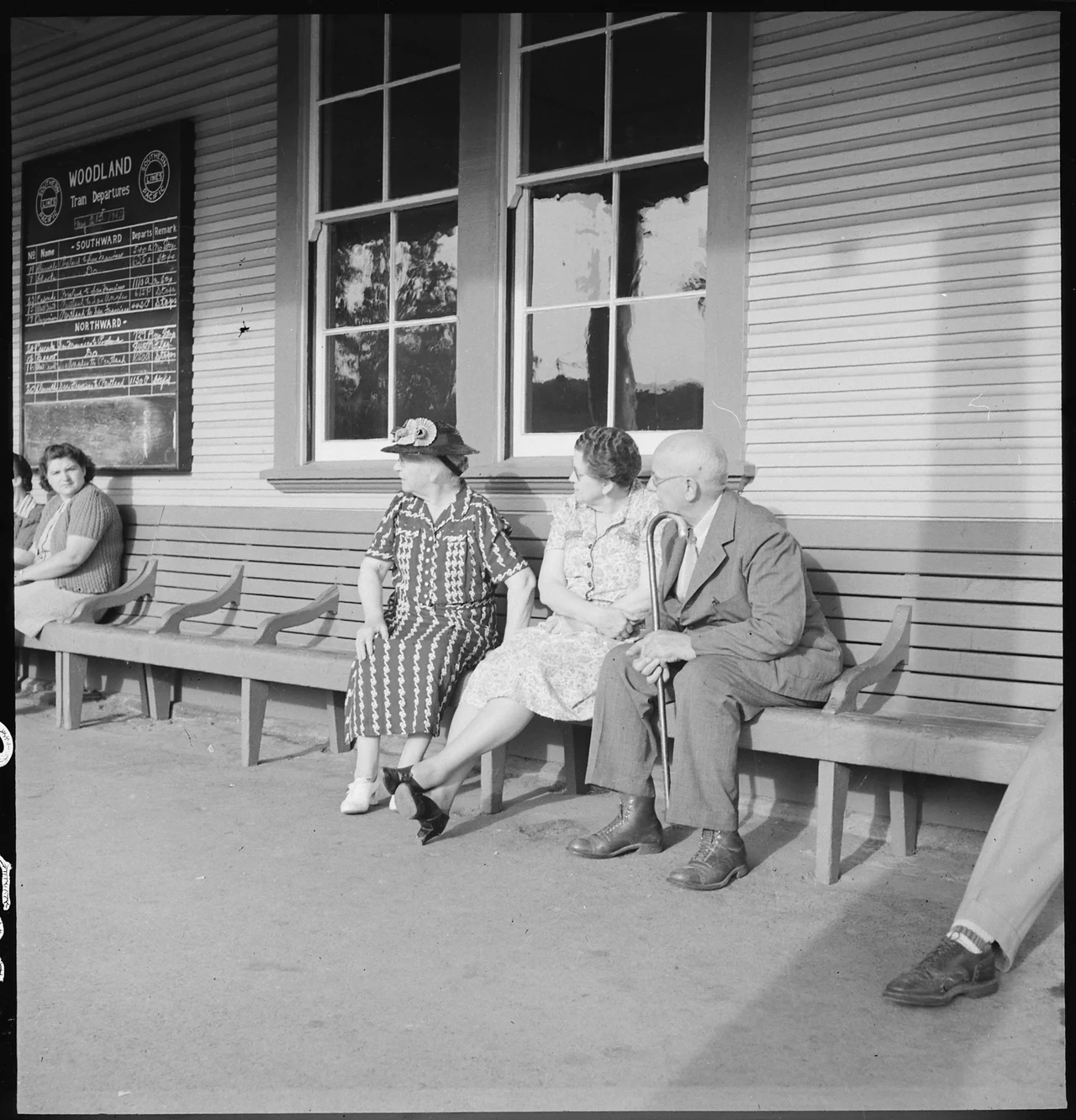
The government hired Dorothea Lange to document the relocation process, expecting images that showed Japanese Americans being treated well. Lange was instructed to exclude barbed wire, watchtowers, and armed soldiers from her frames. WRA officials followed her constantly, and an Army major named Beasley tried repeatedly to catch her violating the agreement. He never did - but Lange found ways to tell the truth regardless. She photographed families waiting at railroad stations with their luggage, children staring from train windows, the quiet devastation of people uprooting their lives under government order. The government censored 97 percent of her images, suppressing them for years. They survived only because they were transmitted to the National Archives, where Lange's former assistant Richard Conrad and his wife later used them in a traveling exhibition titled Executive Order 9066. Meanwhile, Ansel Adams photographed the Manzanar camp on his own initiative. Lange urged him to use his images to challenge the government's narrative. Adams declined, opting for a more conciliatory approach. Lange's censored photographs ultimately became some of the most powerful visual records of the internment.
What Remains at the Fairgrounds
In September 1942, the incarcerated were transferred in groups of roughly 500 to the Amache concentration camp in southeastern Colorado, a process that took several weeks. The Merced Assembly Center closed on September 15, 1942, and the fairgrounds returned to agricultural use. For decades, little marked what had happened there. A California Historical Landmark marker, number 934, was placed in 1982 - one of ten such markers honoring the temporary detention centers across the state. A fuller reckoning came later. In 2010, after initial hesitation from the Fair Board, the Merced Assembly Center Memorial opened on the fairgrounds. It features the names of all those incarcerated, a statue of families waiting with their luggage, and a reflection pool. The memorial does not soften what happened. It records it. The fairgrounds still host the annual county fair, and the memorial stands among the exhibition buildings - a permanent reminder that the ground where people now enjoy livestock shows and carnival rides was once ringed with barbed wire.
From the Air
Located at 37.29N, 120.48W at the Merced County Fairgrounds in Merced, California, in the San Joaquin Valley. The fairgrounds are visible from altitude as a complex of buildings and open grounds on the south side of the city. Elevation approximately 170 feet MSL. Flat agricultural terrain with excellent visibility most of the year; summer haze and heat common. Merced Regional Airport (KMCE) is nearby. Castle Airport (former Castle AFB) is just north. Fresno Yosemite International (KFAT) is approximately 50nm southeast.
Nearby Stories
- Ferguson Fire 3.9 km away
- La Grange Dam 6.8 km away
- California Central Valley Grasslands 14 km away
- The Lifeline of Madera County 18 km away
- Twelve Thousand Bolts 19 km away
- The Spinach Riot 49 km away
- Mount Hamilton (California) 62 km away
- Salinas and Steinbeck Country 78 km away