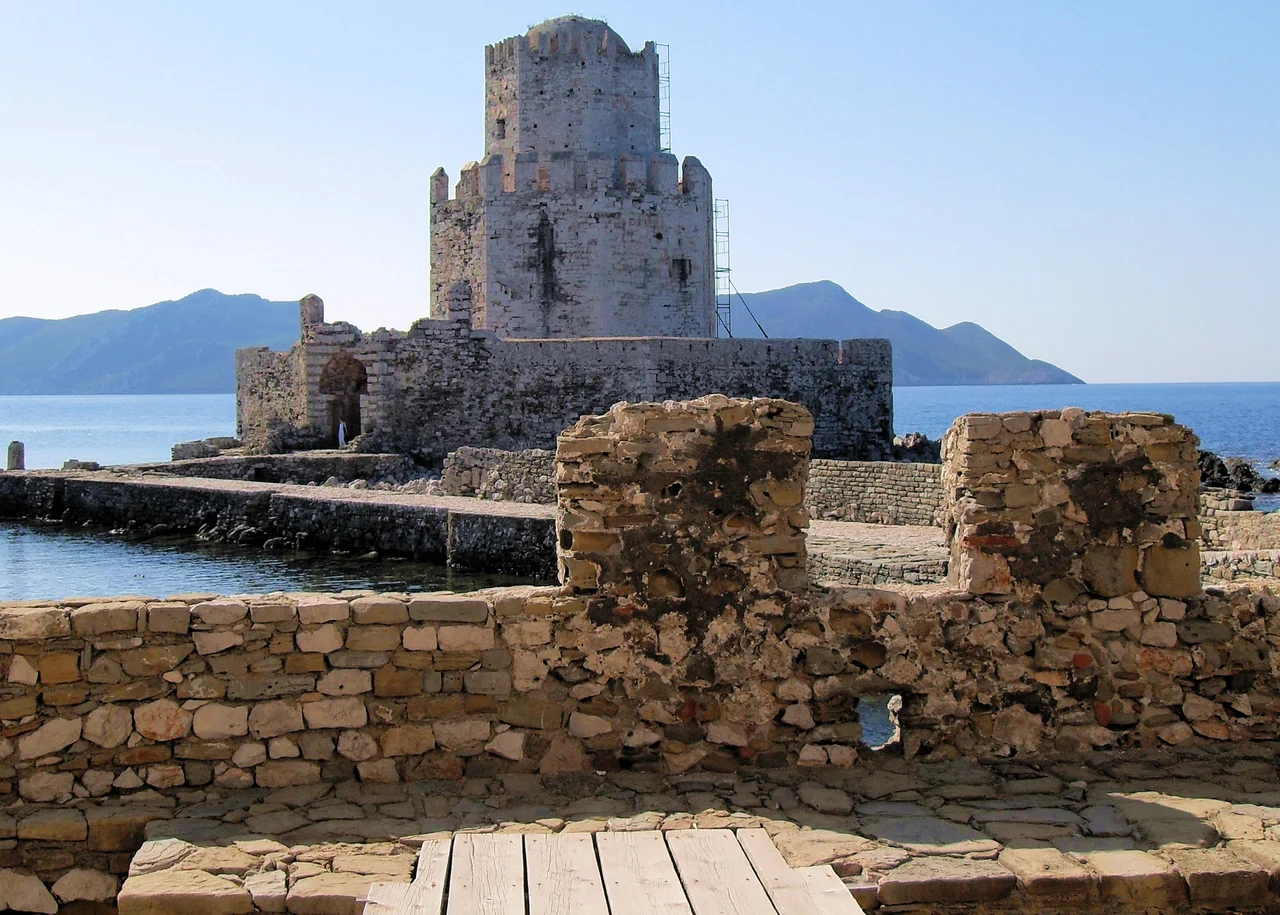

Methoni Castle
Stand at the sea gate of Methoni Castle and the water is on three sides of you. The fortress does not merely sit beside the sea — it occupies a cape, a headland that the builders understood could be made impregnable simply by controlling the thin neck of land at its north. The Venetians knew a good thing when they saw it. For nearly three centuries, their winged lion of St. Mark flew above these walls, and the port they called Modon was considered one of the most valuable staging posts on the entire route between Venice and the Holy Land. Pilgrims heading east stopped here. So did crusaders, merchants, admirals, and, eventually, a famous Spanish novelist who, according to local tradition, may have passed through a Turkish tower on his way to greatness.
The Eye of the Republic
Venice fixed its gaze on Methoni as early as the twelfth century, drawn by the harbor's position on the route to the eastern markets. What they ultimately acquired — after the chaos of the Fourth Crusade reshuffled control of the Peloponnese — was not just a port but an empire's forward base. Under Venetian rule the town reached its zenith: a cosmopolitan hub trading with Egypt and the Levant, its population a mixture of Greeks, Jews, Albanians, and Latins by the fourteenth century. The castle that guarded all this grew incrementally, each new threat prompting another layer of stone. The entrance today is still reached by a 14-arch bridge built over a deep moat; the original wooden drawbridge has given way to something more permanent, but the intention — to make you feel the seriousness of what lies beyond — survives intact. Pass through the arched gate, with its Corinthian pilasters worked by Venetian craftsmen after 1700, and a domed road opens ahead, leading through a second gate, and then a third. The castle does not let you in all at once.
Centuries Written in Stone
Inside the walls, every era has left its mark. Ruins of Venetian lords' residences neighbor the remains of a Turkish bath. The Byzantine church of St. Sophia stands near a monolithic granite pillar from 1493 or 1494 — unlined, topped with a Byzantine-style capital — that scholars believe once supported either the winged lion of St. Mark or a bust of the admiral Morosini. A Latin inscription on a slate nearby dates to 1714. Farther along, the paved street that once led to the sea gate passes several cisterns and what the source material calls the remains of a British prisoner's cemetery from the Second World War. The castle is not a ruin in the sense of something fallen and forgotten. It is a palimpsest: a text written over and over in different hands, each adding to rather than erasing what came before. On the north wall, a plaque bearing the coats of arms of the Foscarini, Foscolo, and Bembo families commemorates the construction of the Bembo battlement just before 1500. General Antonio Loredan's battlement gets its own inscribed plaque. The Venetians were not modest about their presence.
The Bourtzi — Island of Last Resort
A stone-paved causeway leads south from the main walls across a small bridge to the Bourtzi, a tiny fortified islet connected to the cape. Its two-story octagonal tower, finished with a round dome, dates from the first period of Ottoman occupation — after 1500 — and served at various points as a prison. The name carries weight: it was here, the sources record, that many soldiers and inhabitants of Methoni were killed when the Ottomans took the fortress on 9 August 1500, after Sultan Bayezid II personally supervised a 28-day siege. The town's population at that moment — having held out until starvation and military pressure combined — was either killed or enslaved. The Bourtzi stands quietly now, accessible to visitors who cross to it in the afternoon light, the sea visible in all directions. Its history as both refuge and execution ground is not marked by any dramatic monument, just the weathered octagonal stones of a tower that has seen more than most.
Writers and Soldiers Who Passed Through
Two famous visitors arrived here as prisoners, which is a particular kind of introduction to a place. After the Battle of Lepanto in October 1571, Miguel de Cervantes — who had fought in that naval battle and lost the use of his left hand — may, according to local tradition, have spent time in the Turkish tower at Methoni. He later wrote Don Quixote, and whether any time at the fortress gave him material is unprovable. Historians note that Cervantes was not captured until 1575, four years after Lepanto, and was held in Algiers rather than Methoni; the local connection is cherished but uncertain. Still, it is a story worth holding: one of literature's great visionaries, perhaps passing through a fortress that had already accumulated a thousand years of human drama. François-René de Chateaubriand arrived under better circumstances, disembarking on 10 August 1806 to begin his grand tour of Greece and the Middle East. His account, the Itinéraire de Paris à Jérusalem, was published in 1811. And there is the strange case of Vittore Carpaccio's painting Young Knight in a Landscape, one interpretation of which identifies the knight as Marco Gabriel, the Venetian rector of Methoni during the Ottoman siege of 1500 — the only Venetian survivor, accused of cowardice, taken to Constantinople and beheaded on 4 November 1501. His family, if the identification is correct, commissioned the painting as a tribute.
The Cape Today
The castle passed from Ottoman hands to French control in October 1828, when the Morea Expedition arrived under General Maison. The French stayed until 1833, long enough to build the church of Santa Sotira inside the walls and to commission the 14-arch bridge still in use today. Then they handed the fortress to the newly established Kingdom of Greece. It has been a monument ever since — or more precisely, a living ruin, open to the sky, with the sea gate recently restored and the Bourtzi reachable on foot. The winged lion of St. Mark still appears on various parts of the walls, carved in stone, looking out over a harbor that no longer carries the trade of empires but still draws visitors who come to stand at the edge of the cape and look at the water on three sides.
From the Air
Methoni Castle sits at approximately 36.8154°N, 21.7045°E on the southwestern tip of the Peloponnese, Greece. The cape on which it stands juts visibly into the sea and is readily identifiable from altitude — look for the narrow neck of land with water on three sides and the small fortified islet (Bourtzi) connected by causeway to the south. Recommended viewing altitude: 2,000–4,000 feet for full context of the castle's relationship to the sea. The nearest major airport is LGKL (Kalamata International Airport), approximately 55 km to the northeast. Clear visibility is common in summer; morning light from the east illuminates the sea gate and the Bourtzi particularly well.
Nearby Stories
- Kardamyli 10 km away
- 1886 Peloponnese Earthquake 11 km away
- Vergadeika 18 km away
- Strofades 20 km away
- 2018 Ionian Sea Earthquake 91 km away
- Battle of Cape Spada 171 km away
- Siege of Chania (1645) 245 km away
- Valletta 595 km away