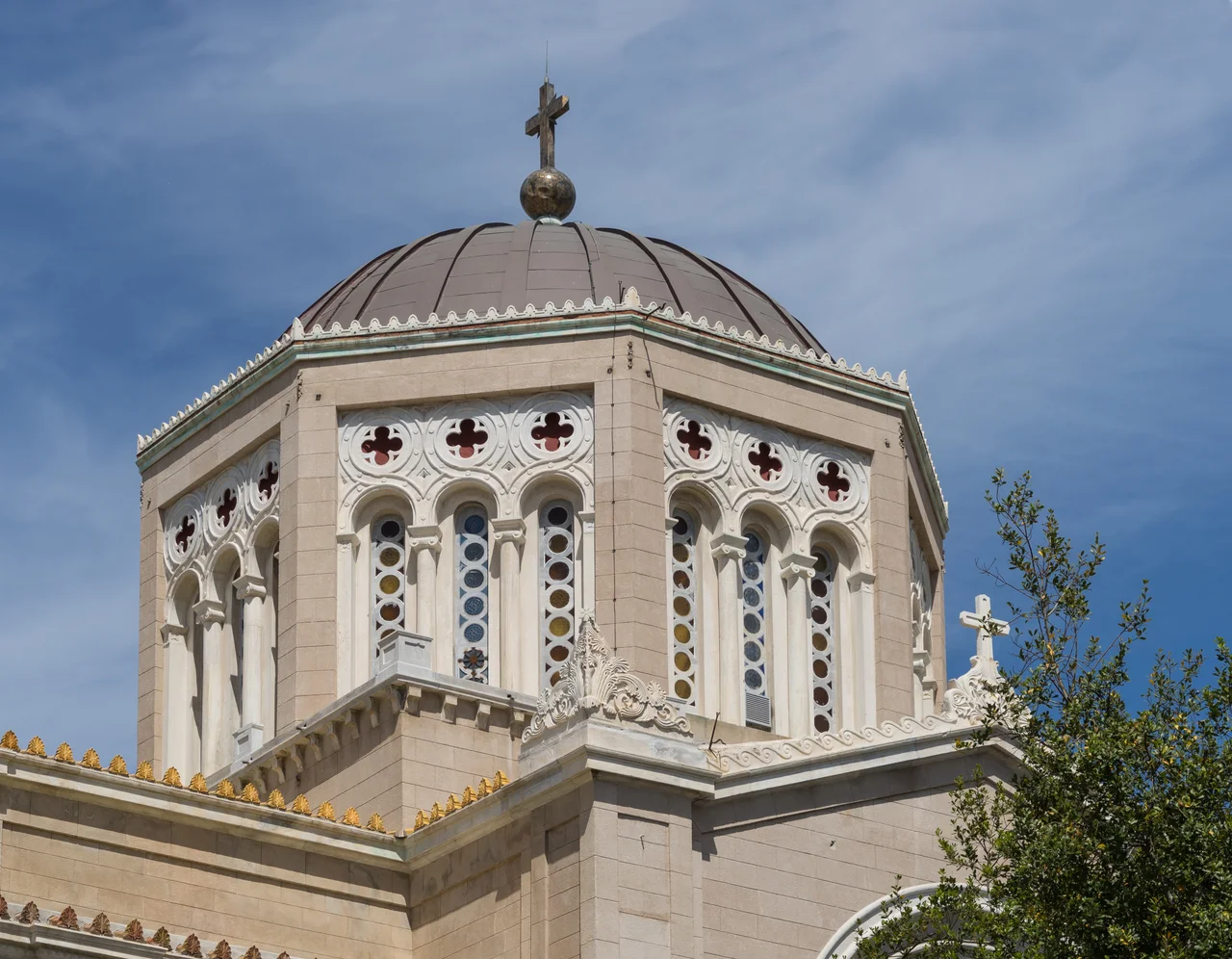

Metropolitan Cathedral of Athens
To build one church, the Athenians of the nineteenth century took apart seventy-two others. The Metropolitan Cathedral of the Annunciation - the Mitropoli, the great church of the Archbishopric of Athens and all Greece - rose from the salvaged marble of dozens of demolished chapels, a new national cathedral quite literally assembled from the bones of the old city's faith. And then, in one of the most charming juxtapositions in all of Athens, it was set down right next to a church so small it looks like a model of itself.
A Cathedral of Salvaged Stone
Construction began on Christmas Day, 1842, when King Otto and Queen Amalia laid the cornerstone - a young Bavarian-born monarchy building a cathedral for a young nation. The work was slow and passed through many hands. It started under the architect Theophil Hansen and was carried on by Dimitris Zezos, Panagis Kalkos, and François Boulanger. To raise its immense walls, workers gathered marble from 72 demolished churches across the city, a practice that gave the cathedral a piecemeal, gathered quality and stripped Athens of much of its smaller religious architecture in the process. Three architects and twenty years later, on 21 May 1862, the king and queen returned to dedicate the finished basilica to the Annunciation of the Mother of God.
The Tombs of Two Martyrs
The cathedral is a three-aisled domed basilica, roughly 130 feet long and 80 feet high, and inside it rest two saints, both killed under Ottoman rule. Saint Philothei founded a convent and was martyred in 1589; her bones remain visible today in a silver reliquary. She is honoured for a deeply human act of courage - ransoming Greek women held in the harems of the Ottoman Empire. Beside her lies Gregory V, Patriarch of Constantinople, hanged on the order of Sultan Mahmud II in 1821 and his body cast into the Bosphorus, in reprisal for the Greek uprising that began the War of Independence. Greek sailors recovered his body, and it was eventually enshrined here, in the cathedral of the nation his death helped to forge.
The Little Mitropoli
Step just south of the great cathedral and you meet its tiny companion, the Church of Saint Eleftherios - the "Little Mitropoli." Where the cathedral is grand and nineteenth-century, this one is small and medieval, its outer walls studded with carved marble reliefs reused from across antiquity and the Byzantine centuries. The pairing is irresistible: the towering new cathedral of a modern state, and beside it the diminutive old church that survived the Ottoman centuries to see it built. Together they compress the whole arc of Athenian Christianity into a single courtyard - the ancient gem and the national giant, standing shoulder to shoulder.
Statues and Ceremonies
In the square before the cathedral stand two figures who frame the Greek story. One is Constantine XI, the last emperor of the Eastern Roman Empire, who died defending Constantinople in 1453. The other is Archbishop Damaskinos, who led the church through the dark years of the Second World War and went on to serve as Regent for King George II and, briefly in October 1945, as Prime Minister of Greece. Between these two - a fallen emperor and a wartime shepherd - the Mitropoli does its living work. It remains the stage for the great public moments of the nation: state ceremonies, and the weddings and funerals of Greece's notable figures, the place where the country gathers to mark its beginnings and its ends.
From the Air
The cathedral stands at 37.9753 N, 23.7300 E in Mitropoleos Square, in the historic heart of Athens between Syntagma Square and the Plaka district. From the air, look for its dome amid the dense low rooflines just north of the Acropolis, which is the dominant landmark of the area. Athens International Airport (LGAV) is roughly 30 km to the east-southeast. Summer haze over central Athens can soften the view; mornings tend to be clearest.
Nearby Stories
- Great Sand Beach 5 km away
- Battle of Delium 7.7 km away
- Tower of Aliartos 9 km away
- HMHS Britannic 10 km away
- Saronic Gulf 15 km away
- Sousaki Volcano 17 km away
- Sanctuary of Apollo Maleatas 24 km away
- Skyros 66 km away