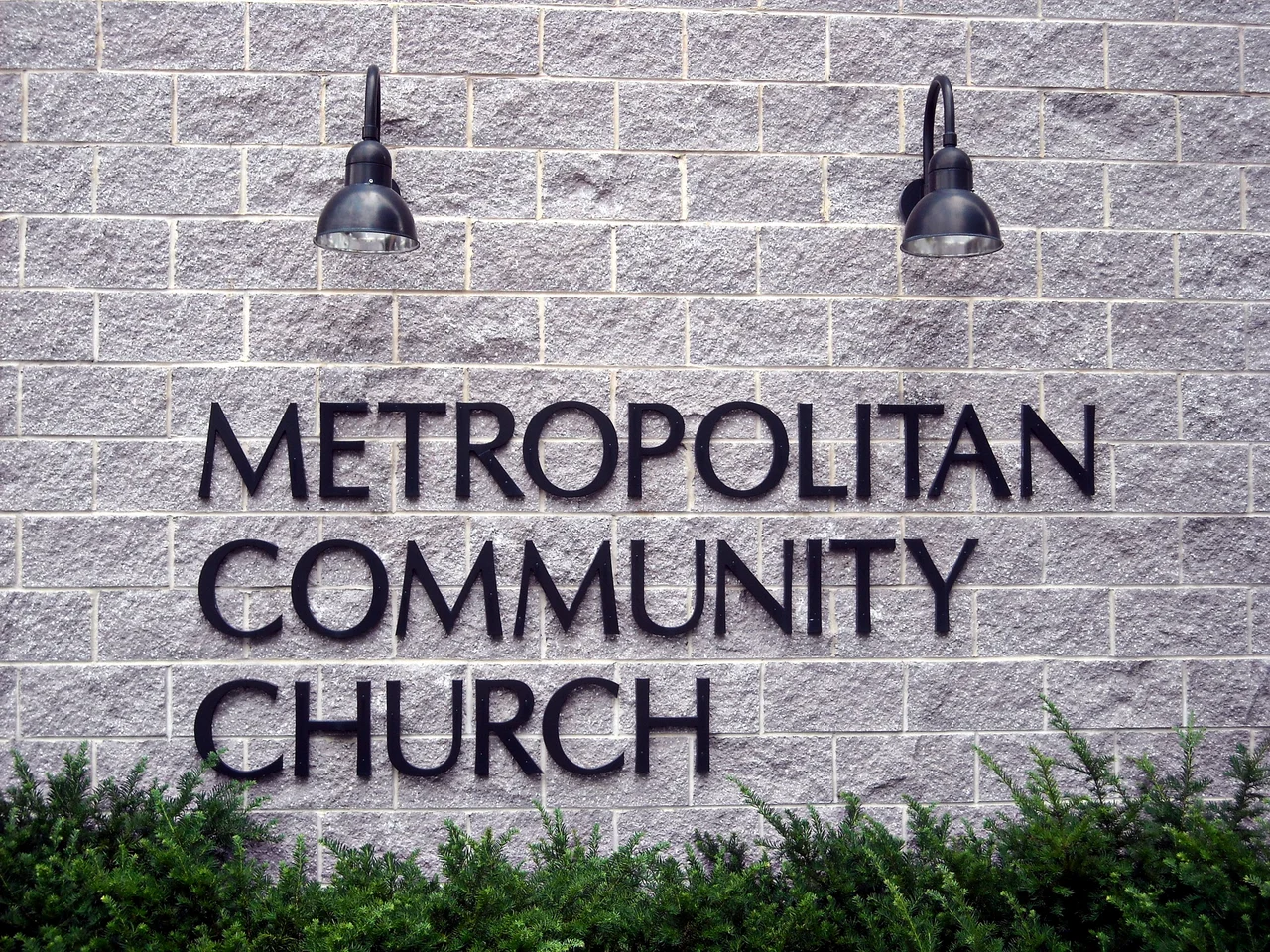

Metropolitan Community Church of Washington, D.C.
In February 1971, the Reverend Troy Perry was preparing to officiate a wedding ceremony for two members of the Community Church of Washington, D.C. The plan had been to hold the service in the sanctuary of St. Stephen and the Incarnation Episcopal Church. When Bishop William Creighton learned that two men were being married inside an Episcopal building, he locked the doors. The wedding moved to the steps outside. Perry, standing in front of the closed church, told his congregation: Even though Bishop Creighton has locked us out of this church, God hasn't locked us out of His heart. Twenty-two years later, the Metropolitan Community Church of Washington opened its own permanent sanctuary on Ridge Street, designed by Suzane Reatig - the first new sanctuary in the United States built by an LGBT religious organization. The locked doors of 1971 had pushed the congregation toward something the Episcopal Diocese could not lock them out of: their own building.
From the Homophile Social League
In January 1970, a group of LGBTQ Washingtonians formed the Homophile Social League. Paul Breton, a former Roman Catholic seminarian from Hartford, served as league president; he was also a founding member of the Gay Activist Alliance. That year, the league worked to get local churches to accept LGBT congregants. As part of those efforts, they began an ecumenical service at All Souls Unitarian Church. Frank Kameny, the Mattachine Society co-founder who had spent the 1960s building the modern American gay rights movement, introduced Breton to Troy Perry, the Pentecostal minister who had founded the Metropolitan Community Church in Los Angeles in 1968. Breton wanted advice on forming a Washington chapter. By the end of 1970, the Community Church of Washington was meeting at All Souls. In March 1971, Breton was ordained at All Souls by a Roman Catholic priest and three Methodist ministers - an ecumenical confirmation, he called it, of a commitment in grace and conscience already made. On May 11, 1971, the congregation was chartered as the Metropolitan Community Church of Washington.
The Rowhouse Years
After Bishop Creighton's lockout, the congregation moved to Breton's Capitol Hill rowhouse at 705 7th Street SE. Space was limited but services continued, and Breton's house became the site of additional weddings and commitment ceremonies. By late 1972, the congregation had outgrown the rowhouse and started meeting in an abandoned Capitol Hill church. Breton resigned in 1973 to start MCC congregations in Baltimore, Phoenix, and Los Angeles. John Barbone, a former Catholic priest, took over and led MCCDC into the First Congregational United Church of Christ, where they were briefly evicted after a vote by conservative FCUCC members - then welcomed back after a 1975 settlement. That same year, MCCDC helped establish the Jewish egalitarian community Bet Mishpachah and joined the local Council of Churches. In 1984, the congregation finally bought its own building: an 1866 rowhouse at 415 M Street NW that had previously housed the Shomrei Shabbos Orthodox Synagogue, then the Hebrew Home for the Aged.
Free Funerals
When the AIDS epidemic arrived in Washington, MCCDC was one of the first organizations to confront it directly. On December 9, 1982, the church hosted the area's first community AIDS forum, attended by around 200 people. The Reverend Larry Uhrig, then leading the congregation, spoke not only about the physical course of the disease but the psychological damage of internalized self-oppression that he saw shaping how gay men received the news of their own diagnoses. The forum was the first of many. A 1983 event co-hosted with the D.C. Coalition of Black Gays addressed AIDS in minority communities and was held at the Clubhouse, a Black gay bar. Because many churches and most funeral homes in the city refused to handle bodies of people who had died of AIDS, MCCDC changed its policy and began hosting funerals at no charge. Associate pastor Candace Shultis later remembered: There was only one funeral home in town at the time that was willing to even do an AIDS funeral. So we did a lot of funerals - not just for our own people, but for other people whose churches wouldn't do them. One of the reasons why I think there are so many women clergy in MCC is because the men died. The leadership began to be female because we were the ones who were surviving.
Reatig's Glass
By the late 1980s, the rowhouse on M Street was running three services every Sunday, with attendees standing in the doorway. The congregation began raising money for a permanent building. By mid-1990 they had $235,000 and bought a corner lot at 5th and Ridge Streets NW, a block from the rowhouse. Troy Perry attended the July 1990 groundbreaking. Architect Suzane Reatig - who had never designed a place of worship - was hired after impressing the building committee with what one member called unconventional ideas, chemistry, and enthusiasm. Her design ran contrary to what Pastor Uhrig had imagined; he had wanted formal seating, stained glass, dark wood. Reatig delivered something else: a cube of lightly pink concrete with a vaulted glass sanctuary rising from it, an arched concrete entrance with a single columnar support, and an inclined wall and staircase facing 5th Street. The $1.2 million building was dedicated in March 1993. A columbarium for cremated remains was built into the second-floor chapel - a quiet acknowledgment of how many of the congregation's funerals were still being held. The Washington Post architecture critic Benjamin Forgey and The New York Times critic Herbert Muschamp both praised the design. Reatig collected four major awards that year alone, including the 1993 Excellence in Religious Architecture award.
A Mission Largely Accomplished
Membership peaked at almost 500 by the early 2000s. The MCC congregations and the Human Rights Campaign organized the Millennium March on Washington in April 2000, drawing hundreds of thousands of people - though the march was criticized by many LGBT activists for what they called corporate sponsorship and an ill-defined platform. When D.C.'s same-sex marriage law took effect in March 2010, Pastor Dwayne Johnson officiated weddings on the first day marriage licenses were available. He performed 35 weddings before the year ended. By 2016, Sunday attendance had dropped to just over 200. The decline was largely a function of success - most mainline Protestant denominations had moved toward affirming LGBT congregants, and the safe space MCCDC had provided since 1970 was now widely available. Johnson's framing was matter-of-fact: Part of our early mission was to change society, to transform the world and ourselves. MCC accomplished that on many levels. More churches are welcoming now. That's not a loss for us. That speaks to the power of our message. The cube on Ridge Street still holds services. The congregation that was locked out of an Episcopal church on Stephen Square in 1971 still holds the key to its own door.
From the Air
The Metropolitan Community Church of Washington sits at 38.9063 N, 77.0187 W, at 474 Ridge Street NW in the Mount Vernon Square neighborhood of Washington. Best viewed from 1,500 to 2,500 feet AGL. Suzane Reatig's distinctive vaulted glass sanctuary atop a pink concrete cube is visible from above and stands out within the rowhouse-and-brownstone block. The Mount Vernon Square Metro station lies a few blocks south; the U.S. Capitol is about a mile southeast. Reagan National (KDCA) sits four nautical miles south. The site is inside the Washington Flight Restricted Zone; GA overflight prohibited.
Nearby Stories
- Gunston Hall 1.1 km away
- 2023 Baltimore Shooting 4.9 km away
- Battle of Middleburg 6.6 km away
- Crownsville Hospital Center 10 km away
- Battle of Loudoun Heights 13 km away
- First Battle of Rappahannock Station 20 km away
- Howard County, Maryland 21 km away
- Harriet Tubman Underground Railroad 50 km away