
Mid-Levels
Sara Roosevelt, the mother of Franklin D. Roosevelt, spent three years on a hillside in Hong Kong. From 1862 to 1865, during the American Civil War, she lived with her family on a Mid-Levels estate called Rose Hill — one of those spacious Victorian mansions with terraced gardens carved into the steep slope of Victoria Peak. The city spread below her; the harbor glittered beyond. The address said something about who you were. More than 160 years later, the logic holds.
Between the Peak and the Counting Houses
Mid-Levels occupies the band of hillside between Victoria Peak and the Central business district — high enough to catch cleaner air and better views, close enough to walk down to the financial core. This positioning made it desirable from the earliest colonial period, when British merchants and officials built large mansions with names like Cringleford and Idlewild on terraces hacked from the slope. The area today holds a population of around 49,320. Most residents are Chinese (62.4%), with Filipino (15%) and white (10.1%) communities forming the largest minority groups. The district divides into four rough quadrants: Mid-Levels West, anchored by Bonham Road, Caine Road, and Conduit Road near Sheung Wan; Mid-Levels Central, rising above Hong Kong Park and the Botanical Gardens; Mid-Levels East, curving toward Causeway Bay around Jardine's Lookout; and Mid-Levels North, near Braemar Hill and North Point. Many of the streets carry the names of former colonial governors — Bonham Road for Sir George Bonham (governor 1848–1854), Kennedy Road for Sir Arthur Edward Kennedy (1872–1877) — an overlay of imperial nomenclature on an area that has long since become something more complicated and more interesting than its origins.
The World's Longest Outdoor Escalator
In a city of steep hills and dense urban packing, the question of how to move people between levels without exhausting them is not trivial. Hong Kong's answer, at least for the Mid-Levels corridor, is the Central–Mid-Levels escalator system: 800 meters of covered moving walkway and escalator that cuts through the neighborhood from Central up to Conduit Road. It opened on 15 October 1993 and holds the record as the longest outdoor covered escalator system in the world. The logic of its scheduling reflects Hong Kong's rhythms exactly: downhill from 6 a.m. to 10 a.m. for the morning commute, then uphill from 10:30 a.m. to midnight for the rest of the day. Pedestrians going the other way use adjacent stairs and footpaths. What began as a practical transit solution has become a tourist attraction and a defining piece of the neighborhood's texture — a slow mechanical river running through the terraced streets, past restaurants and shops and residential towers.
Gardens, Temples, and Teaware
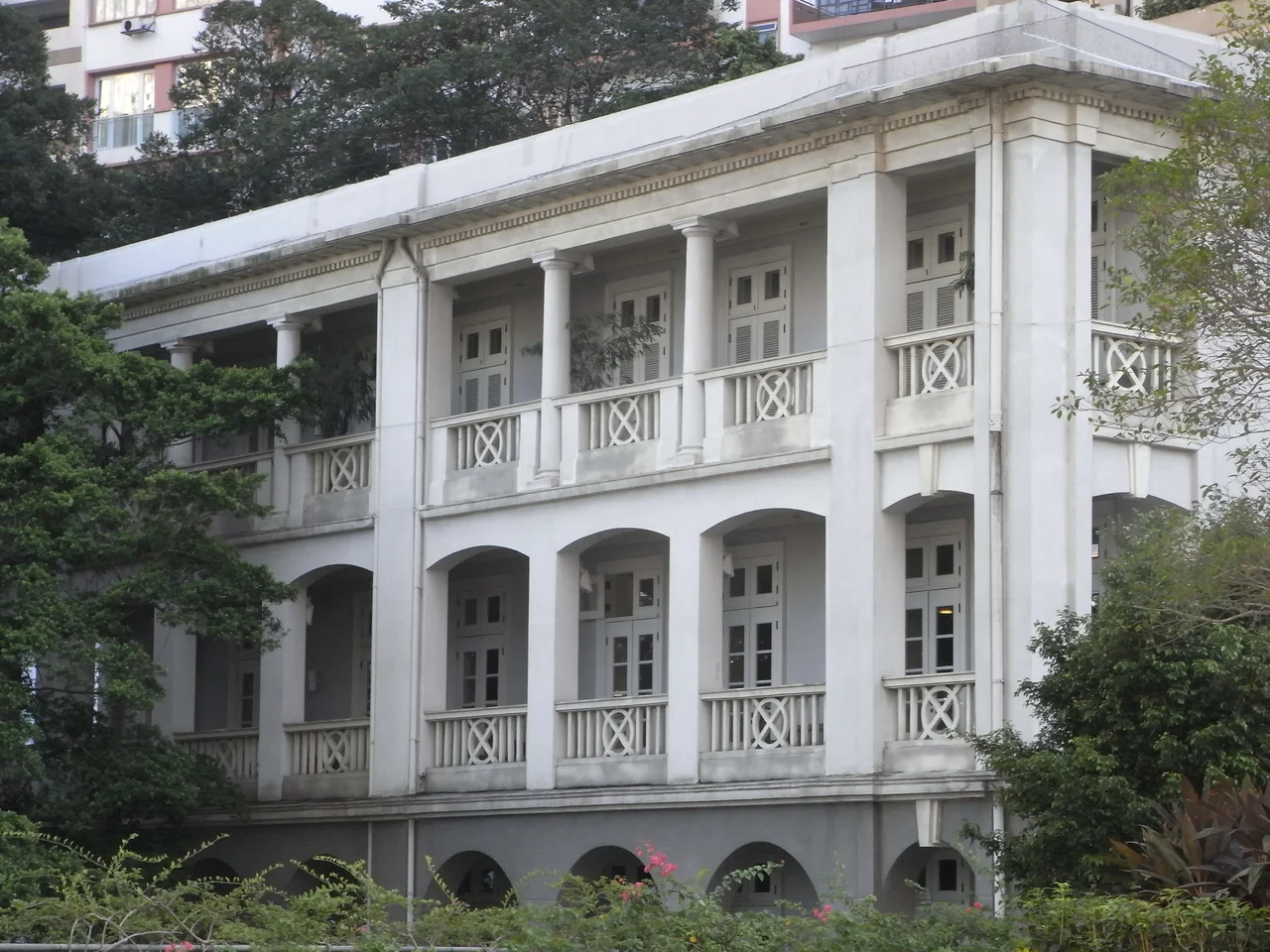
The Hong Kong Zoological and Botanical Gardens stretches across the northern slopes of Victoria Peak on the edge of Mid-Levels, open to the public since 1862. What was once called Bing Tao Garden — the Chief Commander's Garden — evolved over more than a century into a collection of over 600 birds, 70 mammals, and 40 reptiles, including orangutans and gibbons that are part of active captive breeding programs. At Hong Kong Park, lower on the slope along Cotton Tree Drive, the Flagstaff House Museum of Tea Ware occupies one of the oldest surviving Western-style buildings in Hong Kong, a structure from the 1840s that once served as the Commander of the British Forces' residence before it was converted to a museum of Chinese tea culture in 1984. Nearby, the Jamia Mosque on Mosque Street — one of the oldest in Hong Kong — is accessible from the Mid-Levels escalator, a juxtaposition that captures something of the neighborhood's layered identity.
Schools, Sun Yat-sen, and a Future President's Mother
Mid-Levels has accumulated institutions the way old cities accumulate meaning. St. Paul's College, established in 1851, is the oldest school in Hong Kong. The University of Hong Kong's Main Building, completed in 1912 in red brick and granite with four turrets and a central clock tower, sits at the area's western edge — built with donations from Parsi merchant H.N. Mody, its clock tower a gift from Sir Paul Chater. Sun Yat-sen, who would go on to lead the 1911 revolution that ended imperial China, attended what was then To Tsai Church on Hollywood Road while studying medicine in Hong Kong; his teacher of Chinese literature, Fung-Chi Au, was an elder there. The church moved to Bonham Road in 1926 and was renamed Hop Yat Church. The neighborhood's layers run deep: an American president's mother watched the harbor from a terrace here; a future Chinese revolutionary learned Confucian texts a few streets below.
Living at Altitude
Property prices in Mid-Levels communicate ambition in figures that concentrate the mind. Apartments range from tens of millions to hundreds of millions of Hong Kong dollars, with one unit in a Frank Gehry-designed building reportedly offered at US$9,200 per square foot in 2009 — then a world record. A development moratorium established in 1972, designed to limit traffic pressure, restricts building on 43 private sites in the area, constraining supply and maintaining a particular texture. The streets wind between high-rises and low colonial remnants; the escalator hums upward in the afternoon light. Residents trade a commute for altitude, choosing the clean air and views over the flatland density below. Hong Kong compresses everything — history, money, migration, ambition — and Mid-Levels sits precisely at the compression point.
From the Air
Mid-Levels occupies the hillside above Central on Hong Kong Island at approximately 22.2826°N, 114.1426°E, spanning elevations from about 50 to 300 meters. The Peak (Victoria Peak, 552m) rises immediately to the southwest. From the air, the area is visible as the densely built terraced zone between the Central waterfront and the distinctive green summit of The Peak. Hong Kong International Airport (VHHH) lies roughly 25 km to the west on Lantau Island. Crossing the Peak area, maintain 2,500 feet minimum to clear terrain. Victoria Harbour is the prominent water feature to the north; the escalator corridor running northeast up the slope is occasionally visible in satellite imagery.
Nearby Stories
- Lok Ma Chau Loop 2.3 km away
- Portas do Cerco 2.3 km away
- Kweilin Incident 17 km away
- Wanshan Archipelago Campaign 34 km away
- Nanxiong Formation 115 km away
- Battle of Nanpeng Island 148 km away
- Heyuan 169 km away
- Cape Maobitou 632 km away