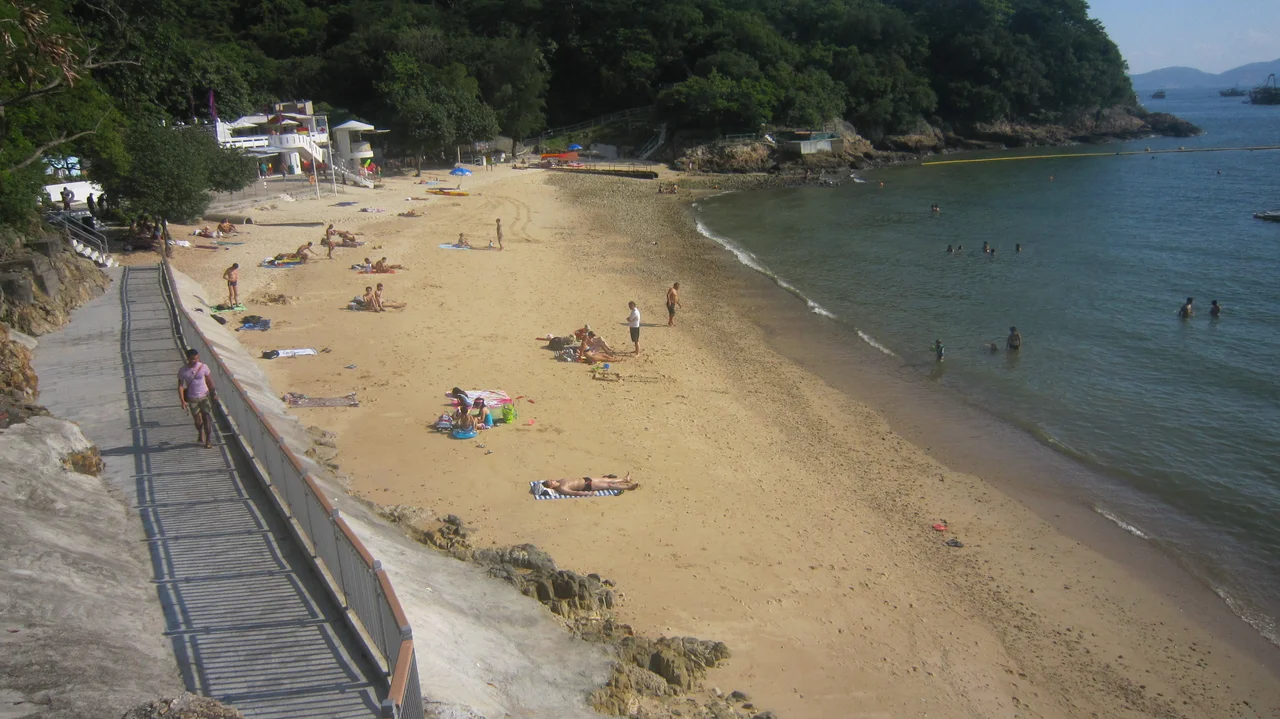

Middle Bay (Hong Kong)
On a Sunday afternoon in July 1983, a red speedboat entered the restricted swimming zone at Middle Bay and struck three young swimmers. The boat did not stop. It fled toward Deep Water Bay, leaving one swimmer, 24-year-old Alun Chan Hon-wah, with injuries that required amputation of his foot and part of his lower leg. The case was never solved. The marine police increased their beach patrols. The Urban Council installed new alarm systems. Middle Bay went on being Middle Bay — a small, sheltered beach on Hong Kong Island's southern shore, tucked between the larger Repulse Bay to the north and South Bay to the south, remembered by most visitors only for its calm water and afternoon shade.
The Shape of the Shore
Middle Bay sits in the Southern District of Hong Kong Island, a modest crescent between two better-known beaches. Repulse Bay, immediately to the north, draws the larger crowds; South Bay lies just beyond the next headland to the south. Middle Bay occupies the space between them — smaller, quieter, and less visited by the tourist circuit. The beach is gazetted, meaning it carries official status under Hong Kong's beach management system, with lifeguards provided by the Leisure and Cultural Services Department during daytime hours in the summer months. The water here is part of the South China Sea, open to the southeast, sheltered from the west by the green hills that run along Hong Kong Island's southern spine.
Pavilions and Ballots
Middle Bay's social history is written in bathing sheds. For much of the mid-twentieth century, the coastline here was lined with wooden structures built by swimming associations, university alumni groups, and various civic organizations. The Hong Kong University Alumni Association opened its swimming pavilion at Middle Bay in 1957. By 1962, there were 49 such huts along the bay's shoreline, each leased annually through a public ballot. They were informal, communal, a little ramshackle — the kind of beach infrastructure that accumulates when a city of people from many different backgrounds finds a shared pleasure in the water. The Urban Council began dismantling this arrangement in the late 1960s, replacing private huts with public changing facilities. Some huts came down in 1969. A new beach building was completed in July 1975. The rest of the bathing huts were demolished shortly after. What was once a mosaic of private beach clubs became a public beach, uniform and accessible.
After the Speedboat
The 1983 hit-and-run changed Middle Bay in practical ways. The case — classified by police as endangering life at sea — prompted a broader government response to water safety at Hong Kong's southern beaches. Marine police patrols increased around beach zones. The Urban Council fitted new alarm systems and loudspeakers at beaches around the territory. Alun Chan Hon-wah, whose injury was among the most severe, rebuilt his life in the months that followed; the South China Morning Post reported on his recovery in August 1983. The boat, and whoever was steering it, were never identified. The restricted swimming zone remained in place. The beach received its swimmers the following summer, and the summer after that.
A Beach in the City
Today Middle Bay is what Hong Kong's southern shore beaches generally are: a local amenity used by residents of the nearby neighborhoods, accessible by bus from Aberdeen or by foot from Repulse Bay, with BBQ pits, changing rooms, showers, a raft moored offshore, and a tuck shop. The hills behind the beach carry the dense green cover typical of Hong Kong's southern country parks. There are no resort hotels here, no beachfront promenades. The sand is a few hundred meters long. On summer weekends, families spread out across it; on weekday mornings it can be nearly empty. Middle Bay is what the name suggests — a middle place, between the more famous and the more secluded, catching what the others leave behind.
From the Air
Middle Bay sits on the southern coast of Hong Kong Island at approximately 22.2304°N, 114.1973°E, between the more prominent Repulse Bay to the north and South Bay to the south. The bay faces southeast toward the South China Sea. Viewed from altitude, the southern coast of Hong Kong Island shows a series of small bays carved into the green hillside — Middle Bay is the central notch between the larger Repulse Bay beach and the smaller South Bay. Hong Kong International Airport (VHHH) is approximately 28 km to the west on Lantau Island. Aberdeen Harbour lies about 4 km to the northwest. Overfly the area at 1,500 feet or above; terrain rises sharply from the coast.
Nearby Stories
- Lok Ma Chau Loop 2.3 km away
- Portas do Cerco 2.3 km away
- Kweilin Incident 17 km away
- Wanshan Archipelago Campaign 34 km away
- Nanxiong Formation 115 km away
- Battle of Nanpeng Island 148 km away
- Heyuan 169 km away
- Cape Maobitou 632 km away