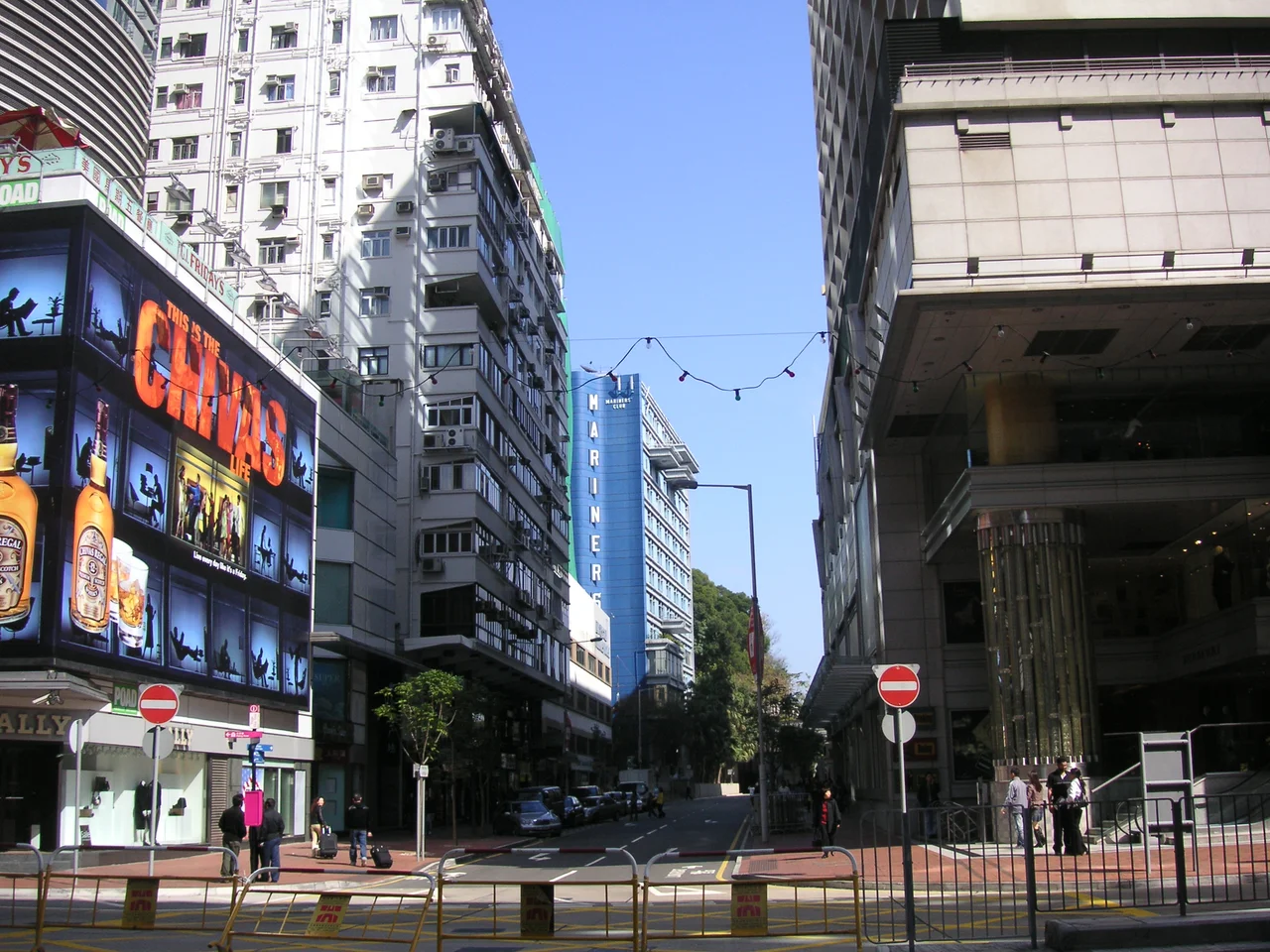

Middle Road, Hong Kong
Before Kowloon was what it is now, there was a beach between Blackhead Point and the hill where the Former Marine Police Headquarters stands. The bay was concave, sheltered, and eventually inconvenient. Engineers reclaimed it in the early twentieth century to build a railway station, and then a hotel rose on the reclaimed land between that station and the road that had followed the old shoreline. Middle Road still traces that curve. Walk along it today and you are following the ghost of a beach that vanished more than a hundred years ago.
A Street That Follows the Old Shore
Middle Road runs through the southern part of Tsim Sha Tsui, one of Kowloon's densest commercial and hotel districts, from Kowloon Park Drive in the west to a ninety-degree turn that terminates at Salisbury Road in the south. The street was constructed in the late nineteenth century, when this part of the Kowloon waterfront still had a natural coastline. The road's gentle curve aligns with what was once the concave shoreline between two promontories. When the bay was reclaimed for the Kowloon station of the Kowloon-Canton Railway, the street found itself inland — and eventually found the Peninsula Hotel, which was built on the reclaimed ground between the old station and Middle Road. The land reclamation that remade this part of Tsim Sha Tsui was one of many such interventions across Hong Kong's coastline; Middle Road is one of the few places where the original topography is still legible, if you know what you're looking for.
The Peninsula and Its Skyway
By the mid-twentieth century, Middle Road had acquired its signature landmark. The Peninsula Hong Kong, one of the most celebrated hotels in Asia, fronts Salisbury Road but backs onto Middle Road at the corner of Nathan Road. For a quarter century, from 1957 to 1982, the hotel operated an annex called Peninsula Court across Middle Road, connected to the main building by a skyway built in the 1970s — a glass bridge spanning the street, carrying guests between the two buildings above the traffic below. The Peninsula Court is gone now; the skyway with it. What remains is the back of the Peninsula, solid and cream-colored, facing the road that once marked a coastline it never touched.
Car Parks, Auctions, and a Tower
The eastern end of Middle Road accumulated its own history at street level. A ten-storey multi-storey car park opened there on 11 January 1965, and on opening day was the largest of its kind in Hong Kong. It stood for nearly fifty years, spanning part of the road itself, housing at various points the Yau Tsim District Office before district boundaries were redrawn. In 2014, the government rezoned the site for commercial use and put it up for auction. Henderson Land won the tender in September 2014 with a bid of HK$4.7 billion. The car park closed and was demolished, replaced by a commercial tower that, unlike its predecessor, does not straddle the road. The section of road the car park once overshadowed was unnamed until May 1987, when the Urban Council formally extended the name Middle Road to cover it.
The Underground Artery
When the Kowloon-Canton Railway extended to a new terminus at East Tsim Sha Tsui station in the early 2000s, engineers needed to connect it to the existing Tsim Sha Tsui station of the MTR. The solution ran beneath Middle Road. A 250-metre pedestrian subway was built under the road between the new KCR station and the Kowloon Hotel. The tunnel was later extended further west to Kowloon Park Drive, linking up with existing government subways. Today, the entire east-west length of Middle Road has a pedestrian underpass running beneath it — an underground corridor that serves as a major artery for the tens of thousands of people who move through Tsim Sha Tsui each day. Above ground, the road carries buses, taxis, and tourist coaches; below, the foot traffic streams quietly through tiled passages lined with exits to the Peninsula, the Kowloon Hotel, and the transit system beyond.
Surface and Depth
Middle Road today is dense with the specific business of Tsim Sha Tsui: hotels, transport exits, a YMCA at the western corner. The street is not long — a few hundred meters at most. But it carries two centuries of layered history: a lost beach, a railway station, a hotel skyway, a landmark car park, an underground pedestrian network. Most people who walk along it, or through it, are not thinking about the concave bay that once sat here. They are transferring between hotel and station, or cutting from Nathan Road to Kowloon Park. The street is useful. It was always useful. That is partly why it has been remade so many times.
From the Air
Middle Road runs through Tsim Sha Tsui in southern Kowloon at approximately 22.2956°N, 114.1720°E, close to the southern tip of the Kowloon Peninsula. Victoria Harbour lies immediately to the south, with Hong Kong Island visible beyond. From the air, Tsim Sha Tsui is identifiable by its dense hotel and commercial towers clustered at the peninsula tip; Nathan Road runs north as a clear corridor through the urban grid. The Peninsula Hotel's distinctive building marks the southern end of the Nathan Road–Middle Road junction. Hong Kong International Airport (VHHH) is approximately 23 km to the west on Lantau Island. Maintain appropriate altitude over the urban Kowloon area.
Nearby Stories
- Lok Ma Chau Loop 2.3 km away
- Portas do Cerco 2.3 km away
- Kweilin Incident 17 km away
- Wanshan Archipelago Campaign 34 km away
- Nanxiong Formation 115 km away
- Battle of Nanpeng Island 148 km away
- Heyuan 169 km away
- Cape Maobitou 632 km away