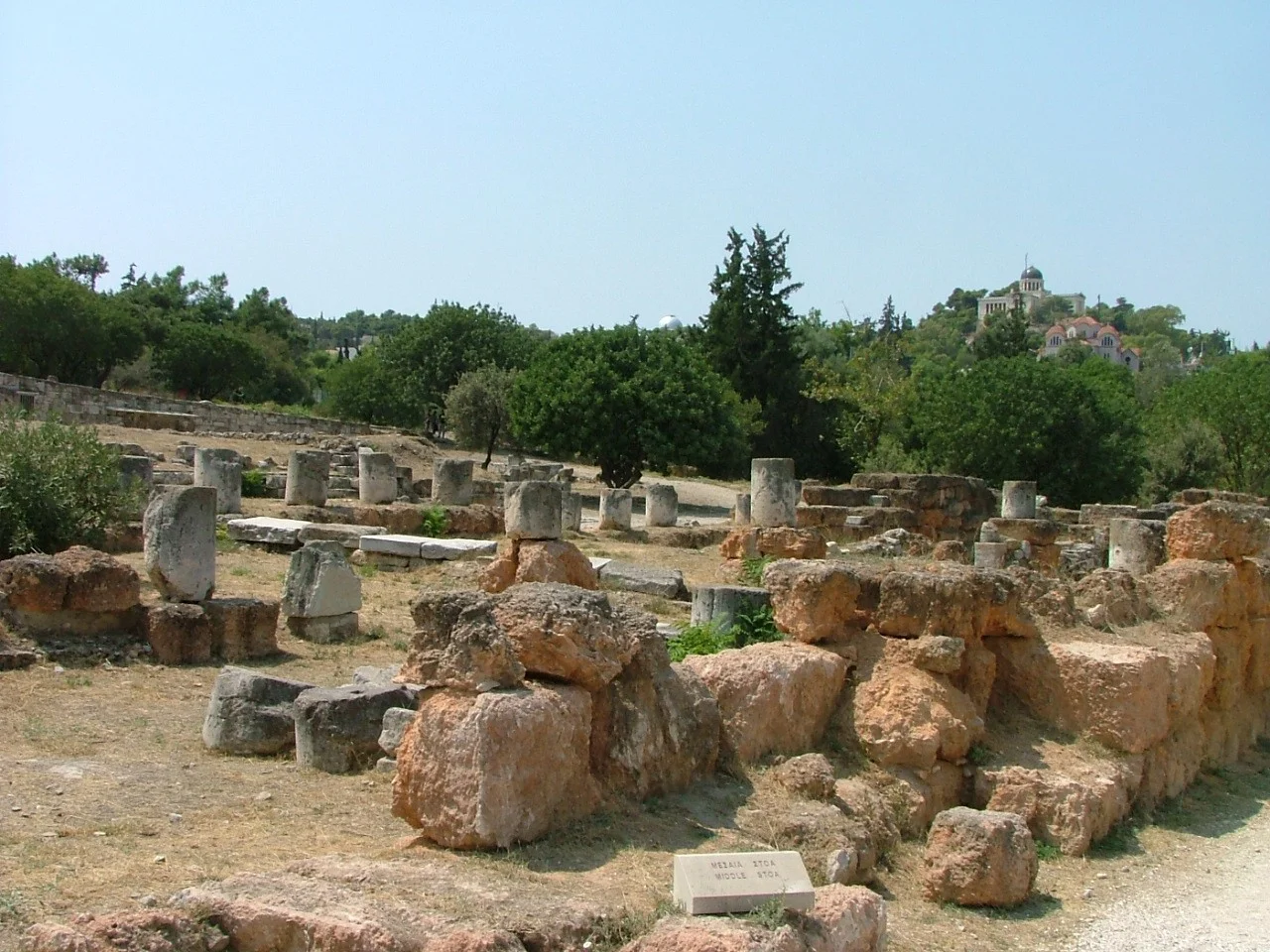

Middle Stoa
Sometimes the biggest building in a place is the one history half-forgets. The Middle Stoa was the largest structure ever raised in the Agora of Athens - 147 meters of colonnade running east to west across the public square - and yet its purpose is still argued over, its builder never named in any surviving inscription. What survives is a foundation of reddish stone, a few columns at the eastern end, and a riddle: who paid for it, and what was it for?
Splitting the Square
In the second century BC, the southern side of the Athenian Agora was transformed. A burst of new construction reshaped the civic heart of the city, and the Middle Stoa came first. Running the length of the square at the northern foot of the Acropolis, just south of the little Eridanos River, the building physically divided the Agora into two unequal halves - a larger zone to the north, a smaller one to the south. Its construction is dated by modern research to somewhere between roughly 180 and 140 BC, and once built, it stayed in use for centuries, right through the long Roman era.
A Date Written in Wine Jars
How do you date a building no one signed? In the case of the Middle Stoa, the answer came from garbage. To level the sloping ground before construction, the builders packed the site with debris - including some 1,500 stamped handles from amphorae, the ceramic jars that carried wine and oil across the Mediterranean. Most of the stamps were Rhodian and Knidian, and a careful reading of them pins the latest material in the fill to the second decade of the second century BC. One detail clinches it: stamps from Sinope vanish from the record around 183 BC, when the city was captured - giving archaeologists a firm cut-off date for when the ground was filled.
The King Who May Have Paid
That date of 183 BC points a finger at a foreign benefactor: Pharnaces I of Pontus. In that very year, Pharnaces seized Sinope and Amisus, taking control of the great grain ports of the Black Sea. An Athenian decree found on the island of Delos, dated 160/159 BC, honours Pharnaces and records a sum he had promised the city, paid in installments - money that scholars argue likely funded the enormous terracing and construction of the Middle Stoa. The design supports the idea of an outsider's hand: the building used construction techniques unusual for Athenian architecture of the period, suggesting foreign architects drew the plans.
Granary or Marketplace?
And here is the puzzle's heart. Tradition calls the Middle Stoa a commercial stoa, a covered space for trade. But its bones tell a different possible story. It was long and narrow, with a raised floor to keep out damp and an enclosed exterior to shut out vermin and weather - exactly the features of an ancient granary, the kind the Romans called a horreum. If Pharnaces, master of the Black Sea grain trade, really was the donor, then a granary would have been a pointed and fitting gift: the grain king giving Athens a place to keep its grain. Inside ran a clever spine of columns - Doric on the outer sides, Ionic down the middle - holding up a terracotta roof over walls of limestone.
What Burned, What Lasts
Walk the Agora today and the Middle Stoa is a ground plan more than a building. At the eastern end, original steps and three columns still stand where they were set more than two thousand years ago; at the western end, only the heavy reddish conglomerate foundations remain. The narrow parapets that once ran between the columns are partly preserved. And across the ruins lie the scars of fire - the excavated remains show signs of intense burning, proof that this vast stone hall once carried a great deal of timber in its roof and upper works, all of it long since gone to ash and memory.
From the Air
The remains lie within the Ancient Agora of Athens at 37.9747 N, 23.7231 E, in the archaeological zone northwest of the Acropolis. From the air, the Agora reads as a green archaeological clearing below the unmistakable plateau of the Acropolis, with the well-preserved Temple of Hephaestus on its western edge as the clearest single landmark. Athens International Airport (LGAV) is about 31 km east-southeast. Best viewed at low altitude on a clear morning before the summer haze builds.
Nearby Stories
- Great Sand Beach 5 km away
- Battle of Delium 7.7 km away
- Tower of Aliartos 9 km away
- HMHS Britannic 10 km away
- Saronic Gulf 15 km away
- Sousaki Volcano 17 km away
- Sanctuary of Apollo Maleatas 24 km away
- Skyros 66 km away