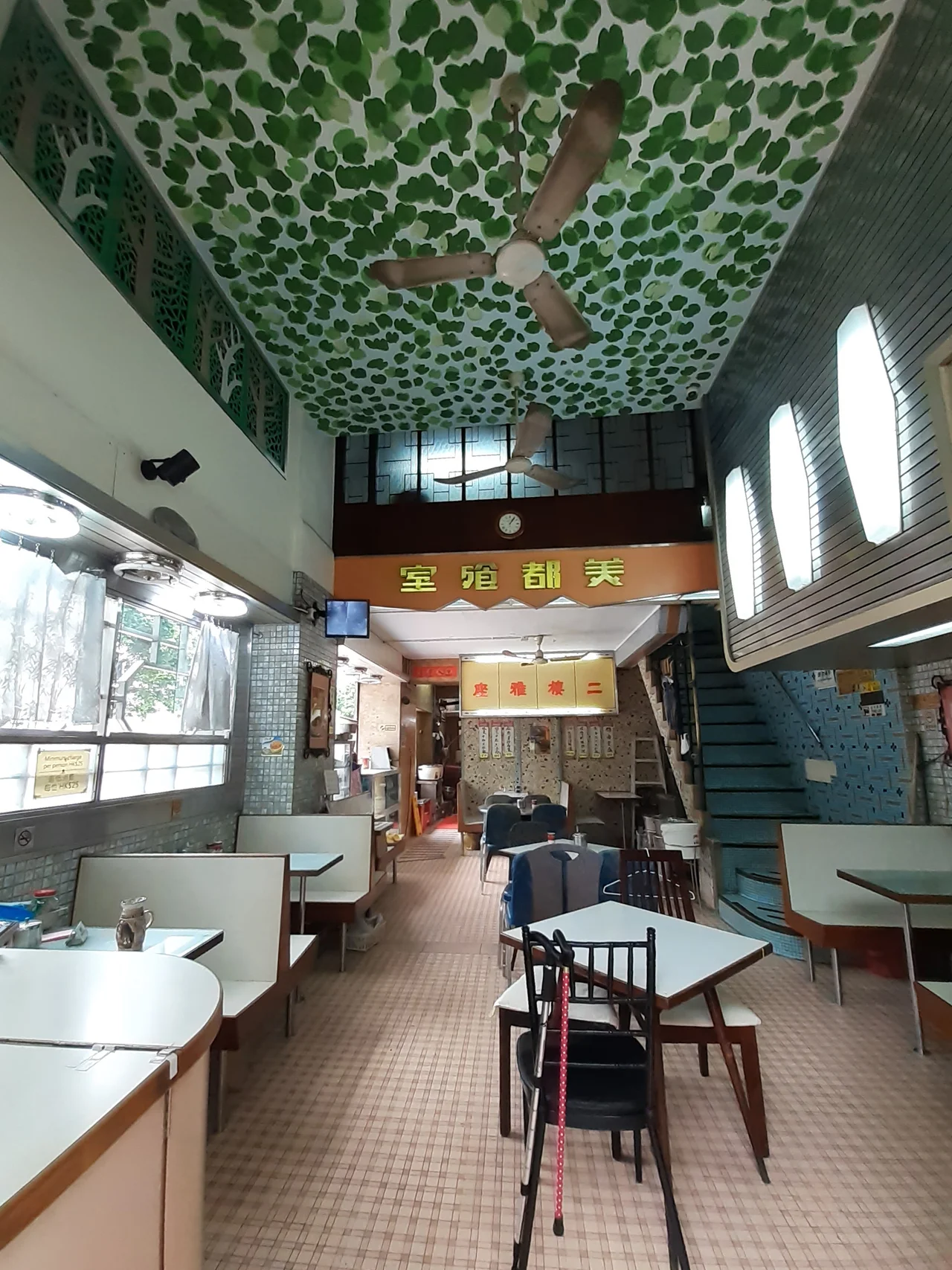

Mido Cafe
On July 18, 2022, a hand-written letter appeared on the door of No. 63 Temple Street. No explanation. No timeline. Just a notice that Mido Cafe was closed. The neighbourhood had seen the 1950 restaurant weather triad films and acid attacks, urbanisation and economic upheaval, more than seven decades of neon-lit change on the street outside — and then nothing but a note. Three months later, the doors opened again.
Tea, Toast, and a Corner Table
A cha chaan teng is part café, part cultural institution — the quintessentially Hong Kong hybrid of Western and Cantonese food culture that emerged in the mid-twentieth century when working-class neighbourhoods wanted affordable Western-style meals without the expense of hotel dining. The bing sutt variant, which Mido Cafe also embodies, is its cooler, more leisurely sibling: a place for milk tea, pineapple buns, and a newspaper at midday. Mido Cafe opened in 1950 at the corner of Temple Street and Public Square Street in Yau Ma Tei, Kowloon. The upper floor, with its mosaic-tiled surfaces and wrought-iron balustrades, has the unhurried feel of a place that never tried to be fashionable. It simply stayed while everything around it changed. The milk tea arrives in the same style it has for decades. The toast is thick-cut. The ceiling fans move slowly overhead.
A Street That Never Sleeps
Temple Street runs through the heart of Yau Ma Tei, a neighbourhood that has stubbornly preserved its older character while the rest of Kowloon has been repeatedly rebuilt around it. By day the street is a narrow corridor of hardware sellers and fortune tellers. After dark it transforms into a night market — incense, Cantonese opera, the clatter of mahjong tiles from open windows above. Mido Cafe sits at its northern reach, where Public Square Street crosses. The corner location gives it two street-facing windows and a view across the temple courtyard to the Tin Hau Temple that gives Temple Street its name. Film crews have used this view repeatedly: The World of Suzie Wong shot here in 1960, making Mido Cafe part of Hong Kong cinema history before that history had accumulated much weight.
The Camera Keeps Coming Back
Over seventy-five years, Mido Cafe has accumulated a filmography that reads like a condensed history of Hong Kong cinema. Moonlight Express found its atmosphere here in 1999. Goodbye Mr. Cool used the interior in 2001. Revolving Doors of Vengeance returned in 2005. The 2018 television series Strangers discovered that its worn tiles and wooden booths still read, on screen, as authentic Hong Kong in a way that newer interiors cannot replicate. This is not nostalgia for its own sake — it is the camera recognising that some interiors accumulate meaning faster than they accumulate age. The upper floor, photographed from across Temple Street, shows a layered facade that could only exist in a city that built and rebuilt itself without ever quite demolishing the original.
The Letter and the Return
The 2022 closure without explanation set off anxious speculation about whether Mido Cafe had finally reached its end. Hong Kong had seen too many beloved cha chaan tengs fall in recent years — replaced by chain outlets or left empty as rents rose. Time Out Hong Kong reported the closure; the South China Morning Post called it iconic. Three months of quiet followed. Then, on October 28, 2022, the doors opened again. No grand announcement. No rebrand. The milk tea was the same. The corner table by the window was occupied again. In a city that can transform a neighbourhood in the time it takes to demolish and rebuild a block, the unremarkable return to service was its own kind of statement.
From the Air
Mido Cafe sits at 22.310°N, 114.170°E in Yau Ma Tei, on the Kowloon Peninsula. From the air, the dense low-rise grid of Yau Ma Tei is visible northwest of the Kowloon MTR terminus. The nearest major airport is Hong Kong International Airport (VHHH), approximately 28 km to the west on Lantau Island. Recommended viewing altitude is 3,000–5,000 feet to distinguish the Kowloon street grid; descend toward Victoria Harbour to see the Temple Street corridor. The Tin Hau Temple courtyard just south of the café provides a navigational reference from low altitude.
Nearby Stories
- Lok Ma Chau Loop 2.3 km away
- Portas do Cerco 2.3 km away
- Kweilin Incident 17 km away
- Wanshan Archipelago Campaign 34 km away
- Nanxiong Formation 115 km away
- Battle of Nanpeng Island 148 km away
- Heyuan 169 km away
- Cape Maobitou 632 km away