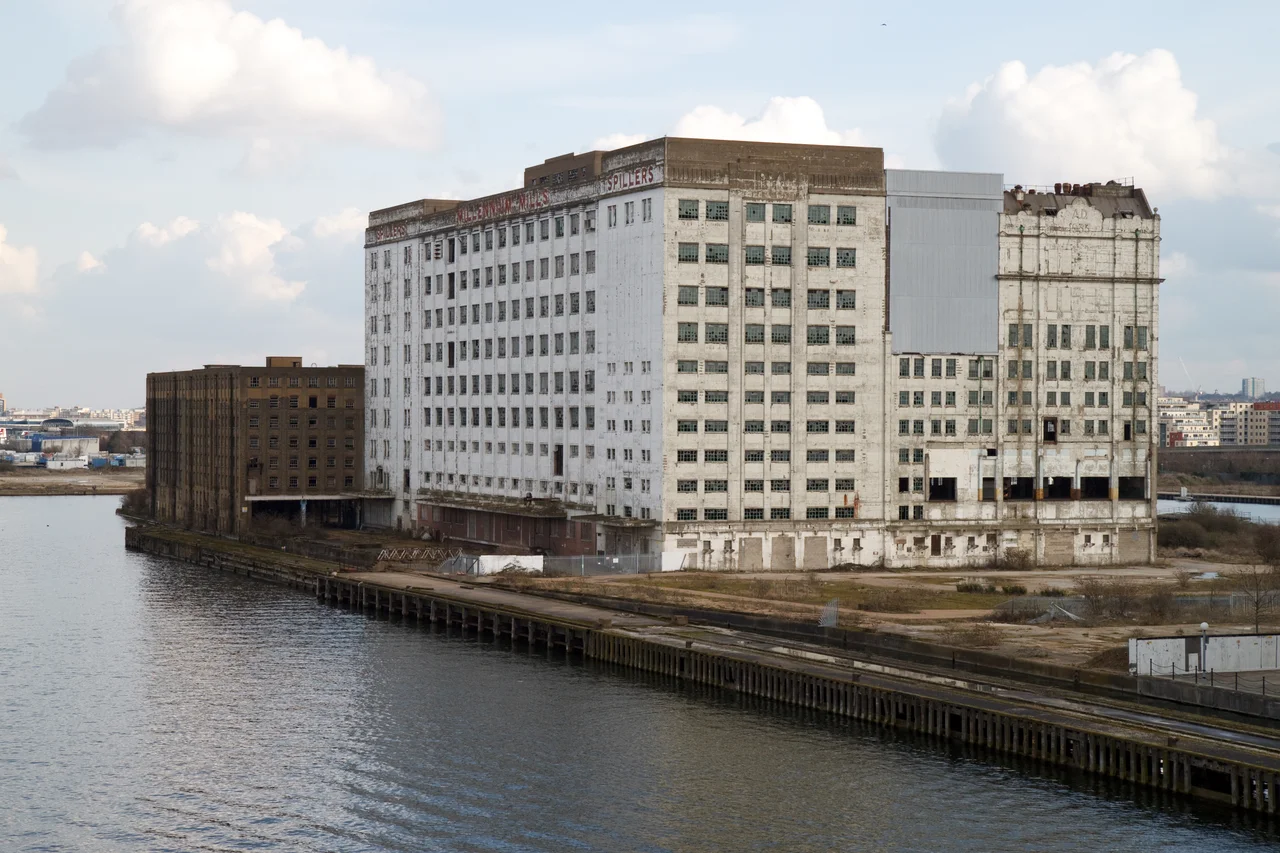

Millennium Mills
Film directors have a particular love for Millennium Mills, and it is not hard to see why. The vast concrete bulk rises over the Royal Victoria Dock like an industrial cathedral that has lost its congregation - smoke-stained, window-broken, scrawled with three decades of urban explorer graffiti, and somehow more cinematic for the abandonment. Matt Reeves shot scenes for The Batman here in 2022. Paddington 2 came in 2017. Danny Boyle filmed Trance on these floors in 2013. Before any of them, Derek Jarman made a music video here for The Smiths in 1986, when the rust was still fresh and Morrissey could pose in front of broken glass without anyone calling it a location.
Flour for an Empire
The Premier Mill of Vernon & Sons opened in 1905 to grind the wheat that fed London, drawing grain from ships that had crossed the Atlantic and the Black Sea to deliver into the Royal Victoria Dock. At peak production the complex turned out enough flour to supply a city that was still expanding in every direction. The architecture - layered concrete, art deco ornament around the cornices, vast silos and processing halls - was built for the brute economics of bulk milling, then dressed up with just enough style to read as a modern industrial statement. Survived two world wars, including bombing raids that left scars on the eastern walls. Survived the 1917 Silvertown explosion at the nearby Brunner Mond munitions factory, which killed 73 people and damaged buildings for miles. What it could not survive was containerisation.
When the Docks Closed
The Royal Docks closed in 1981. The big ships had moved to Tilbury, where the cranes could load and unload steel containers without the small army of dockworkers that older systems required. Millennium Mills was simply too far inland for the new economy. The doors locked, the lights went out, and the building entered a long limbo that lasted longer than anyone could have predicted. The London Docklands Development Corporation, founded the same year the docks closed, gradually transformed the surrounding wharves into Canary Wharf and luxury riverside housing. The Mills stayed empty. Asbestos. Pigeon nests. Floors carpeted with broken glass and the slow drift of rust. Urban explorers slipped past the fencing, photographed each other on the silo roofs, and posted their trespasses online. The site went into administration in 2012 after the failure of the London Pleasure Gardens festival, costing Newham council £4 million.
The Most-Filmed Ruin in London
Television came calling first. The BBC drama Ashes to Ashes, set in the early 1980s, used the Mills to evoke an East London that had not yet been gentrified - the show literally needed a landscape from before the Docklands transformation, and here it was, preserved in dereliction. Then came the music videos, then the features. In 2013 the cameras came for The Man From U.N.C.L.E., the same year Danny Boyle filmed Trance. In 2016 a quarter of YouTube Rewind was shot here, of all things. Paddington 2 in 2017. The Innocents on Netflix in 2018. The TV series Informer the same year. Alex Rider in 2020. Then in 2022, Robert Pattinson's brooding Batman stalked the Mills' shadows for Matt Reeves. The building's particular gift to filmmakers is its enormity - the kind of scale that production designers cannot fake on a soundstage, and that postapocalyptic stories need almost by definition.
The Long Road Back
In April 2015 Newham Council approved the £3.5 billion Silvertown redevelopment, with Millennium Mills as the centrepiece. Penny Mordaunt, then communities minister, came to mark a £12 million government grant for asbestos removal and called the building "iconic". Boris Johnson, then Mayor of London, talked about breathing new life into the dormant docks. The plan: convert the Mills into a centre for startup businesses, fill in part of Pontoon Dock, build a new business district where the wheat had once arrived. Work began. It has continued, in fits and starts, ever since. The asbestos came out. The structural surveys came in. The film crews still came when the rooms could spare them. As of the mid-2020s the building stands somewhere between ruin and renewal - cleaner than it was a decade ago, not yet what it will become, still photogenic enough that the location scouts have not stopped calling.
A Building That Holds Its Eras
There is something instructive about a structure that has been so many things to so many people. To Edwardian London, a triumph of industrial logistics. To dockworkers, a place of skilled and dangerous labour. To urban explorers, a forbidden playground. To filmmakers, a ready-made dystopia. To developers, a £3.5 billion problem and opportunity. Few buildings collect this many contradictions and keep standing. The Mills do, partly because the concrete was poured to last and partly because no era has yet decided what to do with them. Walk along the dockside path on a clear morning and the building's reflection breaks across the still water, the silos rising into mist, and for a moment the place is exactly what every photographer hopes for - a monument to a city in transition, still legible, still unfinished.
From the Air
Millennium Mills sits at 51.51°N, 0.03°E on the Royal Victoria Dock in the London Borough of Newham. The complex is immediately recognisable from the air: a massive rectangular block of concrete silos and processing halls beside the dock, with the ExCeL exhibition centre to the north and the Thames Barrier downstream to the southwest. London City Airport (EGLC) is less than a mile to the east, and approaches to runway 27 fly directly past the Mills. Best viewed from 1,500-3,000 feet.
Nearby Stories
- Waytemore Castle 2 km away
- Prittlewell Royal Anglo-Saxon Burial 4.2 km away
- Sevenoaks 5.6 km away
- Central line (London Underground) 6.4 km away
- River Lea 9.7 km away
- Surrey 11 km away
- Mercury Theatre, Colchester 14 km away
- Faversham Munitions Explosion Memorial 14 km away