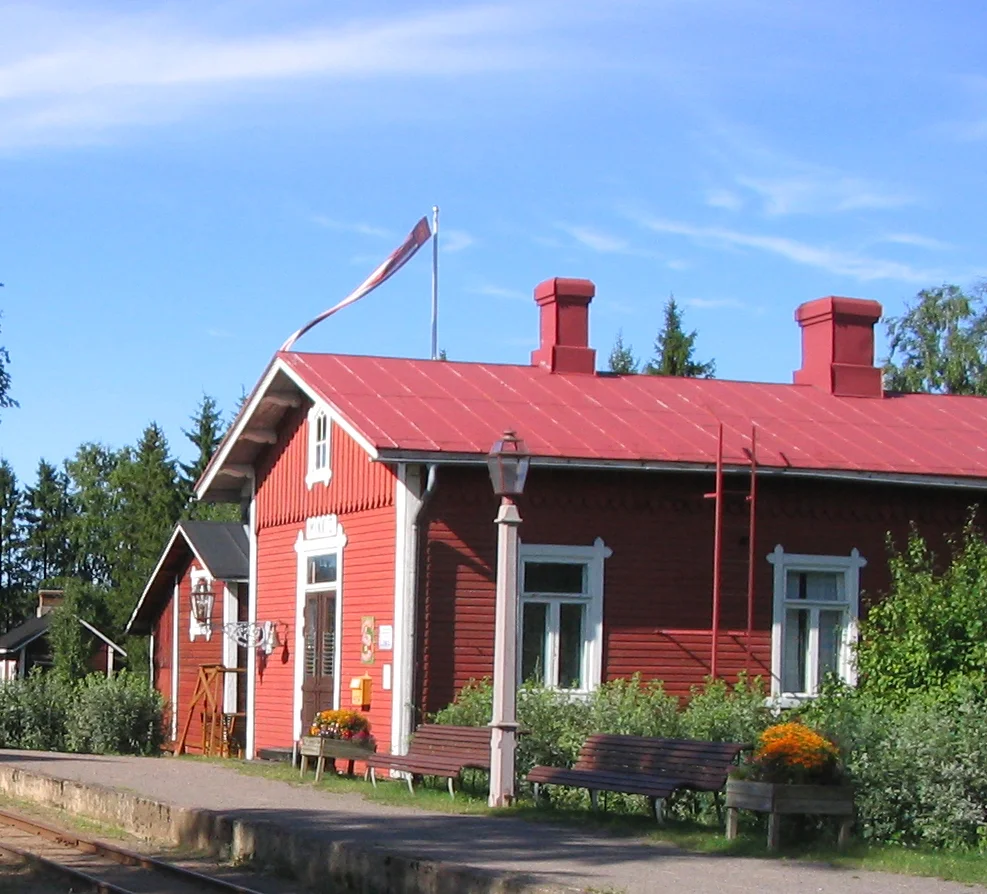

Minkiö railway station
The station is named Minkiö, and the village of Minkiö is four kilometres to the south. Nobody has ever corrected this. The people who actually used the halt called it Kiipun laituri - the Kiipu platform - after the village it genuinely served, and the timetables went on saying Minkiö regardless, for the whole fifty-odd years that trains stopped here for passengers. It is a small, characteristic piece of Finnish railway pedantry, and it has survived along with everything else about the place, because Minkiö turned out to be the one station on a doomed narrow-gauge line that history decided to keep.
Seven Hundred and Fifty Millimetres
The Jokioinen Railway was built to a gauge of 750 millimetres - about two and a half feet between the rails, roughly half the width of a Finnish main line. Trial running began on 9 December 1898 and regular service on 25 October 1899, over 23 kilometres from the state railway junction at Humppila through Jokioinen to Forssa. It was a freight line first and a passenger line second, hauling timber, produce and mill goods down to the broad-gauge network. Both peaks came in the war years and just after: 90,000 tonnes of freight in 1940, and 402,254 passengers in 1945, when petrol was scarce and a slow narrow-gauge train was still better than walking. Then the roads improved, and the numbers fell away and never came back.
The Halt That Was Never Quite a Station
Minkiö's building went up in 1898 with the line and was enlarged in 1903 - all of 64 square metres. Officially the place began as a platform point and was later promoted to a station stop, but it never became an independent station; a stationmaster down in Jokioinen was responsible for it throughout. You could not even buy a ticket here until the mid-1930s, some thirty-five years after trains started calling. Daily passenger service ran from 1899 to 1951, and the line's remaining passenger trains stopped at the end of August 1954. Minkiö was declared unstaffed on 1 December 1962. Freight lasted until 29 March 1974, and with it went the last commercially operating narrow-gauge common carrier in Finland.
A Yard You Can Still Walk Around
What makes Minkiö unusual is not the station house but everything clustered behind it. A sauna and baking hut of 23 square metres. A shed and cattle shelter of 43. A goods shed of 41. These are the outbuildings of a rural station that had to be a small farm as well as a railway stop, because the staff lived here and the trains carried livestock, and they are all still standing. The yard itself held three tracks at its largest, the third laid in 1933 for goods loading and lifted again in 1966. When the freight stopped, the building drifted through a decade of odd, occasional use - the fate of most redundant halts, which is usually a slow decay into nothing.
Fifteen Tracks Where There Were Two
Preservationists had been running steam trains on the working line since 1971, and in 1972 a society formed around the Forssa-Humppila route rented the Minkiö station house. In 1978 a new company bought the surviving stretch of line from Jokioinen to Minkiö outright, along with the buildings, and museum steam services began that summer. Sixteen years later the operation pushed eight kilometres north to Humppila, restoring a 14-kilometre run and reconnecting the narrow gauge to the national network at the same junction it had used since 1898. Minkiö became the depot. The yard that once had two tracks now has fifteen, filled with a collection that includes a 2-8-0 built in 1909, a Belgian-built 2-6-2 tank engine from 1947, and locomotives rescued from the Hyvinkää-Karkkila Railway. A country halt that was never important enough to have its own stationmaster is now the operational centre of narrow-gauge railway preservation in Finland.
The Sound of It
Narrow-gauge steam does not sound like main-line steam. The locomotives are small, the exhaust beat is quicker and lighter, and the carriages ride close to the ground, so that from a seat by the window the grass along the Jänhijoki river goes past at what feels like an intimate speed. That is roughly the experience the line offered farmers in 1899, and the reason preserving it matters. Finland built a handful of these narrow-gauge lines to open up countryside that could not justify a proper railway, and the Jokioinen was the last of them to earn its keep commercially. What runs today between Jokioinen and Humppila is not a replica of that. It is the actual railway, on its actual formation, working out of the same wooden station that never did get the village's name right.
From the Air
Minkiö station lies at 60.863 N, 23.438 E in the Kiipu area of Jokioinen municipality, Kanta-Häme, on the north bank of the Jänhijoki river - about 8 km from the centre of Jokioinen and 8 km from Humppila, and roughly 11 km northwest of Forssa. From the air the giveaway is the 750 mm formation itself: a dead-straight, unusually thin line running southeast to northwest across flat farmland between Humppila and Jokioinen, narrower and tighter-curved than any Finnish main line, with a fan of yard tracks and shed roofs at Minkiö roughly halfway along. The broad-gauge Turku-Toijala main line crosses at Humppila to the north. Recommended viewing altitude 1,500-3,000 ft; the line is easily lost against ploughed fields above that. Nearest airfield is the light strip at Forssa; nearest commercial airports are Tampere-Pirkkala (EFTP), Turku (EFTU) and Helsinki-Vantaa (EFHK). Steam operations run mainly in summer, and on still days the plume is visible well before the train is.
Nearby Stories
- Tibet Art Center 1 km away
- Huittinen 8.2 km away
- Hiidenlinna 21 km away
- Paimio Sanatorium 21 km away
- Battle of Pälkäne 27 km away
- St. Olaf's Church, Tyrvää 31 km away
- The Artillery Museum of Finland 32 km away
- National Museum of Finland 77 km away