.jpg)
Monmouth Rebellion
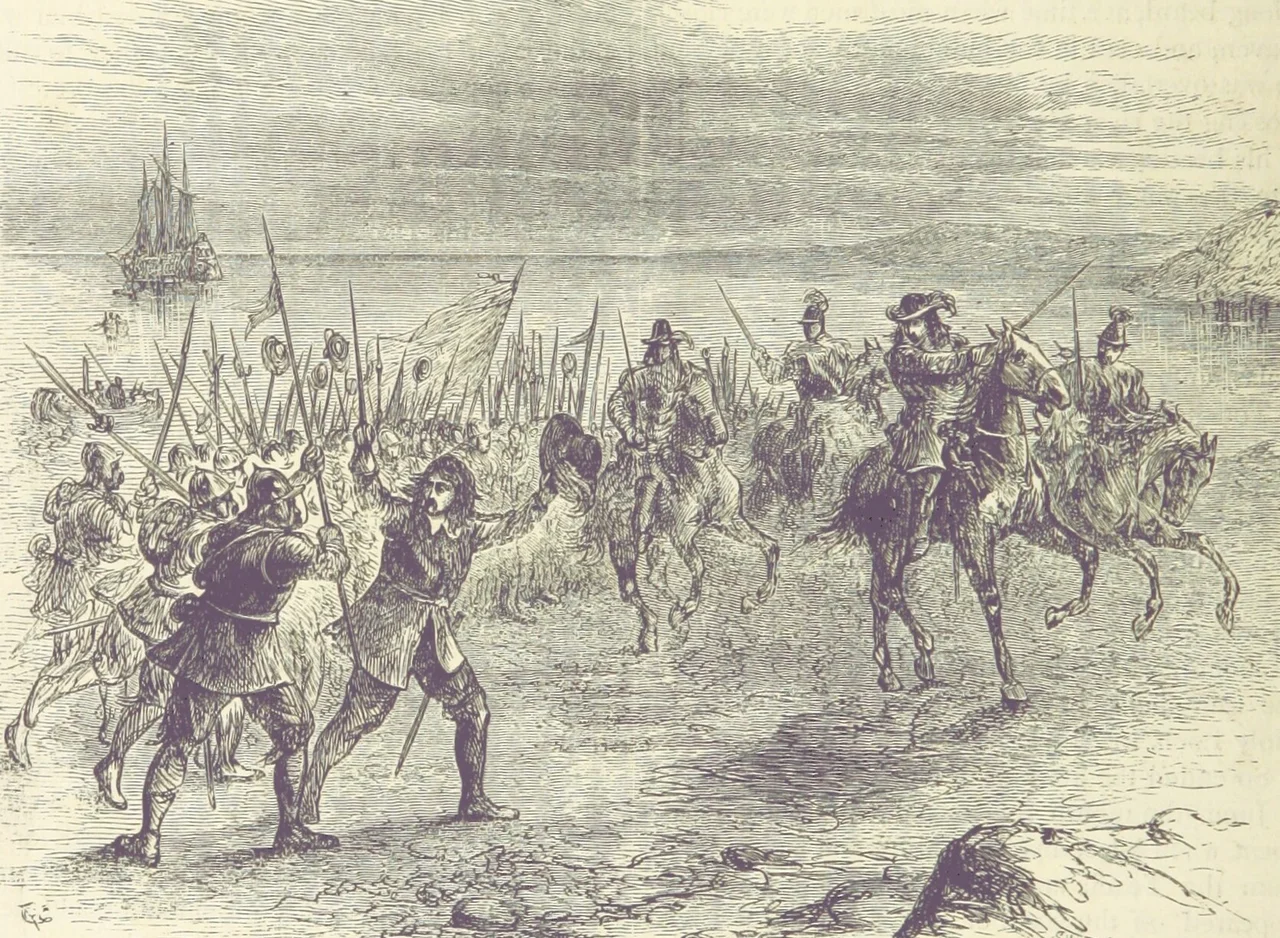
Three small ships dropped anchor off Lyme Regis on 11 June 1685. From them stepped James Scott, Duke of Monmouth, with eighty-two companions, four light field guns, and 1,500 muskets. He was Charles II's eldest illegitimate son, Protestant, charming, and convinced that the West Country would rise to put him on the throne in place of his Catholic uncle James II. The West Country did rise. By the end of June some 6,000 men - nonconformist artisans, weavers, farm workers, the kind of people the gentry rarely counted - had joined him. By 15 July his head had been struck from his body on Tower Hill, and the executions of his followers had only just begun.
The Bastard's Hope
Monmouth's mother was Lucy Walter, a Welsh gentlewoman who had been Charles II's mistress during his exile in The Hague. Rumours that Charles had secretly married her circulated for decades; Charles always denied them, insisting his only wife was Catherine of Braganza. Monmouth himself believed otherwise, or wanted to. He had been appointed Commander-in-Chief of the English Army by his father in 1672 and Captain General in 1678, distinguishing himself with British troops serving the French in the Third Anglo-Dutch War. He was popular - tall, athletic, easy with crowds. His 1680 tour of the South West had brought him cheering throngs in Chard and Taunton. When the Exclusion Crisis tried to keep Charles's Catholic brother James from the throne, some members of Parliament had even proposed Monmouth as alternative heir. Charles dissolved Parliament rather than agree. After being implicated in the 1683 Rye House Plot to assassinate the king and his brother, Monmouth fled to the Netherlands. So long as Charles lived, Monmouth could hope to inherit peaceably. The accession of James II in February 1685 ended that hope, and on 30 May Monmouth set sail.
Marching North Instead of East
Word of Monmouth's arrival had reached London ten days before he landed; the mayor of Lyme Regis, Gregory Alford, dispatched a customs officer named Samuel Damsell to ride two hundred miles to the capital with the news. He made it on 13 June. John Churchill - later Duke of Marlborough - was given command of the royal foot. The Huguenot Earl of Feversham took overall command. While the regular army assembled in London, local militias tried to hold the line. Monmouth's force, gathering volunteers daily, won a skirmish at Bridport but lost two senior officers when Thomas Hayward Dare and Andrew Fletcher quarrelled over a horse and Fletcher shot Dare dead. By 15 June the rebel force exceeded a thousand. Monmouth fought the militia at Axminster and took the town. Then, instead of marching east toward London, he turned north into Somerset, hoping to consolidate Protestant support before risking the capital.
A Coronation at Sword Point
He denounced King James at Chard, and on 20 June 1685 he was crowned king in Taunton. The Taunton Corporation was compelled to witness the ceremony at sword point outside the White Hart Inn - not because the townspeople opposed Monmouth, but because his more radical supporters wanted royal pageantry to woo the country gentry. The republican Nathaniel Wade hated the spectacle. The recruits loved it. Monmouth formed a new regiment of 800 men in Taunton alone. He moved north to Bridgwater, where he stayed at the castle, then to Glastonbury and Shepton Mallet under worsening weather. The Royal Navy captured his ships on 21 June, cutting off any retreat to the continent. He encamped at Pensford on 24 June and his men took Keynsham, securing a crossing over the River Avon. Bristol - the second city of England - lay open, defended only by the Gloucestershire Militia. Historians have long wondered what would have happened had Monmouth moved on it at once. He hesitated. By the time he arrived, Henry Somerset, Duke of Beaufort, had occupied the city with his own forces, and the moment was lost. His troops had also damaged Wells Cathedral on the march - tearing lead from the roof to make bullets, smashing the windows and the organ, briefly stabling horses in the nave. The rebellion was an act of religious passion but also of soldiers in a hurry.
Norton St Philip and the Retreat
On 26 June Monmouth approached Bath and found it held against him. He camped at Philips Norton, now Norton St Philip. The next morning Feversham's leading elements attacked. Monmouth's half-brother, Henry FitzRoy, Duke of Grafton, led royalist cavalry into the village and was surrounded; the rebels almost had him before Churchill's relief force broke through, hacking out through hedges. Casualties were roughly equal - twenty on each side - but each commander believed he had bloodied the other. Feversham, awaiting his artillery from London, hung back. Argyll's coordinating rebellion in Scotland had already collapsed; his Campbell levies had drifted away after disputes over strategy, and the diversion that should have split the king's attention came to nothing. With Feversham gathering strength, Monmouth was pushed back through Shepton Mallet toward the Somerset Levels - the same low marshy country where Alfred the Great had once hidden from the Vikings nine centuries earlier. On 3 July he reached Bridgwater and ordered the town fortified.
Sedgemoor and the Axe
On the night of 5-6 July, Monmouth led his men out of Bridgwater to attempt a surprise attack on the royal camp at Westonzoyland, three miles east. The march across the dark moor was guided by Richard Godfrey, a local farmer's servant. The first rebel cavalry over the rhynes startled a royal patrol; surprise was lost; Feversham's regulars formed up; the King's Regiment of Horse routed Lord Grey of Warke's cavalry; the rebel infantry was outflanked and cut down by musket and cannon. Estimates of the rebel dead range from 727 to 2,700. Royalist casualties were 27, buried in Westonzoyland churchyard. Monmouth fled the field and was captured two days later in a ditch in Dorset, dishevelled and exhausted. Parliament had already passed an Act of Attainder on 13 June condemning him to death as a traitor; no trial was necessary. He was taken to Tower Hill on 15 July. He begged James for mercy, even offering to convert to Catholicism, but no mercy came. The executioner Jack Ketch botched the beheading - the official Tower of London record says it took five blows of the axe, other sources say seven or eight. Monmouth's body and head were buried separately in the chapel of St Peter ad Vincula at the Tower.
The Bloody Assizes
What followed was a calculated terror. Judge George Jeffreys led a special commission, the Bloody Assizes, through the West Country in September 1685. Around 320 people were condemned to death. About 800 more were sentenced to transportation to the West Indies for ten years of hard labour - effectively forced to toil as enslaved people on Caribbean plantations, where many died. The condemned faced not simple execution but the full medieval ritual of being drawn and quartered: hanged until barely alive, then disembowelled, beheaded, and quartered, the body parts boiled in pitch and displayed at crossroads to warn other villages. The Hewling brothers, Benjamin and William, were both sentenced. Benjamin's sister paid £1,000 for him to be hanged rather than quartered; William went to the gallows. Daniel Defoe, who had marched with Monmouth as a young man, escaped with crippling fines that cost him most of his land. Across Somerset and Dorset, villages lost their sons by the dozen. The smell of tar-preserved bodies would have hung for months at particular crossroads. Three years later, James II was overthrown by William of Orange in the Glorious Revolution - the very outcome Monmouth had died trying to achieve, accomplished without a battle that mattered.
From the Air
The rebellion's geography stretches across Dorset and Somerset, centred at 51.12°N, 2.93°W (Sedgemoor). Key sites along the route: Lyme Regis (50.72°N, -2.94°W) where Monmouth landed; Taunton (51.02°N, -3.10°W) where he was crowned; Bridgwater (51.13°N, -2.99°W) his last headquarters; Westonzoyland and Sedgemoor where the final battle was fought; Wells Cathedral (51.21°N, -2.64°W) which his men damaged. Recommended viewing altitude is 3,000-5,000 feet to take in the broad sweep from coast to Levels. Nearest airfields: Bristol (EGGD) to the north, Exeter (EGTE) to the southwest, Dunkeswell (EGTU) on the Devon border. The Somerset Levels are unmistakable from the air - flat marshland cut by straight drainage channels (rhynes) that defined the battle's terrain.
Nearby Stories
- Grand Pier, Weston-super-Mare 2.2 km away
- Royal Albert Memorial Museum 8.5 km away
- Royal Victoria Park 9 km away
- Siege of Lyme Regis 9.1 km away
- Dorset Museum 9.6 km away
- Stourhead 11 km away
- Porlock 17 km away
- Ewenny Priory 18 km away