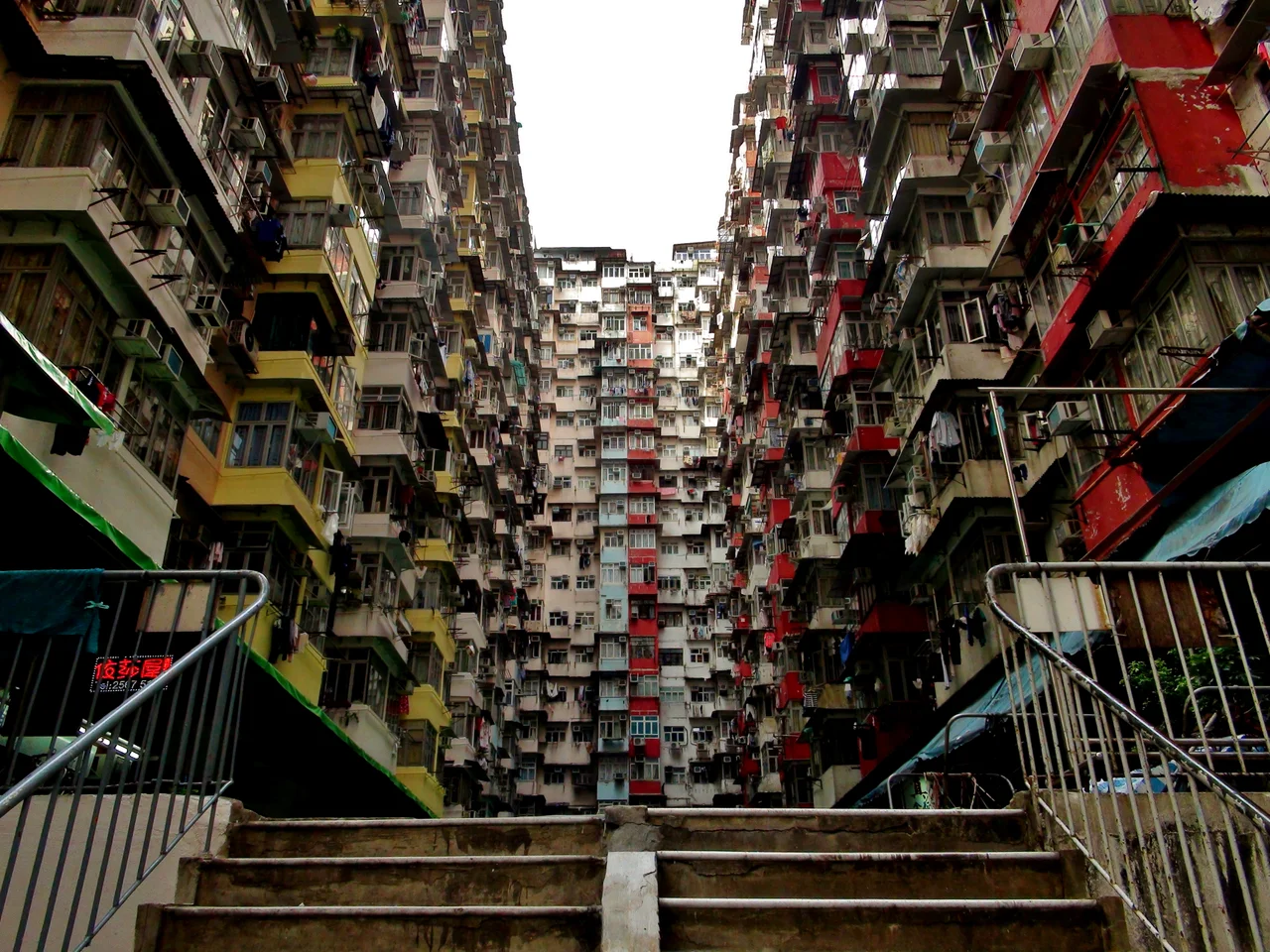

Monster Building
Romain Jacquet-Lagrèze pointed his camera upward from the central courtyard in 2013 and the resulting photograph went viral. The housing estate officially called Parker Estate — named for Mount Parker, the peak south of the site — acquired a second name almost immediately: the Monster Building. The residents who had been living there since the 1960s now shared their courtyard with photographers, film scouts, and tourists following a path from Instagram to King's Road, Quarry Bay.
Five Blocks, One Courtyard
The estate was originally built in the 1960s as a unified development and sold as Parker Estate, named for the neighbouring peak. In 1972, the housing block was divided and designated as five separate buildings: the Fook Cheong Building (福昌樓), the Montane Mansion (海山樓), the Oceanic Mansion (海景樓), the Yick Cheong Building (益昌大廈), and the Yick Fat Building (益發大廈). The five share walls and a common central courtyard — a composite structure in which the interior void, open to the sky, creates the vertigo effect that photographers seek. The highest building is the Oceanic Mansion at 18 floors. Together, the five blocks contain 2,243 units. Around 10,000 people currently live in the complex. The shops along the King's Road street front have been there since the beginning.
The Photograph That Changed Everything
Jacquet-Lagrèze published the courtyard image as the cover of his photo book Vertical Horizon. The image of the five connected facades rising around the open interior, each floor stepping inward slightly toward the sky, circulated through photography forums and then beyond them. By the mid-2010s, the Monster Building had become a destination. Visitors arrived to stand where Jacquet-Lagrèze had stood and look up. The residents, who had not chosen to live in a landmark, began posting warning signs: be respectful, this is our home. It is a situation that repeats across cities where the aesthetics of density have attracted outside attention — the building as backdrop, the people inside as incidental. At the Monster Building, the signs remain. Visitors continue to arrive.
Hollywood and the Vertical City
Once the building entered the visual vocabulary of photographers, it followed inevitably into cinema. The structure inspired locations in Transformers: Age of Extinction. Ghost in the Shell, the 2017 science fiction film, drew on its aesthetic for the layered, dense future city its directors wanted to evoke. The music video for "Labyrinth" by Mondo Grosso and Hikari Mitsushima used the courtyard. "Cave Me In" by Gallant and Eric Nam did the same. The Monster Building has also acquired the alternate nickname Monster Mansion. What each of these productions found is the same thing Jacquet-Lagrèze found: a built form that exists almost nowhere else, in which the geometry of Hong Kong density — vertical, enclosed, stacked — becomes visible as a single image rather than only as accumulated experience.
Quarry Bay Behind the Lens
The Monster Building stands on King's Road in Quarry Bay, on the northeastern shore of Hong Kong Island. The neighbourhood around it was historically industrial — Quarry Bay gets its name from the stone quarrying operations that preceded the reclamations and developments of the twentieth century — and the area retains a working quality that has kept it less visited than Causeway Bay to the west or the Peak above. The MTR Quarry Bay station sits nearby. The hillside behind rises toward Quarry Bay Park and the ridge that separates this stretch of coast from the harbour-facing south. For the 10,000 residents of Parker Estate, the viral photograph was a disruption of ordinary life. The courtyard is still a courtyard. The laundry still dries on the poles. The view upward is still the same.
From the Air
The Monster Building is located at 22.284°N, 114.212°E in Quarry Bay on the northeastern coast of Hong Kong Island. From the air, Quarry Bay's industrial and residential character is visible east of Causeway Bay, with the building's distinctive footprint on King's Road approximately 500 metres from the waterfront. Hong Kong International Airport (VHHH) lies approximately 30 km to the west on Lantau Island. Victoria Harbour is visible to the north. Approaching from the east at 3,000 feet, the coastline of Hong Kong Island's northern shore runs left to right below, and the building's five-block courtyard structure is large enough to identify against the street grid.
Nearby Stories
- Lok Ma Chau Loop 2.3 km away
- Portas do Cerco 2.3 km away
- Kweilin Incident 17 km away
- Wanshan Archipelago Campaign 34 km away
- Nanxiong Formation 115 km away
- Battle of Nanpeng Island 148 km away
- Heyuan 169 km away
- Cape Maobitou 632 km away