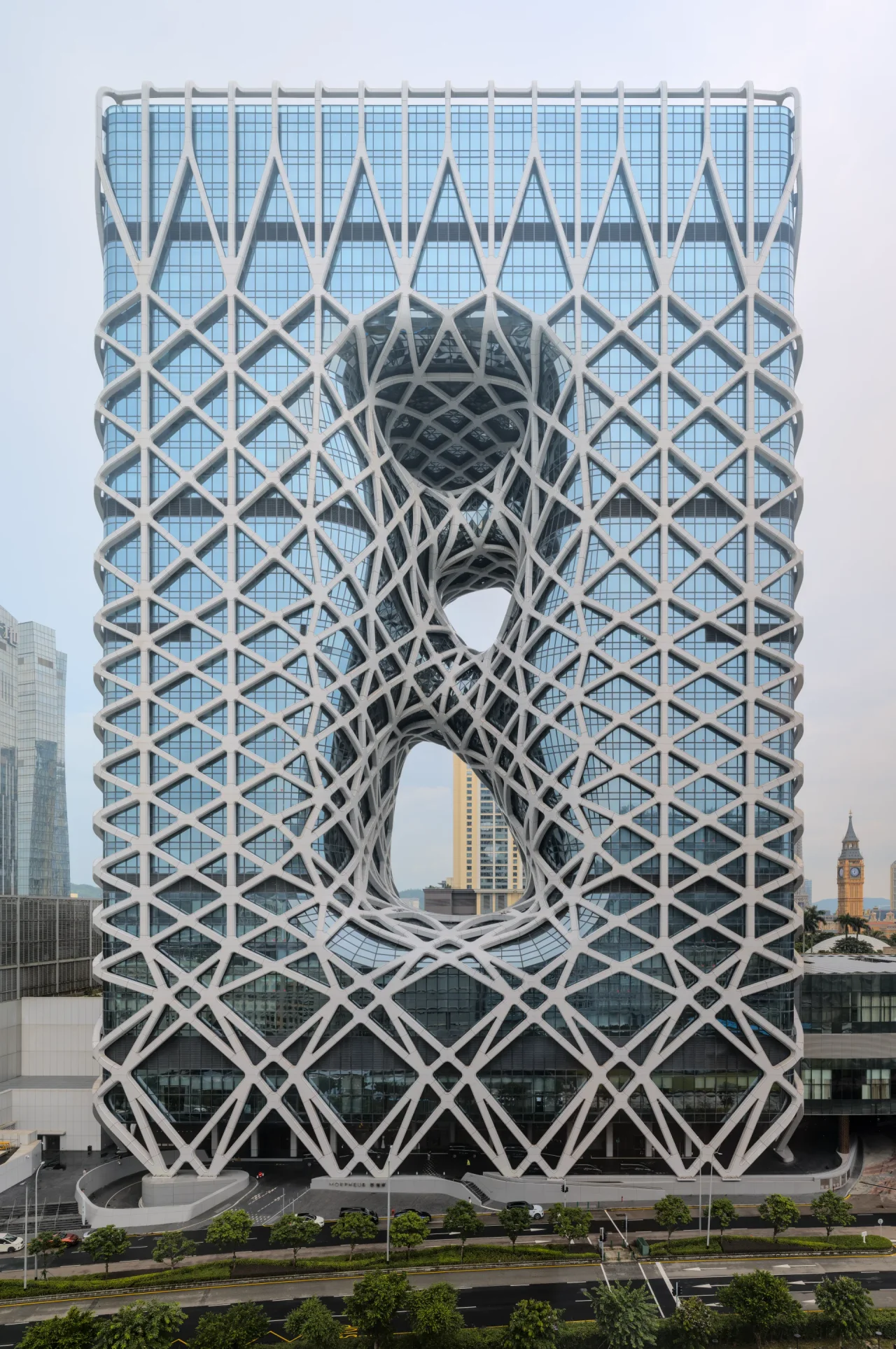

Morpheus Hotel
Zaha Hadid died in March 2016, and Morpheus opened in June 2018. She never saw it finished. That two-year gap between the death of an architect and the completion of her final major work gives the building an elegiac quality that even the Cotai Strip's relentless glitter cannot quite dissolve. The tower stands 153.7 meters above Macau's reclaimed land, its exoskeleton of interlocking steel tubes twisting around three enormous voids — oval apertures cut through the building's body like windows to a parallel dimension. Forbes Travel Guide called it an engineering masterpiece, and for once the superlative feels earned.
A Structure That Should Not Stand
Engineering ambition drove every decision at Morpheus. The building is the first in Asia constructed without a singular internal column — a structural feat that required a complex external exoskeleton to carry the load that conventional buildings distribute through their cores. Twelve interconnected mega-columns and a diagrid steel frame do the work instead, transferring forces around the three dramatic void cutouts that pierce the tower's midsection. Each void is large enough to contain a substantial building in its own right. The Leitner Group concept for how a cable bears load informed the same logic here: distribute the tension across the whole system rather than concentrating it at any single point. When Zaha Hadid Architects first visited the Cotai site in 2012, the design challenge was to create something that would not simply be another glass box in a city that already had plenty of them. The solution was a building that looks different from every angle — fluid from the north, geometric from the east, almost organic from below.
Hadid's Last Commission
Melco Resorts & Entertainment contacted Zaha Hadid Architects in January 2012 to design what would become the fifth hotel tower at City of Dreams. Construction began in 2014. Hadid, who had become the first woman to win the Pritzker Architecture Prize back in 2004, was at the height of her influence when she took the commission. Her practice had already produced the MAXXI museum in Rome, the Heydar Aliyev Center in Baku, and the London Aquatics Centre. Morpheus was to be something different: a building where the skin itself was the structure, and the interior could be shaped around absence rather than presence. Hadid did not live to see the result. She died of a heart attack aged 65, and the project was completed under the leadership of her longtime partner Patrik Schumacher. The hotel opened on 15 June 2018 to considerable global attention — not just as architecture, but as a monument to a particular kind of ambition.
Inside the Void
The 772 rooms include nine two-story sky villas, three of which come with private pools. Interior designer Peter Remedios handled the rooms themselves, creating spaces that deliberately contrast with the drama outside — calm, textured, warm against the exoskeleton's cool precision. The Morpheus Spa occupies the 21st floor. On the 23rd floor, during the summer of 2019, Melco opened the building to the public for five months as part of Art Macao, displaying works by artists including KAWS and Daniel Buren in a space that was itself the artwork. Chef Alain Ducasse — who holds more Michelin stars than almost any other chef alive — operates two restaurants in the hotel. The restaurant Yi serves contemporary Chinese cuisine omakase-style, drawing from Cantonese, Chaozhou, Sichuan, and Hunan traditions. The hotel opened without casino junket operators, a deliberate positioning toward what Melco CEO Lawrence Ho called the premium mass market: travelers who spend generously but are not there solely to gamble.
Macau Remade in Concrete and Steel
Morpheus is not Macau's tallest building, but it may be the one that best captures what the territory has tried to become since the gaming industry's post-2002 liberalization. The Cotai Strip, built on reclaimed land between the islands of Taipa and Coloane, was imagined as an Asian Las Vegas — and in some ways it succeeded. But Morpheus suggests something more complex: a city willing to commission genuinely difficult architecture, to spend USD $1.1 billion on a building that is primarily about form. The overall project cost was absorbed by Melco before a single guest checked in. By January 2019, Morpheus and all other Melco properties were sold out for the Lunar New Year. The gamble, in every sense, had paid off.
From the Air
Morpheus stands at 22.1498°N, 113.5666°E on the Cotai Strip in Macau, visible from the air as a distinctive perforated tower with three large oval voids through its midsection. Approach from the east at 1,500–2,000 feet for the best view of the exoskeleton structure. The nearest airport is Macau International Airport (VMMC), approximately 2 km to the southeast on Taipa Island. Hong Kong International Airport (VHHH) lies about 60 km to the northeast. On clear days the tower is identifiable by its unusual silhouette against the flat reclaimed land of Cotai, flanked by the domes and towers of other City of Dreams properties.
Nearby Stories
- Tai Tau Chau (Southern District) 0.7 km away
- Lai Chi Wo 3 km away
- Wanshan Archipelago Campaign 3.2 km away
- Pearl River Delta 3.7 km away
- Battle of Yamen 13 km away
- Jiangmen 15 km away
- Hong Kong 12 32 km away
- Battle of Nanpeng Island 114 km away