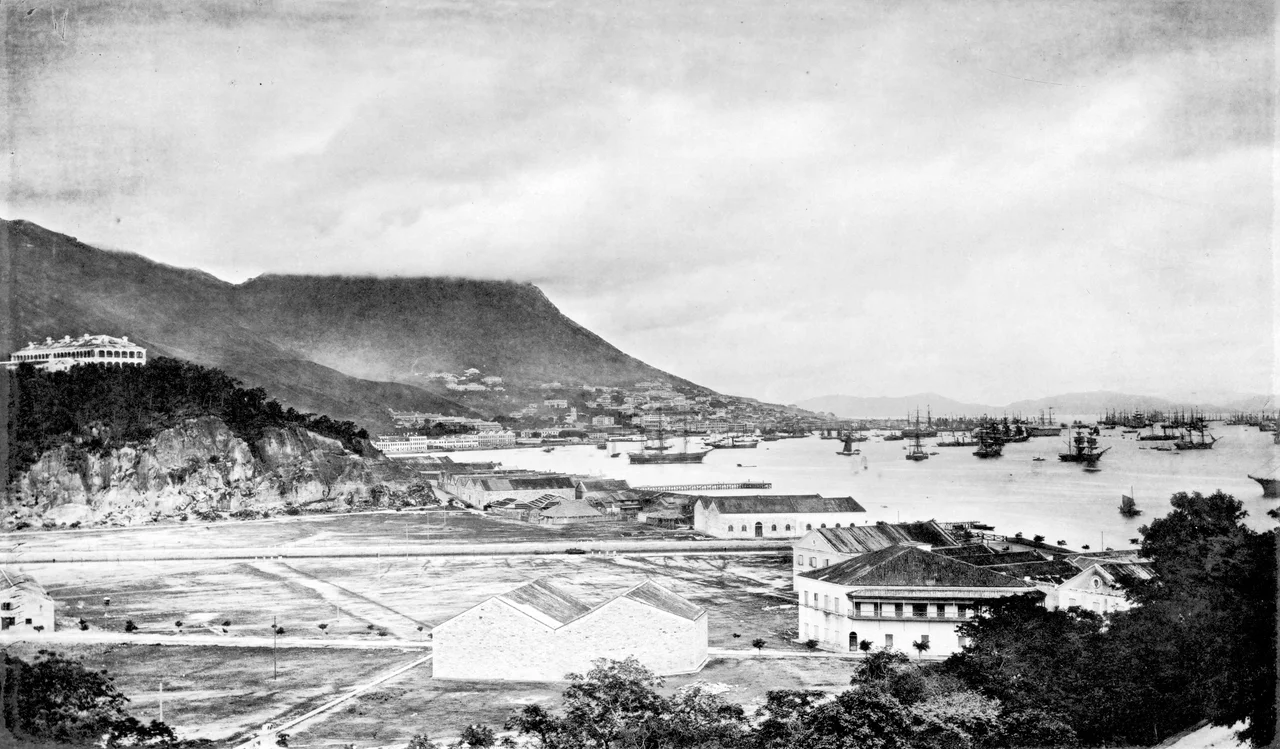

Morrison Hill
John Thomson's photograph from the late 1860s shows it clearly: a modest eminence rising above the harbour, topped with a tidy row of foreign residences. The caption calls it Morrison's Hill. Within a generation, almost all of it would be gone — blasted and carted away to build the very shoreline you see on maps today. What Morrison Hill gave up, Hong Kong kept forever.
The Man Behind the Name
Dr Robert Morrison arrived in China in 1807 as the London Missionary Society's first Protestant missionary to the country. He was a linguist as much as a preacher, compiling a six-volume Chinese dictionary and translating the Bible into Chinese — work that shaped how Western institutions engaged with the country for decades. The hill in Wan Chai was named for him through his association with the Morrison Education Society, which sought to bring Western learning to Chinese students. Morrison died in Canton in 1834, never knowing that a hill in the young colony of Hong Kong would carry his name. The hill itself is now gone, but the name lingers on Morrison Hill Road, Morrison Hill Swimming Pool, and the neighbourhood that grew where the rock once stood.
A Hill That Built a City
The Praya East Reclamation Scheme, launched in 1921 and substantially complete by 1929, was one of colonial Hong Kong's most ambitious engineering projects. The plan was straightforward: use the rock and earth from Morrison Hill to extend the shoreline of Victoria Harbour eastward, pushing the sea back and creating new land for a growing city. To move the enormous volume of material, engineers laid temporary railway tracks running along Bowrington Canal — present-day Canal Road — carrying load after load to the reclamation site. Quarrying consumed roughly 2.9 million cubic yards of material from the hill during the scheme. The softer upper portions came away quickly, but the granite core resisted — final levelling of the hill was not complete until around 1965. By the time it was finished, the hill had been entirely removed and Wan Chai's waterfront had shifted dramatically outward. Morrison Hill ceased to exist as a geographical feature; the land gained from it did not.
What Replaced the Hill
Where rock once rose, a circular street called Oi Kwan Road now loops around a cluster of institutions that give the neighbourhood much of its civic character. The Morrison Hill Swimming Pool sits at the centre of the area, drawing residents from across Wan Chai. The Queen Elizabeth Stadium — a mid-sized indoor venue — handles everything from graduation ceremonies to concerts on the southern fringe. Tang Shiu Kin Hospital occupies the same edge of the district, while several secondary schools crowd the interior. The Hong Kong Institute of Vocational Education maintains a campus here, with the Vocational Training Council's headquarters next door. A skatepark has appeared near the children's playground to the south-east, perhaps the most contemporary thing to occupy a spot shaped by nineteenth-century industry.
A Neighbourhood's Quiet Plurality
Look closely at the institutions clustered around Oi Kwan Road and you find a quietly plural community. The Ammar Mosque and Osman Ramju Sadick Islamic Centre serves Hong Kong's Muslim population from a corner of the neighbourhood. The Scout Association of Hong Kong keeps its regional headquarters here. Residential towers rise at Oi Kwan Court. The Lady Trench Training Centre and the MacLehose Dental Centre fill in further gaps in the street map. None of these landmarks would exist if the hill had not been removed; they are, in a sense, the hill's legacy. Morrison gave his name to a place that repaid his memory by disappearing — and then coming back as something entirely different.
From the Air
Morrison Hill sits at approximately 22.2754°N, 114.18°E in Wan Chai on the north coast of Hong Kong Island. Approaching from the harbour at 1,500–2,000 feet, the area appears as a dense urban grid between the elevated expressway and the hills rising to the south. The Queen Elizabeth Stadium's curved roof is a useful visual reference. Hong Kong International Airport (VHHH) lies about 30 km to the northwest across Lantau Island. Approach with caution — the terrain rises sharply to 500m+ just south of the district.
Nearby Stories
- Lok Ma Chau Loop 2.3 km away
- Portas do Cerco 2.3 km away
- Kweilin Incident 17 km away
- Wanshan Archipelago Campaign 34 km away
- Nanxiong Formation 115 km away
- Battle of Nanpeng Island 148 km away
- Heyuan 169 km away
- Cape Maobitou 632 km away