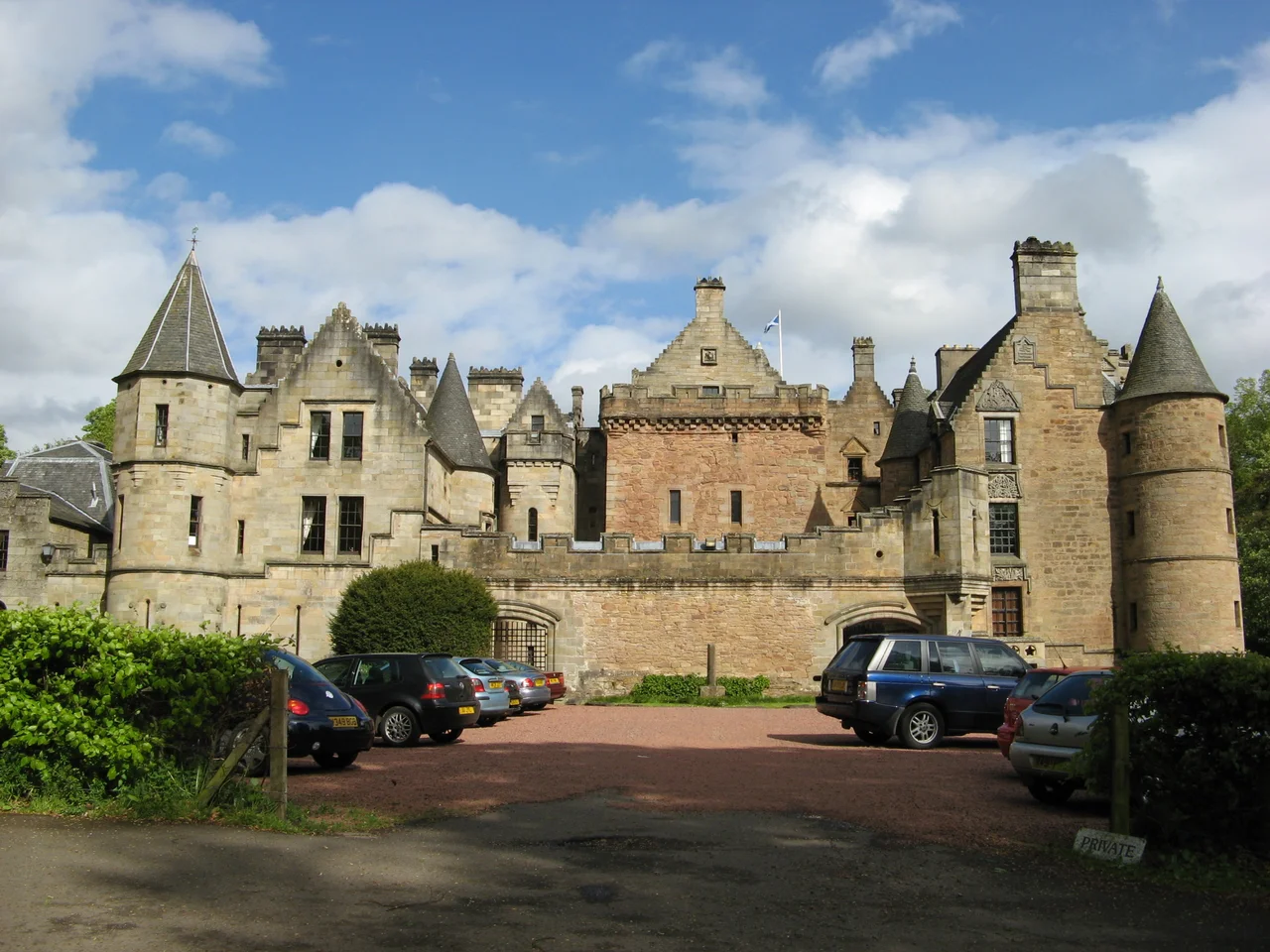

Motherwell
In the middle of the 1970s, more than 13,000 people in Motherwell worked in steel. Three vast cooling towers and a gas holder dominated the skyline so completely that the town had a nickname: Steelopolis. By 1992 the gas holder was being readied for demolition and the cooling towers stood empty. The closure of Ravenscraig ended large-scale steel making in Scotland in a single decision, taking 770 jobs immediately and an estimated 10,000 more in the supply chain. Three decades later the brownfield site is still being rebuilt as a new town. Motherwell itself has recovered, slowly, around what came after.
From Lady Well to Burgh
The town's name comes from a well dedicated to the Virgin Mary, the Lady Well, the site of which is now marked by a plaque on Ladywell Road. Roman engineers built a road and a fort with a bath house here, where their route crossed the South Calder Water near Bothwellhaugh. The name Moderwelt appears on Timothy Pont's manuscript map of Lanarkshire from around 1596. For most of its history Motherwell was tiny - 600 people at the start of the 19th century, 1,700 by 1841 - a farming hamlet centred on a crossroads near the 16th century laird's manor at Jerviston. The railway arrived in 1848 and everything changed. By 1881 David Colville had opened both an iron and a steel works, the town had piped water and burgh status, and the population had jumped to 13,800.
Steelopolis
What followed was a century of metal. Colville's mills grew into one of the great industrial complexes of Britain, eventually employing 13,000 people by the 1970s and dominating the skyline with the water tower and three cooling towers of Ravenscraig. The plant had one of the longest continuous casting and hot rolling lines in the world. Steel from Motherwell built ships at Govan, locomotives at Springburn and the structures of post-war reconstruction across Scotland. The Dalzell plate works still operates under Liberty Steel, but Ravenscraig closed in 1992 and the gas holder, the town's most familiar landmark, was demolished in 1996. What is now the largest brownfield site in Europe is being rebuilt as the new town of Ravenscraig, with New College Lanarkshire and a major sports centre already in place.
The Steelmen
Motherwell Football Club was founded in 1886 and is known as the Steelmen, the name a salute to the industry that built the town. They play in the Scottish Premiership at Fir Park Stadium, and have remained continuously in the top division since the mid-1980s, no small achievement against the gravity of Glasgow's Old Firm. The club's last major trophy was the 1990-91 Scottish Cup, won 4-3 against Dundee United in a final remembered as one of the great Hampden games. The Viking Thunder Clap, now a feature of major football tournaments worldwide, has its credible origin at Fir Park, where Motherwell fans used it during a 2014 Europa League tie against the Icelandic club Stjarnan.
Strathclyde Park
Strathclyde Country Park, on the western edge of town, is built over the buried village of Bothwellhaugh, abandoned and flooded in the 1970s when the loch was created. Excavations have turned up a Roman mosaic, a Roman bath house and a bridge. The park has hosted Commonwealth Games events — rowing in 1986, triathlon in 2014 — and the 2011 International Children's Games, and was once the home of T in the Park, Scotland's biggest music festival, before it moved to Balado in 1997. The North Lanarkshire Heritage Centre next to the railway station has a viewing tower on its fifth floor: on clear days the view extends as far north as Ben Lomond.
Notable Sons and Daughters
Motherwell has produced an unusually broad cast of public figures. Sir Matt Busby, the manager who rebuilt Manchester United after the Munich disaster, attended Our Lady's High School. Billy McNeill, captain of Celtic's 1967 Lisbon Lions, was a fellow pupil, as more recently was the Arsenal and Scotland defender Kieran Tierney. The town's writers include Deborah Orr, whose 2020 memoir Motherwell drew an unsparing portrait of the place she grew up in from the 1960s onwards. Walton Newbold, born in Motherwell in 1888, was the first Communist MP elected to the UK Parliament. Hamish Imlach lived in Muirhouse. Katie Leung played Cho Chang in the Harry Potter films. The Delgados came out of the town's indie scene. The cathedral of Our Lady of Good Aid, the mother church of the Roman Catholic Diocese of Motherwell, sits at the centre of a town that has been many things and continues to remake itself.
From the Air
Located at 55.789 N, 3.996 W in North Lanarkshire, about 12 miles southeast of Glasgow. The town sits in the Clyde valley between the South Calder Water and the river itself, with Strathclyde Loch on its western edge a distinctive landmark. Best viewed from 2,500-4,000 ft. Glasgow Airport (EGPF) is about 14 nm northwest; Edinburgh Airport (EGPH) about 31 nm east. The M74 runs along the western boundary, with the M8 about 3 miles north.
Nearby Stories
- HMS Gannet 3.6 km away
- Luss 5.3 km away
- Oliver Castle 6.8 km away
- Battle of Bannockburn 6.9 km away
- Beith 7.9 km away
- Pentland Hills 7.9 km away
- Lochleven Castle 16 km away
- Cumnock 17 km away