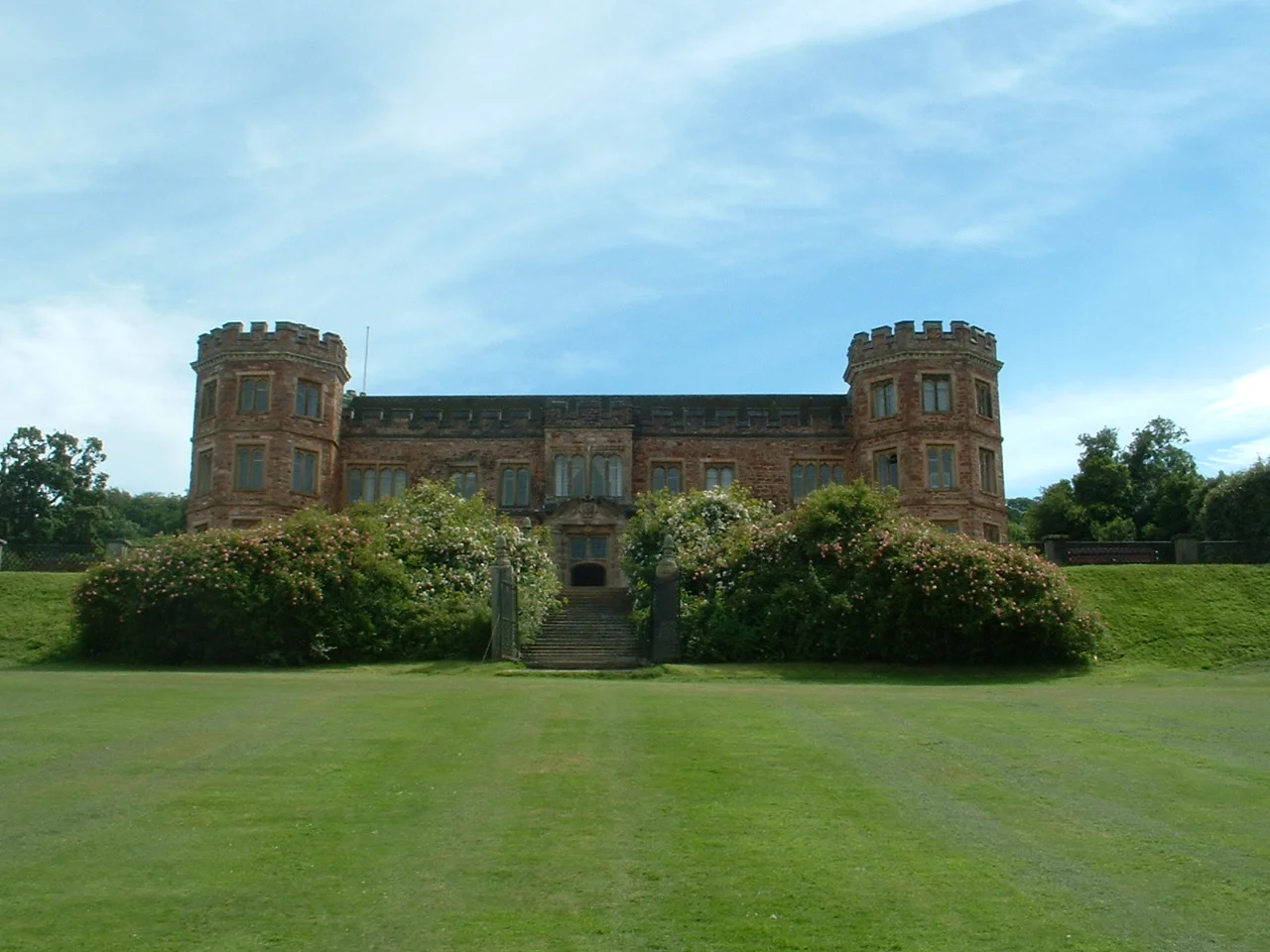

Mount Edgcumbe House
On the night of 22 April 1941, German bombers came for Plymouth, and the firestorm that consumed the city's centre reached far enough west to find a Tudor house on the Rame Peninsula. Mount Edgcumbe House, built by Sir Richard Edgcumbe between 1547 and 1553, burned through the night. By morning the roof was gone and the interiors were ashes. Four hundred years of family portraits, furniture, and accumulated objects were destroyed in a single raid. The house stood gutted and roofless for seventeen years. Then, in 1958, the 6th Earl decided to rebuild. The shell was sound, the foundations were good, and the family was determined that what could be recovered would be recovered. The restored interiors, in their 18th-century styling, opened to the public in 1988, a slow and patient response to a single night's destruction.
The House That Inspired Wollaton
Sir Richard Edgcumbe built the original Mount Edgcumbe House over six years in the mid-sixteenth century, choosing a site on the Rame Peninsula that commanded long views across Plymouth Sound. The architecture was striking enough that the great Elizabethan designer Robert Smythson is said to have studied it before producing his own masterpiece at Wollaton Hall in Nottinghamshire. Whether or not the connection is direct, the resemblance is real: the same compact, four-towered massing, the same dramatic siting high above its setting. From Tudor times until the twentieth century, Mount Edgcumbe was the principal seat of the Edgcumbe family, many of whom served as Members of Parliament. Richard Edgcumbe was raised to the peerage as Baron Edgcumbe in 1742, and his second son George was advanced to the rank of Earl in 1789. The family's coat of arms, with its three boars' heads couped argent, still appears throughout the grounds.
The Cremyll Ferry
The estate has been connected to Plymouth by ferry since around 1204, more than eight centuries of continuous service across the narrow neck of Plymouth Sound. The Cremyll Ferry still operates today, carrying foot passengers between the village of Cremyll at the estate's main gate and the Devon shore at Stonehouse. King John was on the throne when the first crossing was recorded. The Edgcumbes used the ferry, their guests used the ferry, the workmen who built the house and the gardeners who tended the formal gardens used the ferry, and visitors today step onto the same crossing those Tudor builders knew. The crossing takes about ten minutes. On a summer afternoon, with the great house visible through the trees on the Cornish side, the journey can feel surprisingly unchanged.
Camellia Country
Today Mount Edgcumbe Country Park houses the National Camellia Collection, a comprehensive gathering of one of the great ornamental flowering plants of the temperate world. Camellias love the soft, damp Cornish climate, with its long mild winters and gentle summers, and they bloom across the grounds from autumn through spring in waves of red, white, pink, and rose. The collection is the largest of its kind in Britain, drawing horticultural pilgrims who walk the grounds in February and March when the formal gardens are scarce of other colour. Beyond the camellias, the estate hosts an annual classic car show organised by the Friends of Mount Edgcumbe, art classes with the painter Louise Courtnell, theatre performances, and a forestry school. In 1986 it was even the campsite for the Westcountry Jamboree, a gathering of Devon and Cornwall scouts with international guests.
The Park and the House
Cornwall Council and Plymouth City Council have jointly owned the estate since the 7th Earl sold it in 1971. The Country Park is open every day from 8 am till dusk; visitors can walk all the way from the Cremyll Ferry through the property to the painted fishermen's villages of Kingsand and Cawsand on the seaward side. The house itself and the adjoining Earl's Garden, however, open only in summer, from the beginning of April until the end of September. Inside the restored interiors visitors can see what care and money brought back after the war: Georgian and Regency furniture, paintings recovered or replaced, the formal rooms restored to the eighteenth-century styling the family decided was the right point in time to remember. The Deer Wall, built around 1695 to protect the gardens from the herd Henry VIII had originally permitted, is mostly still in place. The descendants of those Tudor deer roam past it as if it were not there.
Five Centuries on the Edge of the Sound
From the upper terraces of the house the view is unchanged in its essentials since the Tudor builders chose it. Plymouth Sound opens to the east, the breakwater lying like a punctuation mark across its mouth. To the south the limestone cliffs of the Hoe rise above the water. The Hamoaze runs to the north, with the masts and grey shapes of Devonport visible on the Devon shore. Sir Richard Edgcumbe stood here and saw essentially this view. Charles Darwin saw it from Barn Pool just below the house in 1831 as HMS Beagle prepared to sail. The German bombers saw it in 1941 as they began their run. The visitors who arrive on the Cremyll Ferry today see it again, eight hundred years on, with the same boars'-head crest still over the door.
From the Air
Mount Edgcumbe House sits at 50.354 degrees north, 4.176 degrees west, on the Rame Peninsula just east of Cremyll village, overlooking the western entrance to Plymouth Sound. From the air, look for the symmetrical Tudor house with its four corner towers near the lower part of the estate close to the water, with the Italian Garden's geometric parterres immediately to its east. The folly crowns the highest point of the wooded estate behind the house. The Cremyll Ferry crossing to Plymouth's Stonehouse waterfront is visible immediately to the northeast. Nearest controlled airport is Newquay (EGHQ), 38 miles west-northwest; Exeter (EGTE) is 50 miles east-northeast. Plymouth Sound is heavily trafficked by naval vessels from Devonport just to the north, and military exclusion zones may apply at low altitudes.
Nearby Stories
- Davidstow Circuit 3.7 km away
- Golden Hind 3.9 km away
- Powderham Castle 4.4 km away
- Fowey Lifeboat Station 5.1 km away
- Okehampton Castle 12 km away
- Battle of Plymouth (1652) 19 km away
- Goonhilly Satellite Earth Station 44 km away
- German Submarine U-672 73 km away