
Mount St John Anti-Aircraft Battery
It is hardly a mountain. Mount St John is a low scrub-covered hill on the dry plain west of Townsville, and at its summit four concrete platforms sit empty, their steel mounting rods still bolted into the slabs. In the autumn of 1942 those rods held 3.7-inch anti-aircraft guns, crewed around the clock by Australian gunners who watched the sky to the north-east and waited. Their job was simple to describe and terrifying to perform: protect the airfield at Garbutt, and shoot down anything that came for it. For a few weeks that summer, the war reached out and touched them.
Why a Hill Mattered
By early 1942 the war in the Pacific was going badly for the Allies. Singapore fell in February; Darwin was bombed days later. Townsville, the largest city in Australia's north, suddenly found itself a frontline port and the principal staging base for the looming fight over New Guinea. Its airfield at Garbutt was the prize, and the prize needed guarding. Two batteries of the 16th Heavy Anti-Aircraft unit were positioned to cover it. One, at Rowes Bay, became X Station. The other rose here, on Mount St John, directly west of the main runway and roughly two and a half kilometres away. When it was finished at the end of April, this was Townsville's largest and most modern battery: four gun positions, four buried magazines, and a semi-underground command post where plotters tracked the height and bearing of every aircraft in the sky.
The Watchers
The gunners called it Y Station, and their work was as much vigilance as violence. Every aircraft approaching Garbutt was assigned a correct lane of entry. Anything that strayed from it was to be treated as hostile and fired upon. The post was wired by telephone to the fighter sector headquarters and manned twenty-four hours a day, which meant long stretches of nothing punctuated by sudden alarm. On 21 March 1942 the first Japanese aircraft seen over Townsville was spotted high over the city, silvery against the noon sky, almost certainly a long-range Mitsubishi reconnaissance plane sent to photograph the airfields. The men below could not yet fire accurately; their open gunsights had not been fitted. They could only watch it cross the sky and disappear, knowing exactly what it meant. Someone, somewhere, was planning a raid.
The Nights the Bombs Fell
It came in late July. On three nights, huge four-engined Kawanishi flying boats, the type the Allies code-named Emily, lumbered down from their base at Rabaul to attack Townsville. The first raid, on the night of 25 to 26 July, dropped its bombs harmlessly into the sea off the wharves. Y Station held its fire. But early on 28 July, searchlights at Rowes Bay caught a lone Emily at ten thousand feet, and the Mount St John guns opened up. After twenty rounds a shell burst close to the aircraft's nose, and the rattled crew jettisoned its bombs over the empty ranges south of the city. The hill had done its job. A final raid on 29 July scattered bombs into Cleveland Bay and a paddock at Oonoonba before American fighters drove the intruder off. No one in Townsville was killed in any of the three raids, a fact owed in part to the gunners who made the night sky dangerous.
What the Hill Remembers
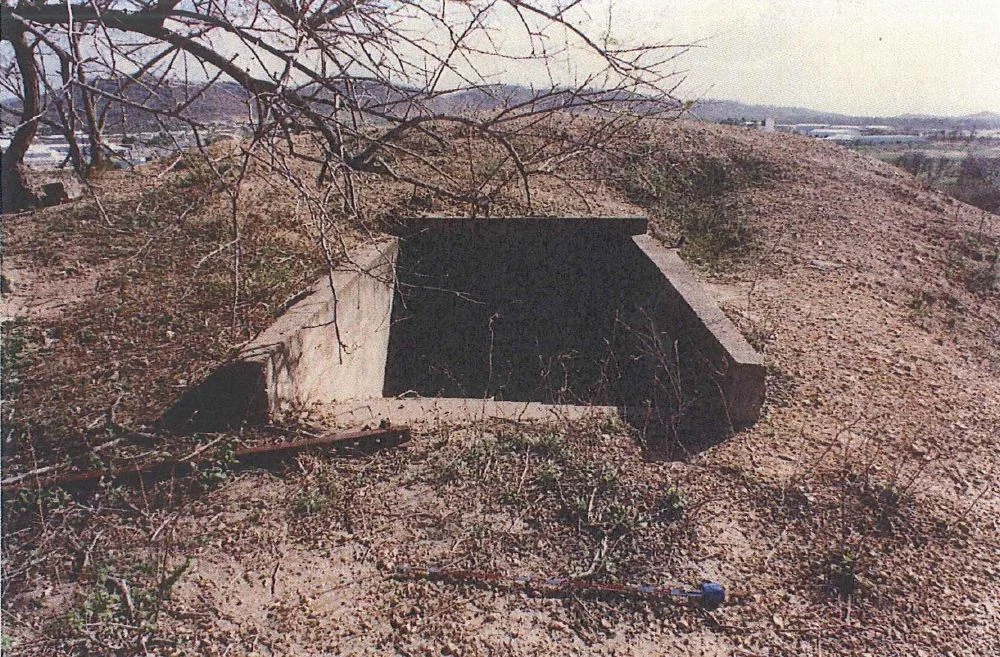
The 16th Battery disbanded in 1944, and after the war the hill was sold, quarried, and half-forgotten. Industry crept up its flanks; a sewage treatment plant sits nearby now. Yet the bones of Y Station survive better than almost any other wartime gun position in Queensland. Two of the magazines stand fully exposed, their stairs torn out and lying where the quarrymen dropped them. The other two remain buried, holding whatever the gunners left behind. The command post is structurally intact, its single steel door still hanging. Heritage-listed in 1999, Mount St John is the only Townsville battery known to have actually fired on the enemy, both before and after the Battle of the Coral Sea turned the tide. Stand among the platforms and the sight lines to the old airfield are still clear. That clear view was the whole point.
From the Air
Mount St John lies at 19.256 degrees S, 146.743 degrees E, a low hill on the dry plain about 2.5 km west of the main runway at RAAF Base Townsville (Townsville Airport, ICAO YBTL), which shares the field. From the air the site reads as a scrubby rise above the industrial flats and the Bohle River floodplain northwest of the city; Castle Hill's pink granite dome stands prominently to the east over the CBD. Best appreciated at low level on approach to or departure from YBTL in clear dry-season conditions (May to October), when visibility across the coastal plain is excellent. Cleveland Bay and Magnetic Island lie to the northeast, the direction the wartime gunners watched for raiders.
Nearby Stories
- Ayr 13 km away
- SS Yongala 34 km away
- Great Palm Island 35 km away
- Bindal People 50 km away
- Cardwell UFO Festival 83 km away
- Hinchinbrook Island 113 km away
- Porcupine Gorge 215 km away
- Samarai 998 km away