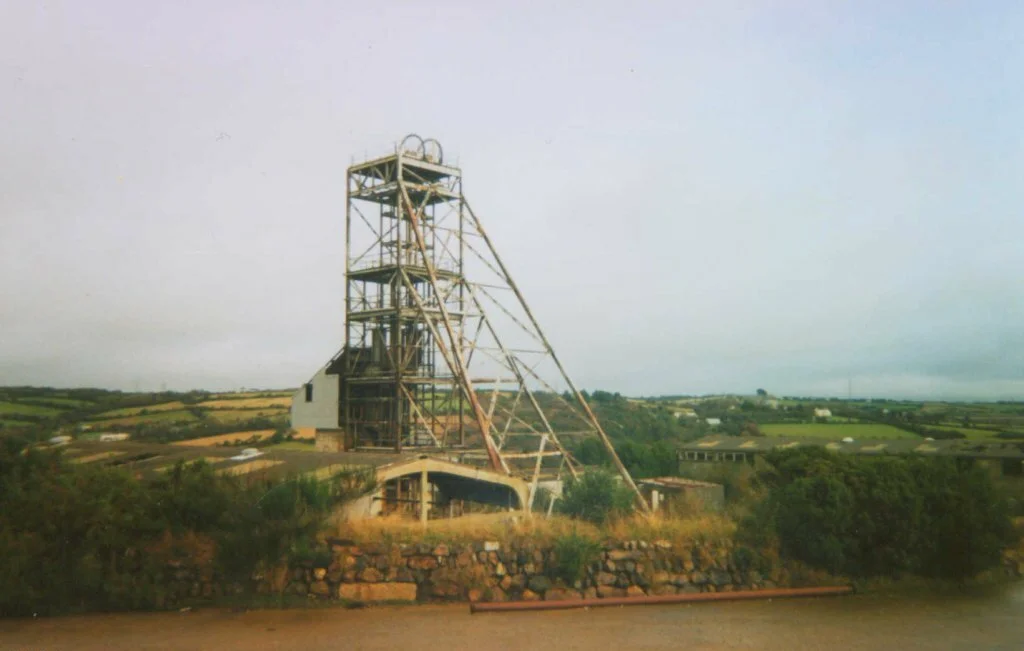

Mount Wellington Tin Mine
When the brothers named Wellington started chipping away at the old Wheal Andrew lodes near St Day in the 1920s, Cornwall's tin industry had been in decline for half a century. They were working what miners called 'in a small way': primitive tools, an old shaft, ore lugged down the valley to a Cornish stamp mill for crushing. Captain Josiah Paull of the Mines and Metallurgical Club in London came down to look. He reported that the brothers were getting an average of 30 pounds of black tin per ton of ore broken. He also reported, with a Cornish miner's plain language, that 'being only ordinary Cornish miners,' the Wellingtons could not afford the new shaft they needed. The mine that bore their name would not properly exist for another fifty years.
Two False Starts
The first real attempt to develop the property came in 1935, when Mount Wellington Ltd, backed by the British Non-ferrous Mining Corporation, acquired rights to United and Consolidated Mines, Wheal Clifford and Wheal Andrew. Shares were advertised that February. Shafts were sunk, buildings raised, and through the late 1930s the new operation tried to get the milling going. Tin prices were low. Profitable extraction was impossible. On 16 December 1939, three months into the Second World War, work stopped at Mount Wellington Mine for lack of finance. The shafts went silent. The mine returned to the half-life that defined so many Cornish workings: not closed, not operating, just waiting for the next cycle of tin prices to make development worth trying again.
The 1970s Revival
It took until 1963 for serious money to come back. International Mine Services Ltd of Toronto became interested in Cornwall's mineral potential. Exploratory drilling began at Mount Wellington in 1967. In 1969 the contract to sink the No.1 Wellington Shaft and build new surface buildings was awarded to Thyssen (Great Britain) by Cornwall Tin & Mining Ltd. The plan was ambitious: an all-gravity concentrating plant aiming for 200,000 tonnes of ore per year, producing about 1,600 tonnes of tin metal annually plus copper, zinc and silver as byproducts. The shaft would be deepened from 210 to 310 metres. The mine was projected for a 25-year life and a workforce of up to 300. The UK government chipped in a 20 percent capital grant, around £4.25 million in initial investment. The concentrating plant came online in January 1976. Mount Wellington was Cornwall's third new tin mine in three years, alongside Wheal Jane next door and Geevor further west.
Closed in Two Years
The economics did not work. On 20 April 1978, just over two years after first ore came up the No.1 shaft, Mount Wellington Mine closed. The shaft was retained for access but no more ore was ever raised through it. The administrators of Cornwall Tin & Mining Ltd sold the site to a Falmouth scrap dealer. In August 1979 Carnon Consolidated, a subsidiary of Rio Tinto Zinc, bought the freehold of the No.1 shaft area and the engineering building back from the scrap dealer. Billiton Minerals, a Shell subsidiary, bought the mill, the offices, the rest of the surface buildings and the Wheal Maid tailings dam. The mine that had taken decades to plan and millions to build was carved up between corporations within eighteen months.
Operating as a Satellite
From 1980 onwards Mount Wellington operated as a satellite of Wheal Jane next door. Some ore from Wellington fed Wheal Jane's mill. Old mine waste was slurried and pumped through a new pipeline to be reprocessed for residual tin. By 1984 Carnon Consolidated had also bought South Crofty in Camborne, and the three mines were run as a single unit. The Wheal Maid Decline was driven on land that had once belonged to Wellington, reaching toward a Cornwall County Council waste dump at United Downs. Methane gas seeping from the dump worried the underground crews. In March 1991 the whole operation, Wheal Jane and Mount Wellington and the Wheal Maid Decline together, finally closed. Cornwall's modern tin industry was effectively over.
The Pollution Plume
On 16 January 1992 the most infamous mine water disaster in UK history happened next door at Wheal Jane. Without active pumping, the rising groundwater eventually breached an old adit. Three hundred and twenty million litres of untreated acidic mine water and sludge burst out of the Nangiles adit into the Carnon River. The plume travelled downstream, discolouring the estuary, depositing high concentrations of cadmium and zinc. Cadmium levels in the water reached 600 times the UK water quality standard. The incident became the textbook example of why a closed mine is not the same as a dead mine. The acid water continues to be treated today at a passive treatment plant built specifically to handle the legacy of the Wheal Jane and Mount Wellington workings.
Renewable Energy in the Ruins
Mount Wellington Mine site was bought in 2007 by Mount Wellington Mine Ltd. The remaining headgear was removed. The site was renovated as a private gated business park. The first tenant was Kensa Heat Pumps, a manufacturer of ground-source heat pump systems, and the parallel was hard to miss: the company drilled boreholes into the same Cornish granite that the Wellingtons had once chased for tin. In February 2020, the first new building on the site since the 1970s went up: a manufacturing facility for Kensa. The mine that had failed to make money on tin had become a working business park dedicated to renewable energy. Tim Smit of the Eden Project officially reopened the site on 22 January 2007. The new business park has no headframe and no shaft, just office blocks and the same view of the Carnon Valley that the Wellington brothers saw a hundred years ago.
From the Air
The Mount Wellington site sits at 50.23°N, 5.14°W, in the Bissoe Valley two miles east of the village of St Day in central Cornwall. From the air it appears as a tight cluster of industrial buildings and a small business park, on the south side of a small valley between Truro and Redruth, with the larger neighbouring Wheal Jane site visible on the opposite side. The Carnon River runs through the valley toward Devoran and the head of Restronguet Creek. Newquay Cornwall (EGHQ) is 16 nm north-northeast; Perranporth (EGTP) is 9 nm north; Land's End (EGHC) is 27 nm west-southwest. The wider Camborne-Redruth-St Day mining district is one of Cornwall's most visually identifiable from the air, with derelict engine houses and waste tips scattered across it.
Nearby Stories
- Morvah 2.9 km away
- Carnewas and Bedruthan Steps 6.1 km away
- Liskeard 7.5 km away
- Battle off Lizard Point 14 km away
- Polperro 17 km away
- MV Cita 47 km away
- HMS Affray 86 km away
- 1979 Fastnet Race 96 km away