.jpg)
Mui Wo
In March 1278, a Chinese emperor fell from a boat in the bay at Mui Wo. Emperor Duanzong of the Southern Song dynasty had been fleeing the Mongol advance south through China for nearly a year, and the bay then known as Mei Yu was one of a string of desperate refuges. He was rescued from the water, but he had become ill. A few months later, still in Mui Wo, he died. His successor, Zhao Bing — the last emperor of the Song dynasty — was enthroned at Mui Wo on 10 May 1278. The dynasty would last one more year. The bay has been called Silvermine Bay ever since.
Silver in the River
The silver that named Silvermine Bay came from a real mine. A silver and lead operation near the settlement of Pak Ngan Heung formally opened in March 1886, extracting ore from the hillside above the Silver River — the waterway that still flows through the village to the sea. The mine closed by 1896, a couple of years before Britain began its 99-year lease of the New Territories from China in 1898. What remains is Silvermine Cave, the main entrance tunnel cut into the hillside. Visitors can enter the first ten metres or so; beyond that, the tunnels have been sealed off, partly for structural reasons and partly because a rare species of bats has made the deeper passages its home. Silvermine Waterfall, a short hike from the cave, tumbles down the same valley where the ore was once cut from the rock.
The Massacre After the War
Japan surrendered on 15 August 1945, ending the Second World War. Between 19 and 27 August, Japanese soldiers in Mui Wo killed at least nine people and arrested 300 villagers. Many of those arrested were beaten and tortured. Some were beheaded. The soldiers' stated rationale was that they had been responding to a guerrilla attack after the capitulation — that they needed to maintain order until they could formally surrender to Allied forces. In 1946, twelve of the soldiers were convicted of war crimes. Three were hanged. The rest received sentences ranging from two to ten years in prison. The judge rejected the soldiers' argument that the Mui Wo residents bore responsibility for the guerrillas' actions. The village had already endured three and a half years of Japanese occupation. The killing continued nine days after it was supposed to have stopped.
Feral Animals and a Slower Pace
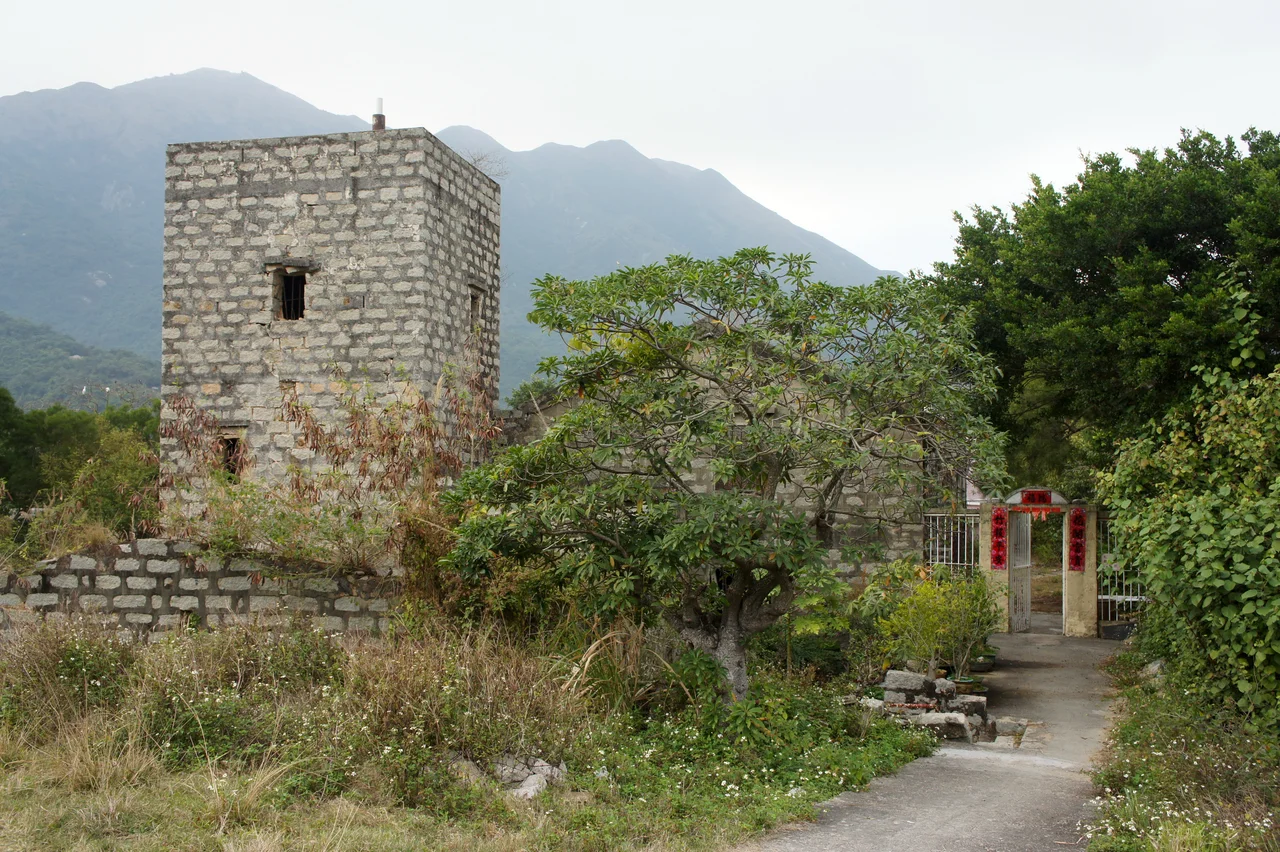
Mui Wo sits on the eastern shore of Lantau Island, connected to Hong Kong Island by ferry from Central's Pier 6 — about 35 minutes on the fast ferry, or 55 minutes on the ordinary service. Water buffaloes and cows roam the surrounding fields — feral descendants of working animals, now part of the landscape in a way that surprises first-time visitors. As early as the 16th century during the Ming dynasty, farmers had been working the Mui Wo valley; by the 19th century, the area had grown into six distinct villages. The Man Mo Temple, originally built during the reign of the Wanli Emperor (1573–1620), still stands in the village. The Lantau Trail, the island's long hiking route, begins at Mui Wo and extends across the terrain that rises steeply behind the town. Before Tung Chung was developed and the airport opened on northern Lantau, Mui Wo was the island's main gateway for visitors.
Silver Mine Bay Beach
The beach at Silvermine Bay is one of five gazetted beaches on Lantau, meaning it carries official status and lifeguard coverage from April through October, along with a shark net for the swimming season. In the 2012 bathing season, 69,580 visitors came over seven months — an average of 201 on weekdays and 461 on weekends and public holidays. The busiest single day saw 4,550 people on the sand. The beach runs along the same bay where a dynasty ended and silver was extracted and soldiers were tried for murder, though nothing in the water or the sand shows any of that. A small local museum behind the Silvermine Bay Resort Hotel holds old photographs and rural artefacts that tell the longer story. It opens only on Wednesday, Saturday, and Sunday afternoons.
From the Air
Mui Wo sits at 22.2644°N, 114.0014°E on the eastern coast of Lantau Island, at sea level on Silvermine Bay. From the air at 1,500–2,500 feet, the bay is a distinct semicircular indentation on Lantau's eastern shore, with the ferry pier clearly visible and the Silver River delta just north of it. Hong Kong International Airport (VHHH) lies approximately 18 km to the north, making this a notable waypoint when approaching Lantau from the east. The peaks of Lantau rise to over 900 metres to the west — maintain safe altitude when transiting to the western island.
Nearby Stories
- Lok Ma Chau Loop 2.3 km away
- Portas do Cerco 2.3 km away
- Kweilin Incident 17 km away
- Wanshan Archipelago Campaign 34 km away
- Nanxiong Formation 115 km away
- Battle of Nanpeng Island 148 km away
- Heyuan 169 km away
- Cape Maobitou 632 km away