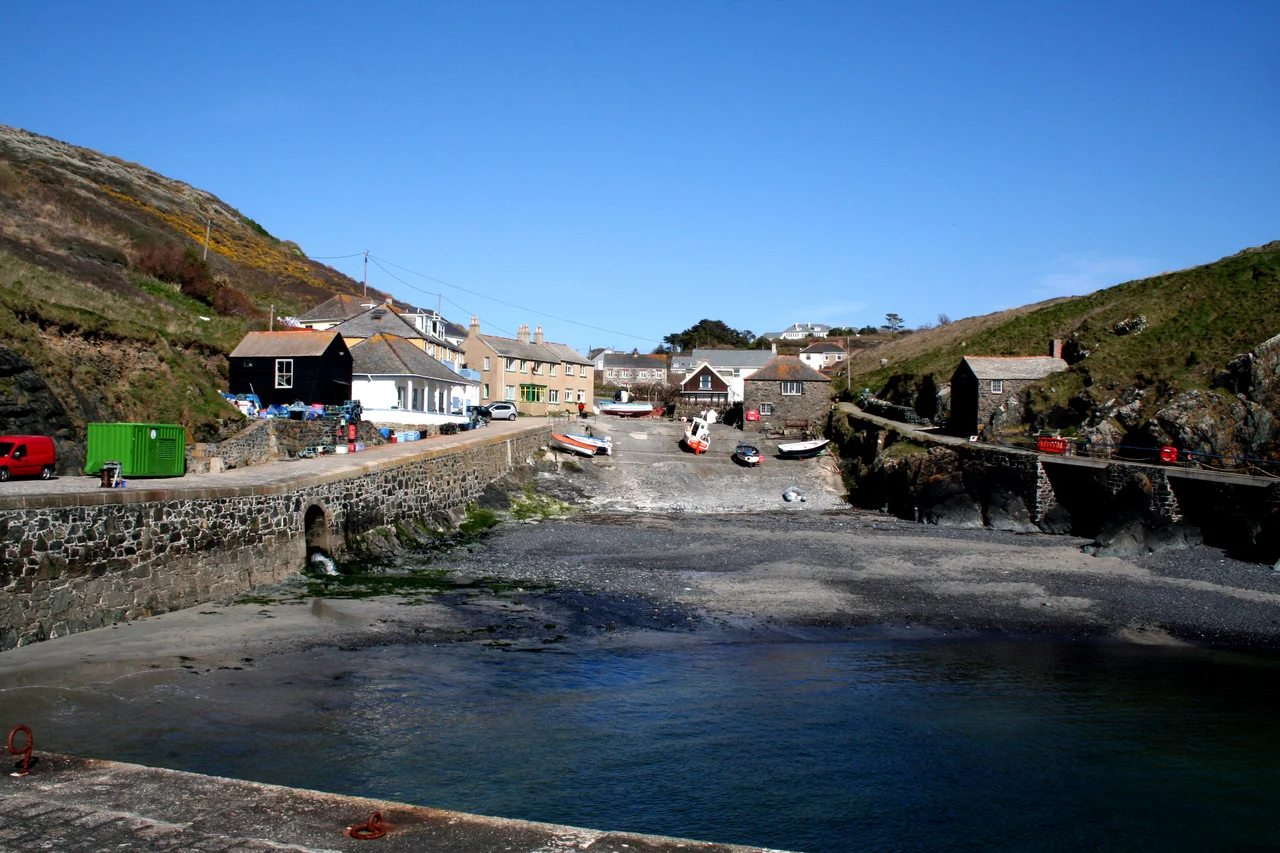

Mullion Lifeboat Station
On 11 January 1866 the SS London sank in the Bay of Biscay on her way from Gravesend to Melbourne. Among the dead was the Reverend Daniel James Draper, a Wesleyan preacher whose obituary became, in a sense, the founding document of a small lifeboat station in Cornwall. Methodists across Britain donated to a memorial fund through the Methodist Recorder. The money went west - to a cove on the Lizard Peninsula where, the previous winter, four men had drowned on a schooner called the Margaret and another whole crew had gone down with the Cherub. The RNLI named the new station's first boat Daniel J. Draper. Mullion Lifeboat Station was open for business.
The Case for a Boat
Even before any RNLI station existed in 1867, the rescue ethic ran strong in the cliffs north of Mullion. In a hurricane on 27 April 1824, the brig Olive of Tenby was driven ashore under a cliff at Halzephron, just north of Mullion. Two men, William Rowe and John Freeman, got a rope aboard the wreck and saved eight people, including a woman. They became the first recipients of the new Silver Medal of the Royal National Institution for the Preservation of Life from Shipwreck, the body that later renamed itself the RNLI. The medals were meant to be rare. They were not, in practice, rare enough. By January 1867 the schooner Margaret had foundered off the peninsula with all four crew. Two days later the Ebbw Vale and the Cherub collided off Mullion - the Ebbw Vale's crew was saved by a passing Jersey smack; the Cherub's crew was not. The RNLI committee, meeting on 7 February 1867, voted unanimously to put a boat at Mullion Cove.
A Methodist's Memorial
On 10 September 1867 the new boathouse stood ready at Mullion Cove, built on land donated by T. J. Agar-Robartes, MP for East Cornwall, at a cost of £183 and 4 shillings. The lifeboat, a 33-foot self-righting Pulling-and-Sailing model with ten oars and a sail, had been shipped down free of charge by the Bristol and Exeter, South Devon, Cornwall, and West Cornwall railways - one of those quiet acts of corporate decency that the Victorian era could occasionally manage. The mayoress of Penzance named the boat Daniel J. Draper. Eleven days later, on 21 October 1867, the barque Achilles stranded on Polurrian Beach in fog. The new lifeboat launched. It saved three men. The remaining crew were taken off the wreck by the Rocket Brigade firing lines from the cliff. The station also received a Negretti and Zambra barometer, which was placed where local seafarers could read it. The thinking was elegantly practical: an accurate forecast meant a boat that did not sail at all, which meant a rescue that did not have to happen. The barometer is still visible in the village.
Forty-One Years, Three Lives
The Daniel J. Draper served until 1887, replaced by the 37-foot Edith, paid for by an anonymous lady in London. In 1894 came the 38-foot Nancy Newbon, funded by the bequest of E. A. Newbon of Islington, whose estate ultimately paid for five new lifeboats across the RNLI. Then on 21 October 1908 - 41 years to the day after the Achilles rescue - Mullion Lifeboat Station was closed. In four decades the boat had launched 14 times. It had completed exactly one effective service: the three men saved from the Achilles in the first fortnight. The pattern is not unusual in lifeboat history. A station's value is not measured only in lives counted but in lives that never had to be counted, because the local boats were watching, the barometer was read, the cove had eyes on the sea.
What Remains
Nancy Newbon was transferred east, where she served another four years before retiring. The boathouse Lord Robartes had funded still stands at Mullion Cove, now a private residence with the bones of a 19th-century launch facility tucked inside its walls. Lifeboat coverage of this stretch of coast moved to the surviving Lizard station at Kilcobben Cove, two miles southeast, where a Tamar-class boat sits ready in a clifftop boathouse with its own funicular railway to bring the crew down to the water. The Reverend Daniel Draper, drowned in the Bay of Biscay in 1866, never knew that his memorial would last 41 years on a Cornish cliff and would help bring three men of the Achilles home alive. Most memorials do less.
From the Air
Mullion Lifeboat Station was located at the harbour of Mullion Cove, 50.015 degrees north, 5.257 degrees west. The boathouse - now a private residence - sits at the base of the cliff on the north side of the harbour. Nearest commercial airport is Newquay (EGHQ), 65 km north. RNAS Culdrose (EGDR, military) is 11 km north. Best viewed 1,500 to 3,000 feet, ideally together with the harbour and Mullion Island. The active Lizard lifeboat station is 13 km southeast at Kilcobben Cove, identifiable by its clifftop boathouse and the diagonal scar of the funicular running down to the sea.
Nearby Stories
- Logan Rock 3.6 km away
- Polperro 7.4 km away
- Great Wheal Charlotte 10 km away
- Battle of Plymouth (1652) 26 km away
- SS Irma (1905) 30 km away
- Black Swan Project 75 km away
- HMS Affray 77 km away
- 1979 Fastnet Race 100 km away